


State Laws Exotic Cats
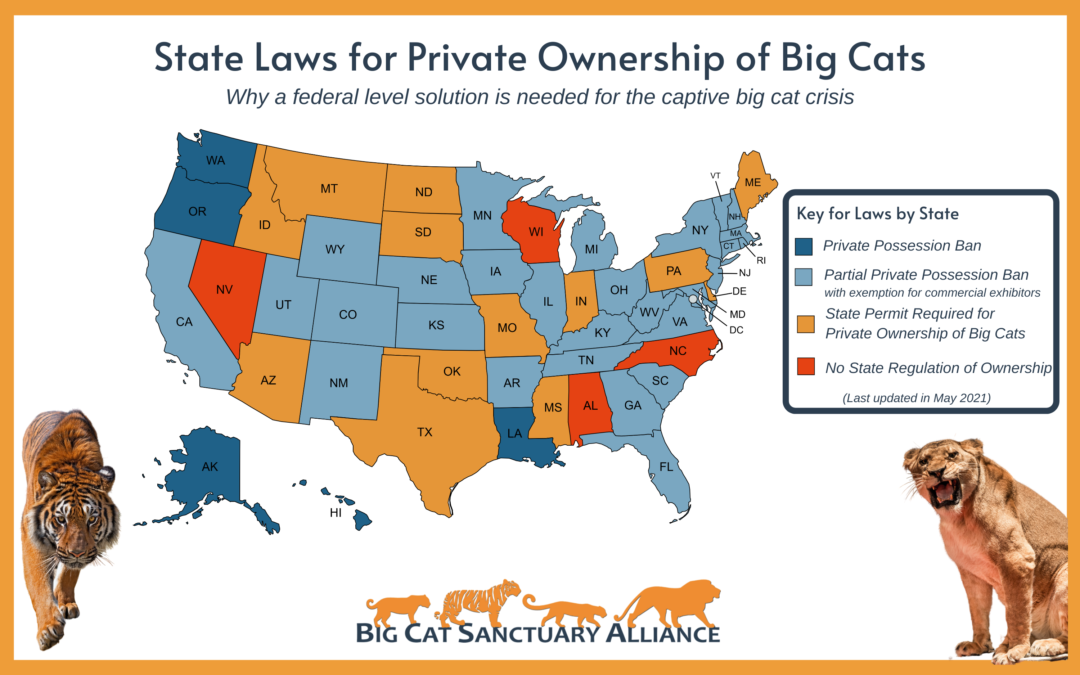
The Big Cat Public Safety Act is now law! Public contact with big cats or their cubs became illegal on Dec. 22-2022 and private owners had until June 18, 2023 to register their cats with the US Fish & Wildlife Service. Only 17 did. The seventeen private owners who registered may keep the cats they have but cannot acquire more. Those who did not register have only one option now and that is to surrender their cats and possibly be faced with fines and jail time. This will rapidly decrease the number of big cats born into lives of deprivation and confinement, and since most private owners already give up their cats when they reach adulthood, by the age of 5, that means that within 5 years there will be very few cats languishing in backyards and basements. State laws vary, but the federal law supersedes state laws listed below.
State Laws for Keeping Exotic Cats
- 4 states have no laws on keeping dangerous wild animals: Alabama, Nevada, North Carolina, and Wisconsin.
- 6 states do not ban or regulate keeping big cats: Alabama, Nevada, North Carolina, Wisconsin, Delaware, and Oklahoma.
- 21 states ban all dangerous exotic pets, while the rest allow certain species or require permits.
- 35 states ban keeping big cats, with varying exemptions, requirements, and levels of enforcement.
If you wish to report abusive conditions https://www.aphis.usda.gov/aphis/ourfocus/animalwelfare/complaint-form has a complaint form but to get the info necessary to file it check out https://911animalabuse.com/
Find out what your state laws are regarding the keeping of exotic cats from bobcats to tigers as pets. Select the state of your choice below for a synopsis of the law. Keep in mind that laws are improving to protect wild cats from being held captive all the time, so check with each state to make sure the information is current. We are not offering legal advice, but are just reporting on our understanding when we last updated this page on 10/11/2023.
The Library of Congress offers this guide to global laws regarding the private possession of exotic cats.
- ALABAMA
- ALASKA
- ARIZONA
- ARKANSAS
- CALIFORNIA
- COLORADO
- CONNECTICUT
- DELAWARE
- FLORIDA
- GEORGIA
- HAWAII
- IDAHO
- ILLINOIS
- INDIANA
- IOWA
- KANSAS
- KENTUCKY
- LOUISIANA
- MAINE
- MARYLAND
- MASSACHUSETTS
- MICHIGAN
- MINNESOTA
- MISSISSIPPI
- MISSOURI
- MONTANA
- NEBRASKA
- NEVADA
- NEW HAMPSHIRE
- NEW JERSEY
- NEW MEXICO
- NEW YORK
- NORTH CAROLINA
- NORTH DAKOTA
- OHIO
- OKLAHOMA
- OREGON
- PENNSYLVANIA
- RHODE ISLAND
- SOUTH CAROLINA
- SOUTH DAKOTA
- TENNESSEE
- TEXAS
- UTAH
- VERMONT
- VIRGINIA
- WASHINGTON
- WEST VIRGINIA
- WISCONSIN
- WYOMING
Federal Laws:
Legend:
B = Ban on private ownership of big cats
B* = Partial ban on private ownership of exotic animals — allows ownership of some exotic animals but precludes ownership of the animals listed
L = Requires the “owner” of the exotic animal to obtain a license or permit or to register the animal with state or local authorities to privately possess the animal (excludes states only requiring import permits)
N = The state does not require the “owner” to obtain a license or permit to possess the animal within the state, but may regulate some aspect thereof (i.e. entry permit, veterinary certificate, etc.)
To see a list of states that have passed exotic cat bans since 2005 click HERE
The steady increase in legislation banning private ownership represents recognition by our society that private ownership leads to massive abuse. Social values evolve. It took decades to ban slavery in England and for women to win the right to vote in America. Those ideas started out as “radical”, held by a small minority. Gradually more and more people understood and agreed until they became a part of our value system that we take for granted today. The same trend is happening with private ownership of exotics. Gradually more and more people are realizing that this simply leads to widespread abuse of these animals. The best evidence of this is the accelerating trend in state laws.
Alabama
Category: N
Department of Conservation and Natural Resources64 N Union St.Montgomery, AL 36104
(334) 242-3465
No one can possess, sell, or import fish from the genus Clarias or Serrasalmus, Black carp, any species of mongoose, any member of the family Cervidae (deer, elk, moose, caribou), any species of coyote, fox, raccoon, skunk, wild rodents, or wild turkey. There are no licenses or permits required for ownership of exotic animals.
Bobcats and mountain lions are not allowed to be imported into the state, transported within the state (except for licensed game breeders), and future possession permits to keep these species will not be issued. Accredited educational facilities, research facilities, and permitted rehabilitation facilities shall be exempt from this regulation through the written permission of the Director of the Division of Wildlife and Freshwater Fisheries or his designee. Previous owners that already have permits will be grand fathered, but breeding is prohibited. Also issues permits for the public exhibition of wildlife. Carnivals, zoos, circuses, and other like shows and exhibits where ample provision is made so the birds, animals, reptiles, amphibians, and fish will not escape or be released in this state are permitted. Applications require statement regarding person education and experience, description of facilities, number of species desired, and signed agreement that recommended standards for wildlife exhibition will be adhered to.
Section 3-8-1 Rabies vaccine required for any canidae or felidae; applicability. Notwithstanding any provision of law to the contrary, it shall be illegal to own, maintain, sell, or trade any canidae or felidae for which there is no USDA licensed rabies vaccine. Anyone currently owning or maintaining such animal may keep the animal for the length of the animal’s life providing the animal is spayed or neutered and is registered with the Department of Agriculture and Industries. This section does not apply to any zoological parks, circuses, colleges, and universities, animal refuges approved by the Department of Agriculture and Industries, county or municipal humane shelters, the Department of Conservation and Natural Resources, or veterinary clinics.
(Acts 1994, No. 94-322, p. 562, §8.) https://wwwlegislature.state.al.us/CodeofAlabama/1975/3-8-1.htm
Alaska
Category: B
Department of Fish and Game
P.O. Box 115526, 1255 W. 8th Street, Juneau, AK 99811-5526, 907-465-4100
Does not allow private ownership of exotic cats and lawbreakers are subject to a year in jail and a $10,000 fine. Only issues permits for fur farming of lynx and bobcat, or scientific or education use of animals. Applicants must demonstrate a significant benefit to the state and produce a substantial study plan identifying the purpose and need of their study in addition to specific objectives and procedures.
Arizona
Category: L
Game & Fish Dept 5000 W. Carefree Highway, Phoenix, AZ 85086-5000, 602-942-3000
Issues Private Game Farm license, for USDA licensed facilities which allows the sale, trade, rental, purchase, display, import and export, possession and breeding of wildlife. Also has Zoo license and Wildlife Holding License. Wildlife Holding is divided into five categories: Scientific Study permit, Wildlife Management, Education Holding, Humane Treatment and Exhibit licenses. Wildlife holding permit is for animals that are unable to meet their needs in the wild, are abandoned, or are no longer useful in previous captive situations, they may not be exhibited. Scientific Study permit is only issued to students and faculty members of higher learning institutions. Humane treatment license is required to hold non- releasable animals. These are one-year renewable permits. They do not cover healthy specimens wanted for personal possession (no pets). Education Holding does not permit “exhibiting”, but requires educational use of animals. Exhibit license is to exhibit live wildlife already possessed. You must have previous and current year’s wildlife holding license before exhibit license will be issued.
A.R.S. §17-306 restricts the transport, sale and possession of non-domesticated animals. People in violation of the statute may be charged with a class 4 felony. Restricted animals covered by the statute are detailed in the state regulations. R12-4-406 sets out a fairly comprehensive list of forbidden pets. Restricted wildlife includes many different species including tigers, jaguars, lions and other large cats. There are no limits on bobcat hunting. Although Arizona has strict laws about owning exotic pets, hybrid cats are legal.
Arkansas
Category: B*
Game & Fish Commission Two Natural Resources Dr. Little Rock, AR 72205 800-364-4263 and 501-223-6300
In 2005 Arkansas banned the private possession of large carnivores. Regulates ownership of native feline species. The rearing of any wild animal for commercial purposes requires a wildlife commercial breeder/dealer permit and a USDA license. Must follow general provisions applicable to Captive Wildlife in the Arkansas State Game & Fish Commission Code Book, Chapter 9. Also has a new wildlife translocation permit for transport of wildlife through Arkansas – requires a permit and health certificate be on file with AG & F. Possession of wild felines is further regulated on a county level in several counties. A new Cougar possession permit was created in 2007. This permit is for existing cougar holders who are not breeding or dealing, just possessing. This permit does not require monthly reporting.
Although ownership of large cats was banned after 8/2005, you are allowed to own 6 bobcats and it is legal to hunt bobcats. With regard to servals and hybrids, if a person wishes to possess other animals not originally from the state and not listed above then the person must show upon request verification that the animal was legally acquired in the previous state.
California
Category:B 
Department of Fish and Game License and Revenue Branch 1740 North Market Boulevard, Sacramento, CA 95834, 916-928-5805
Department Regulations input Title 14, Section 671
Exhibiting permits for educational purposes, must have a written statement of purpose that specifically incorporates a NO PETS EDUCATION POLICY. Must also present animals in natural setting and natural behavior patterns. Breeding permits will be issued for animals that the department determines will not result in unwanted or uncared for animals or if species is endangered and needs to be propagated. AZA Zoo permit allows possession of only species listed on department approved permit inventory. Research must be college, government, or bona fide scientific institution. Also issues Broker/Dealer and Shelter.
Bobcat hunting will become illegal effective 1/1/2020. Hybrid cats all generations are legal to own.
Colorado
Category: B
Division of Wildlife 6060 Broadway Denver, CO 80216 303-297-1192
Division Regulation Chapter 11, Article II, # 1104
Issues Commercial Wildlife Park Permits. Wild felines must be possessed for commercial purposes only. Has specific requirements to meet definition of commercial; must provide a plan to show a profit, must have experience, maintain business records, hire and train employees, file state and Federal income tax based on this activity, etc. Further, there are caging requirements, and any animal exhibited out of a cage requires a $500,000 liability policy. Big Cats can be held in natural settings. Open topped enclosures must be 10 feet, with double electrified wires on top and fencing sunk 3 feet into ground.
Hybrids are not noted as illegal in the statutes however, they are illegal in the City of Denver and other Colorado cities. Bobcat hunting seems to be legal in Colorado. The Colorado laws regarding exotic animals are very confusing and hard to understand.
Connecticut
Category: B*
Dept of Environmental Protection 79 Elm Street Hartford, CT 06106 860-424-3000
Statutes of Connecticut, Title 26, Chapter 490, Section 26-40a and Section 26-55
Under § 26-40a, no person shall possess a potentially dangerous animal, which includes wildlife such as the lion, leopard, cheetah, jaguar, ocelot, jaguarundi cat, puma, lynx, or bobcat. The provisions of this section shall not apply to municipal parks, public nonprofit aquaria or zoos, accredited by the Association of Zoos and Aquariums or the Zoological Association of America, nature centers, museums, or exhibitors licensed or registered with the United States Department of Agriculture or laboratories and research facilities maintained by scientific or educational institutions licensed or registered with the United States Department of Agriculture, any licensed veterinarian for the purpose of treatment and care of such animal, or to any person who possesses a breed of felidae certified by The International Cat Association, the Cat Fanciers Association or the American Cat Fanciers Association. As of 2013, any generation of savannah cat is legal to own in Connecticut.
Delaware
Category: L
Department of Agriculture 2320 South DuPont Highway Dover, DE 19901 302-698-4500
When an exotic is kept as a pet, the owner or custodian of the exotic must apply to the Department for an Individual Permit on a form supplied by the Department. Individual Permits granted by the Department shall become null and void when the owner or custodian transfers ownership or custodianship of the exotic to another person. The owner or custodian must obtain a separate Individual Permit for each exotic animal kept as a pet. A background check of an owner or custodian applying for an Individual Permit may be completed by the Department. Owning exotic cats, large and small is legal in Delaware with a permit.
Florida
Category: B* & L 
Florida Wildlife Conservation Commission 620 South Meridian St. Tallahassee, Fl 32399 (850) 488-4676
Florida Captive Wildlife Rules
See an interactive online map of exotic cat owners.
Class I wildlife, which includes tigers and lions, is prohibited from personal possession unless the animal was possessed on or before August 1, 1980; or on or before August 27, 2009 for cougars, panthers or cheetahs. Permits are required for public exhibition, sale or personal possession of Class II wildlife which include bobcats, servals and caracals. All generation of savannah cats are legal.
Class I animals (includes panthera cats) can not be kept for personal use – must be commercial exhibitors. Class I permit requires 1 year and 1000 hours experience, details of experience and place acquired and 2 references. Documented educational experience in zoology or other relevant biological sciences, obtained at the college or technical school level or above, may substitute for up to six months or 500 hours of the required experience. The Class I permit applicant still has to prove another documented 500 hours or 6 months, if they have the Biological Sciences qualifications. Class I exhibitors must post a $10,000.00 bond or carry 2 million in liability insurance. Class I animal permits require that facilities for Class I animals must be constructed on properties of not less than 5 acres in size. Under a Class II and Class III permit, animals as large as mountain lions can be kept for pets. Class II permits require 1,000 hours experience, or 100 hours experience and successful completion of a test. Class II and Class III wildlife shall not be possessed in multi-unit dwellings unless the dwelling in which they are housed is equipped with private entrance, exit, and yard area. Class II permits for mountain lion, require that facilities for mountain lions must be constructed on properties of not less than 2 acres in size. Applicants for a Class III animals must be at least 16 years of age and shall require the satisfactory completion of a questionnaire developed by the Commission that assesses the applicant’s knowledge of general husbandry, nutritional, and behavioral characteristics. All permits require adherence to structural cage requirements. There are more than 1500 tigers in Florida, but less than 100 of them are in accredited facilities. If you are a resident, type your zip code into any box on this page to see what legislation is pending in your state and make a difference now! Florida issues more than 4000 exotic ownership permits each year and has to employ 27 inspectors at a cost to tax payers of 1.5 million dollars per year, just to allow people to keep, breed and sell exotic pets. Permits cost between 5. and 250. if you have more than ten animals. This does not generate nearly enough revenue to cover the cost of administration. What can a County in Florida do to ban exotic pet ownership when FWCC says they have supreme authority and no intention of banning this inhumane practice? Click here to see what the Attorney General has to say. Memo of Law.
Georgia
Category: B
Department of Natural Resources 2 Martin Luther King Jr. Drive, SE Suite 1252, Atlanta, GA 30334, 404.656.3500
The exotic species listed below, except where otherwise noted, may not be held as pets in Georgia, this list includes all species of carnivores. Most exotic cat hybrids, such as a savannah cat, are not a legal pet in Georgia. Bobcat hunting is legal.
Hawaii
Category: B 
Department of Agriculture 1428 S. King Street, Honolulu, Hawaii 96814, 808-973-9560
Import of wild felines into this state is granted only for research by universities or government agencies, exhibition in municipal zoos or other institutions for medical or scientific purposes as determined by the Board of Agriculture. No private ownership allowed. Non-domestic dogs and cats and hybrids such as wolf, wolf cross, Dingo, Bengal, Savannah, etc are prohibited under Plant Quarantine law.
Idaho
Category: L
Department of Agriculture
P. O. Box 790, Boise, Idaho 83701-0790 208-332-8540
No person may possess or propagate a deleterious exotic animal in the state, unless such person obtains a possession permit issued by the Administrator. This category includes caracals, cheetahs, jaguars, leopards, lion, ocelots, servals and tigers. Bobcats are classified as a furbearing animal. Furbearers include bobcat, fox, marten, mink, muskrat, beaver, otter, lynx, fisher, and badger. Of these, lynx and fisher are fully protected with no legal harvest, and otters have a quota. Lynx are listed as threatened and wolverine are listed as protected non game. None of the other furbearers have quotas or limits except a few controlled hunts for beavers. Bobcats can be hunted without limit for furring purposes. Other exotic cats can be owned with a permit. Savannah cats can be owned with a permit.
Illinois
Category: B
Department of Natural Resources
One Natural Resources Way, Springfield, IL 62702-1271, 217-782-6302
No person may possess any dangerous animal, defined to include a lion, tiger, leopard, ocelot, jaguar, cheetah, margay, mountain lion, lynx, bobcat, or jaguarundi, except at a properly maintained zoological park, federally licensed exhibit, circus, scientific or educational institution, research laboratory, veterinary hospital, hound running area, or animal refuge. Illinois resumed bobcat hunting and trapping during the 2016-17 season. There are some counties in Illinois where it is prohibited. It is illegal to own a bobcat in Illinois but you can hunt them. It is legal to own a savannah cat.
Indiana
Category: L
Division of Fish and Wildlife
402 W Washington St., Rm. W273 Indianapolis, IN 46204 317-232-4080
Department of Natural Resources Web Site
Department of Wildlife Web Site
Issues Wild Animal Possession Permits. Permits are for one year only, must be renewed annually. Class III is for wild cats. Bobcats are native endangered species, but may be legally possessed with proof of legal captive birth paperwork. Must provide health certificate for animal being possessed, escape recapture plan, pay $10.00 fee, have cages inspected by conservation officer. Provides caging requirements that include: concrete floors must be covered with natural substrate, loafing platforms, 14 foot tall walls with 45 degree incline can be used if no roof provided, etc. Persons licensed by the USDA as commercial exhibitors, zoos or dealers are exempted from this state permit and its requirements. In Indiana, a person can own just about any animal as a pet, from skunks or raccoons, to foxes, cougars and even lions. All one needs is the proper permit.
Iowa
Category: B 
Department of Natural Resources
502 E. 9th Street Wallace State Office Building Des Moines, IA 50319 515 281-5918
BANS possessing, breeding and importing dangerous wild animals except for AZA facilities, wildlife sanctuaries, falconry license, agricultural animals, assistive animals, harvest by hunter or trapper, wildlife rehabilitators, circuses, cities, nonprofit 501(c)3 registered in 2007 for exhibition at a municipal zoo, state fair, research facility, vets other than wild boars, pound, animal shelter, county conservation board, public agency, an animal transported through the state within 96 hours, and state licensed USDA facilities. Grandfathers animals registered by 12/31/07 and microchipped by 9/1/07. Owners are also required to maintain health and ownership records, keep the dangerous animal in a primary enclosure except when visiting a vet or transferring to a sanctuary, put up a sign that a dangerous wild animal lives there, and maintain $100,000 of liability insurance with no more than a $250 deductible. Savannah cats and bengal cats are legal. Limited bobcat hunting is allowed in some counties.
Kansas
Category: B*
Department of Wildlife and Parks
512 SE 25th Ave Pratt, KS 67124 (620) 672-5911
Dangerous regulated animals to include lions, tigers, leopards, jaguars, cheetahs and mountain lions, or any hybrid thereof: BANS possession and breeding except AZA and ZAA facilities, wildlife sanctuaries, the Department and scientific, education or exhibition permit holders, licensed medical or research institutions, and USDA circuses, rodeos, fairs, and carnivals. Grandfathered USDA facilities as of 2006 with no felonies within previous 10 years to maintain inventories to sell to other facilities and out-of-state. Grandfathered owners on 10/1/06 that microchipped and registered them with local animal control. Grandfathered owners and USDA facilities, AZA, ZAA, medical or research institutions, and wildlife sanctuaries must meet caging, $250,000 liability insurance, health and ownership record retention, sign, annual vet visit, recovery plan, and escape notification requirements. Anyone other than the owner who cares for or handles one must apply to become a registered designated handler, which requires 200 hours of experience. Savannah cats are legal to own as are bobcats and you can hunt bobcats.
Kentucky
Category: B
Department of Fish and Wildlife Resources
#1 Sportsman’s Lane, Frankfort, KY 40601, 800-858-1549
Effective 2005, a ban on the private possession of tigers, lions, monkeys, bears, venomous reptiles, and other dangerous wildlife has been enacted in Kentucky. One of the most comprehensive restrictions on the keeping of exotic animals as “pets” in the United States, the regulation also prohibits existing animals from being bred. Existing confining facilities shall be large enough to allow reasonable space for exercise, shelter, and maintenance of sanitary conditions. The holder of an existing pet or breeding permit shall allow a conservation officer to inspect the facilities at any reasonable time. As of 2012 Kentucky has held the record for five years in a row of having the most lacking regulations for protecting animals of all kinds according to the ALDF. With the proper paperwork, interviews, and cage requirements owning servals and other small cats is permitted in most cases. Bobcat hunting is allowed.
Louisiana
Category: B*
 Department of Wildlife and Fisheries
P.O. Box 98000 Baton Rouge, LA 70898 1-800-256-2749
It is unlawful to possess all subspecies or hybrids of the following big exotic cats: tigers, lions, leopards, snow leopards, clouded leopards, jaguars, cheetahs, cougars or mountain lions. An individual who legally possessed one or more of these exotic cats on August 15, 2006, who can prove legal ownership, is authorized to keep their exotic cats under certain specified conditions. The following entities are exempt from this requirement: zoos accredited or certified by the American Zoo and Aquarium Association; research facilities as defined in the Animal Welfare Act; licensed circuses operating temporarily in the state; and Louisiana colleges or universities possessing a big exotic cat of the species traditionally kept by that college or university as a school mascot. Any person transporting any listed animal through the state is exempt if the transit time is not more than 24 hours, subject to certain conditions. Savannah cats are legal but it appears owning other small cats such as servals is not legal in Louisiana. Bobcats can be hunted.
Maine
Category: L
Department of Inland Fisheries & Wildlife
Mailing Address:
41 State House Station
Augusta, ME 04333-0041
Physical Address:
284 State Street
Augusta, ME 04333-0041
Department phone number is: 207-287-8000
Personal Possession requires Import Permit and Propagator Permit. Exhibitor requires exhibitor’s permit. Have caging, health, safety, and sanitation requirements. Permit application asks for reason to be imported, experience level of applicant, and takes into consideration the potential for animal to harm humans or environment. Maine laws are hard to decipher but it appears you can own just about any exotic cat with the proper license/permit. Bobcat hunting is permitted and you can own all generations of savannah cats.
Maryland
Category: B
Department of Natural Resources 580 Taylor Avenue, Annapolis, MD 21401, 1-877-620-8DNR (8367)
A person may not possess a member of the cat family other than the domestic cat, or a hybrid of a member of the cat family and a domestic cat, if the hybrid weighs over 30 pounds. This provision does not prohibit a person who had lawful possession of a prohibited animal on or before May 31, 2006, from continuing to possess that animal if the person provides written notification to the local animal control authority on or before August 1, 2006. This section does not apply to a research facility or federal research facility licensed under the federal Animal Welfare Act; an exhibitor licensed under the federal Animal Welfare Act; qualified animal sanctuaries, animal control officers; licensed veterinarians; or non-residents in the state for ten days or less for the purpose of traveling between locations outside the state. There is no open season for bobcat trapping or hunting. Maryland Department of Natural Resources has designated the bobcat as a species of special concern. Eastern cougars “disappeared” in the late 1800s. The bobcat and eastern cougar are included on the list of “Rare, Threatened, and Endangered Animals of Maryland.” All savannah cats are allowed to be owned if they weigh under 30 lbs.
Massachusetts
Category: B
Department of Fish and Wildlife
251 Causeway St., #400, Boston, MA. 02114, 617-626-1500
No permits for breeding unless in compliance with AZA, IUCN, or the state of Massachusetts or the USA, and in the eyes of MA Director will make a meaningful contribution to the survival and recovery of the species. No personal possession permits for the purpose of pet ownership will be issued. Authentic and legitimate educational use certified by zoological or biological officials will be issued permits. Commercial businesses where the animal is in conjunction with the applicant’s primary existing occupation or livelihood will be granted a permit. Savannahs are illegal to own except by zoos and educational institutions. Bobcat hunting is legal with permit.
Michigan
Category: B*
Department of Natural Resources
Wildlife Division P.O. Box 30444 Lansing, MI 48909 517-373-1263
A person shall not possess any of the following cats of the Felidae family, whether wild or captive bred, including a hybrid cross with such a cat: lion, leopard, snow leopard, clouded leopard, jaguar, tiger, cougar, panther, or cheetah. This prohibition does not apply to persons who were in possession of such animal on July 7, 2000, and who otherwise qualifies for a large carnivore permit. The following entities are exempt from these requirements: an animal control shelter or animal protection shelter; persons licensed by the state or by the U.S. Department of Interior; an approved or accredited zoological park or animal sanctuary; authorized law enforcement officers; a veterinarian temporarily in possession of a large carnivore to provide veterinary services; a person who is not a resident of this state and who is in this state only for the purpose of travel between locations outside of this state; certain for-profit or non-profit businesses whose primary purpose is the presentation of animals including large carnivores to the public for education or exhibition purposes; and circuses. Bobcat hunting/trapping is permitted with the proper fur harvester license issued by the Michigan Department of Natural Resources (MDNR). MDNR regulates the means and methods in which bobcats may be hunted/trapped, establishes open seasons, geographic regions, and bag limits. Furbearer kill tags are required for harvesting bobcat. A person who kills a bobcat shall immediately validate the tag and attach the tag to the hide from the upper jaw to the eye socket or through the lower jaw. MDNR also regulates fur dealers including licensing, shipping permits, labeling and reporting of pelts in possession on the last day of the hunting/trapping season. Cougars were once native to Michigan but were extirpated around the turn of the century. Savannah cats are legal in Michigan all generations.
Minnesota
Category: B*
Department of Natural Resources
500 Lafayette Road, St. Paul, MN 55155-4040 651-296-6157 or toll free 888-646-6367
It is unlawful for a person to possess a regulated animal. A regulated animal is defined as all members of the felidae family (except domestic cats); all bears; and all non-human primates. A person who possesses a regulated animal on the effective date of the law, January 1, 2005, has 90 days to register the animal with the local animal control authority. Persons possessing a registered regulated animal may replace the regulated animal if he/she dies, but may replace he/she only once. The law also requires those longtime owners to have a written plan to recapture escaped animals and to meet Department of Agriculture requirements for caging, including having a perimeter fence around primary enclosures. Regulated-animal signs must be posted, and wildcats must be registered with local animal-control authorities, who in rural counties might be the sheriff. Bobcat hunting/trapping is legal in Minnesota. Serval hybrids are illegal in Minnesota.
Mississippi
Category: L
Department of Wildlife, Fisheries and Parks
1505 Eastover Dr., Jackson, MS 39211, 601-432-2400
Must obtain permit for all big cats, clouded, snows, cheetahs and mountain lions. Can get personal possession, or breeding or exhibiting permits. Requires $100,000 per animal Liability insurance, health certificate $300.00 per animal yearly fee. Sanctuaries are exempted from paying yearly fee, only if they are USDA Class C licensed. Permits have caging, housing, record keeping requirement. You can own just about anything in this state and hunting bobcats is permitted.
Missouri
Category: L
Department of Conservation P.O. Box 180 Jefferson, MO 65102 573-751-4115
Effective January 1, 2012, anyone who possesses, breeds, or transports a tiger, lion, jaguar, leopard, snow leopard, clouded leopard, cheetah, or a hybrid of a listed cat must obtain a permit for each animal. Current owners had 60 days to obtain the permit. Applicants must be at least 21 and not have ever been convicted of animal cruelty or of a felony within the last 10 years, have them microchipped, report any deaths within 10 days, maintain $250,000 of liability insurance, and obtain a permit to transport them. Animal control or humane shelters holding a large carnivore for less than 90 days, law enforcement officers or department of agriculture employees, vets, those just transporting the animal through the state, and USDA Class C Exhibitors who maintain large carnivores on August 28, 2010 are exempt from the permit and microchip requirements, provided that Class C Exhibitors who obtain additional large carnivores must obtain a permit for those animals. Completely exempt from this act are circuses, the University of Missouri-Columbia College of Veterinary Medicine, and zoological parks under Chapter 184. Those who keep a lion, tiger, leopard, ocelot, jaguar, cheetah, margay, mountain lion, Canada lynx, bobcat, or jaguarundi must register them with their local law enforcement agency. This does not apply to a zoological park, circus, scientific or educational institution, research laboratory, veterinary hospital, or animal refuge. You can own just about anything in this state and hunting bobcats is permitted.
Montana
Category: L & N 
Fish, Wildlife and Parks
P.O. Box 200701 Helena, MT 59620 406-444-2535
Bobcats and lynx are listed as furbearers. State issues Fur Farm permit, but make one exception. If animal is raised not for its fur or body parts, a permit is not required. Importation of wild felines into the state requires an import permit. Exotic wildlife is classified into prohibited, controlled, and non-controlled. Servals and jungle cats are non-controlled and may be possessed and sold as pets without a permit. All other felines are automatically prohibited and are limited to zoo or roadside menagerie permit, AZA facility, USDA Class C Exhibitor for less than 90 days, college, university, or government agency for scientific or public health research, scientific institution, USDA nonprofit organization that exhibits wildlife for educational or scientific purposes, a service animal, and national or state agency affiliated rescue facility. Exotic wildlife is classified into prohibited, controlled, and non-controlled. Servals and jungle cats are non-controlled and may be possessed and sold as pets without a permit. Roadside Menagerie is for exhibiting or using wild animals to attract trade. Must keep detailed records of acquisition, birth, death and transfer. There are also housing, feeding, treatment and care regulations. Roadside Menagerie Permits requires proof of liability insurance for bodily injury up to $25,000 per person up to $100,000 on each occurrence along with property damage up to $5,000 per occurrence. Insurance must be with a reputable operation and must cover all injury to the public whether negligent operation, maintenance care, confinement or supervision causes an accident. Permit fees are $10.00 for less then 6 animals, and over 6 animals cost $25.00. No more than 10 animals may be possessed with a Wild Animal Menagerie permit. Has caging, record keeping, feeding, treatment and sanitation requirements. Wild Animal Menagerie is where up to 10 large cats are kept for purposes other than exhibition. Tigers and mountain lions must be tattooed on the left thigh. All generation of savannah cats are legal.
Nebraska
Category: B*
Game and Parks Commission
2200 N. 33rd St., Lincoln, NE 68503 402-471-0641
Private, non-commercial possession of wild felidae, including cross breeds with domestic cats is illegal. Only issues permits for the possession of felidae to municipal, state or federal zoos, parks, refuges or wildlife areas, or bona fide circus or animal exhibit. Also issues fur farm licenses for bobcat and lynx for the purpose of raising these species for fur or producing stock for sale to persons engaged in fur farming. One of the few states where owning savannah cats is illegal
Nevada
Category: N
Department of Wildlife
1100 Valley Rd., Reno, NV 89512 775-688-1500
Requires a permit for the possession of bobcats and mountain lions. Also has import permit for bobcat and mountain lion. All other felines are exempt from permit requirements. Issues both non-commercial licenses ($5.00 per year) and commercial licenses ($100 per year.) Has caging requirements. Allows for the option of open-topped enclosures. mountain lions must have perimeter fences 8 feet tall and have Y-recurve on top of at least 12 inches wide. Gates must be self-closing and have two locking devices. Native felines must be permanently marked or ear-tagged. You can own just about anything in this state and hunting bobcats is permitted for residents.
New Hampshire
Category: B 
New Hampshire Fish and Game Department 11 Hazen Drive, Concord, NH 03301, 603-271-3211
All wild felines other than domestic hybrids at least 3 generations removed and registered with national or international cat registries are considered controlled and may only be possessed and imported under a state exhibitor permit (USDA licensed). The only exceptions to the permit are Department employees, rehabilitators with native wildlife, and wildlife possessed under other licenses. The NH state exhibitor permit requires that one have 2,000 hours of paid experience with a licensed exhibitor to qualify. Exhibitors must not allow direct contact of the felines with the public. Bobcat hunting and trapping has been illegal in New Hampshire since 1989. The Fish and Game Department attempted to open up bobcat hunting again in 2016, but withdrew the proposed administrative rule due to all the opposition raised by conservation and animal protection organizations.
New Jersey
Category: B
N.J. Division of Fish and Wildlife, Mail Code 501-03, P.O. Box 420, Trenton, NJ 08625-0420
609-292-2965
Does not issue permits for potentially dangerous species (All felids) for pet or hobby purposes. Possession of potentially dangerous species must be for scientific holding, animal exhibitor, zoological holding or animal dealer. Application asks for education and background information, demonstration of a working knowledge of the species, the stated purpose and intent, description of housing and caging plans. An Endangered species possession permits will not be issued for the purpose of breeding by amateurs. A scientific institution, zoological society or similar organization must sponsor the possession of any endangered species. Savannah cats are legal. Bobcats are protected under the New Jersey Endangered Species Act.
New Mexico
Category: B
Department of Game and Fish P.O. Box 25112 Santa Fe, NM 87504 505-476-8000
In 2009, New Mexico passed new importation rules. All felines other than hybrids are considered Group IV and are limited to scientific studies, restoration and recovery plans, zoos, temporary events/entertainment, service animals or for a qualified expert only. Issues zoo, Class A Parks, and scientific study permits. An additional Class A Parks License is required if facility is over 3200 acres. Has caging and record requirements. New Mexico regulators have just adopted new rules that will prohibit trapping or snaring cougars for sport. Savannah cats are legal. Bobcats are protected furbearers in New Mexico with an established season for hunting and trapping from November 1 to March 15.
New York
Category: B 
State Department of Environmental Conservation
625 Broadway, Albany, New York 12233-0001 518-402-8995
New York bans the breeding, purchase or sale of wild felines other than hybrids that are at least four generations removed and registered by CFA or TICA for pets. All existing owners had to register their felines by June 30, 2005 and apply for a license. License fee is $170 for 2 years. Exempt are AZA zoos, USDA exhibitors, research facilities, licensed vets, incorporated humane societies, shelters, SPCA, colleges and universities, wildlife rehabilitators, those transporting an animal to an exempted place, wildlife sanctuary, and those traveling through in less than 10 days. Lions require a Dangerous Wildlife License, which is only issued for science, education or exhibition. Native species such as bobcats and cougars may not be kept as pets. Bobcats can be imported for other purposes without a permit, but require a Fur Breeder License to possess or breed. Cougars are considered an endangered species and require an Endangered Species License. In 2012, New York passed legislation which required the department to create lists of prohibited non native species, species that require a permit and legal species. It also passed a ban on releasing exotic animals. On 8/11/2014, a new law passed prohibiting dealers or exhibitors from allowing direct contact with big cats lion, tiger, leopard except clouded leopard, jaguar, cougar or hybrid of such without a permanent physical barrier. New York is the first state to ban anal/genital electrocution of fur-bearing animals (2008). It is legal to hunt bobcats.
North Carolina
Category: N
Wildlife Resources Commission
1701 Mail Service Center, Raleigh, NC 27699-1701 919-707-0010
North Carolina does not have a general statewide law on regulating the ownership of or possession of exotic or dangerous animals. However, every county in the state sets its own ordinances dealing with exotic animal rules. That means it sets rules about what kinds of animals you can own as pets. Requires Wildlife Captivity License for native cougars and bobcats, which is only issued to bona fide publicly supported zoos and educational or scientific research institutions. For private possession of cougars, the state requires natural habitats of rather grandiose proportions: minimum one-acre enclosure, 12-foot fences with 45-degree recurve, pool, den, vegetation and landscaping, property must be owned by applicant. Zoos or Scientific Research facilities are allowed to keep cougars in concrete and chain link cages. Natural habitats are not required for bobcats like they are for cougars, but the state has minimum cage size requirements. Must apply for Import Permit if native feline is being brought into state from outside the state. Must be USDA exhibitor or research institution to import any species native to North or South America. But that is not a requirement to purchase in-state, though NC does not issue permits for pet purposes. Savannah cats are legal. Bobcat hunting is allowed.
North Dakota
Category: L
Board of Animal Health Department of Agriculture 600 E Boulevard Ave. Dept 602 Bismarck, ND 58505 701-328-2655
Regulates private ownership of nontraditional livestock, i.e.: all wild animals in captivity, by issuing licenses. Bobcats and lynx are category 3 animals (native to the state) all other felines are Category 4. (Inherently dangerous) Before any class 3 or 4 animals can be imported into the state, an importation permit must be issued. Nontraditional livestock permitees must keep records of sales, purchases, escapes, captures, diseases or animal transfers or births. Record keeping must be available for inspection. Servals and savannah cats are legal. Bobcat hunting is allowed for residents only and in specific areas of the state.
Ohio
Category: B
Department of Natural Resources 2045 Morse Road, Building G, Columbus OH 43229-6693 614-265-6300 and 800-WILDLIFE
Requires a permit to posses the native endangered species, bobcat. Permits issued for zoological, breeding, scientific and educational purposes. Must have permit before the bobcat can be imported into the state. On June 5th, 2012 a law passed that banned the private possession of dangerous wild animals, including most exotic cats. Those who have the animals must register them but cannot buy or breed more. The only exemptions for breeding are AZA accredited zoos (and ZAA for now, but that needs to change) and sanctuaries that are accredited by the Global Federation of Animal Sanctuaries can continue to rescue wild animals. See the details of the OHIO WILD ANIMAL BAN. Bobcat hunting is illegal. In 2018 there was a proposal to allow hunting of bobcats, but the Ohio Wildlife Council decided to indefinitely postpone the proposal. Savannah cats are legal to own.
Oklahoma
Category: L 
Department of Wildlife Conservation P.O. Box 53465 Oklahoma City, OK 73152 405-521-3851
The state issues noncommercial wildlife breeders permits and commercial wildlife breeders permits. However, exotic felines are exempt from the noncommercial wildlife breeders, commercial wildlife breeders, and import permits. Native bears or cats with an adult weight that exceeds 50 pounds (black bear and cougar) may only be kept under a commercial breeders permit as they are banned as pets. Importation into the state of bobcats or cougars requires an Import Permit. Cage construction and inspection is required before bobcat or cougar permit is issued. Requires that permitee follow the general care guidelines of the AWA. Permit fee is $48.00 for commercial permit and $5.00 for personal possession permit. Exhibition of cougars requires either a Resident Cat/Bear Exhibitors Permit or a Nonresident Cat/Bear Temporary Exhibitors Permit. Effective 5/14/2013 In addition to owners of any member of the family felidae running at large being liable for death or injury to livestock, owners are now also liable for damages caused, including attorney and litigation fees. Owning servals and savannah cats is legal in Oklahoma as is bobcat hunting.
Oregon
Category: B
Department of Fish and Wildlife
3406 Cherry Avenue N.E, Salem, OR 97303 503-947-6000 or 800-720-ODFW [6339]
Prohibits the keeping of wild and exotic animals that include: Any member of the family Felidae not indigenous to Oregon, except the species Felis catus (domestic cat). It is the policy of the state to protect the public against health and safety risks that exotic animals pose to the community, ensure the health, welfare and safety of exotic animals and ensure the security of facilities in which exotic animals are kept, so as to avoid undue physical or financial risk to the public. A permit is required for keeping and breeding exotic animals. A person may not keep an exotic animal in the state unless the person possesses a valid State Department of Agriculture permit for that animal issued prior to January 1, 2010, or issued as provided in ORS 609.351. A person keeping an exotic animal in the state may not breed that animal; a person may not keep an exotic animal in the state for more than 30 days after the expiration, revocation or suspension of a permit; a person may breed a small exotic feline if the person: is exempt from the requirements for a permit under ORS 609.345; or breeds a small exotic feline with a member of the species Felis catus (domestic cat), and the person has a permit issued by the State Department of Agriculture under ORS 609.351; and the person provides written documentation, including the person’s business license, that the person bred the animals for the purpose of retail sale of the offspring (“small exotic feline” means a member of the family Felidae, except the species Felis catus (domestic cat), that weighs 50 pounds or less when fully mature. [Formerly 609.319] Exempts: Wildlife rehabilitation centers operating under a valid permit issued by the State Fish and Wildlife Commission pursuant to ORS 497.308; a facility operating under a valid license or research facility registration issued by the United States Department of Agriculture pursuant to the federal Animal Welfare Act of 1970 (7 U.S.C. 2133 or 2136); An exotic animal protection organization, including humane societies and animal shelters, incorporated under ORS chapter 65, that houses an exotic animal at the written request of the state or a state agency for a period not to exceed 30 days; a law enforcement agency; a licensed veterinary hospital or clinic. Neither bobcat nor lynx can be bartered, sold or purchased in the state of Oregon. Oregon Dept. of Fish and Wildlife issues holding permit for bobcat, but it is not legal for Oregon residents to sell bobcats. Dept of F & W issue commercial wildlife propagators license for cougars. Bobcat hunting is legal. Is is legal to own a savannah cat but not a serval.
Pennsylvania
Category: L
Game Commission 2001 Elmerton Ave Harrisburg, PA 17110 717-787-4250
Has Exotic Wildlife Possession Permit ($50.00 per animal) that does not allow breeding and sale. Exotic Wildlife Dealer Permit ($200.00) does allow breeding and resale. Wildlife Menagerie Permit ($100) allows possession of cats as well as many other species, but to qualify, facility must be open to the public and charge a fee. PA Game Commission has caging, housing, bill of sale, sanitation and general requirements to be met to qualify for permit. State game protector inspects facilities prior to permit approval. Exotic Wildlife Possession Permit requires inspection by game protector prior to receiving animal. Exotic Wildlife Permit allows the importation and possession of wildlife, but a separate permit must be applied for each animal. New regulation passed in April 2003 requires a two year experience requirement for each for each canid or felid species permit applied for. Native bobcats may not be kept or sold as pets, but may be kept or imported by licensed propagators. Exempt are nationally recognized circuses that submit list of acts and dates, public zoological gardens that receive government grant, and AZA zoos. Savannah cats and bobcat hunting are legal.
Rhode Island
Category: L 
Division of Fish and Wildlife 3 Ft. Wetherill Road, Jamestown, RI 02879, 401-423-1920
Rhode Island State Veterinarian Dr Scott Marshall Division of Agriculture 235 Promenade St. Room 370 Providence, RI 02908
Department of Environmental Management
Must obtain a permit from the RI Department of Environmental Management, Division of Agriculture to import, possess or receive any native wildlife or hybrid thereof. Permits are only issued to AZA zoos, US F & W Service, or other USDA approved facilities complying with the AWA, with specific attention to part 3 – Standards, part 2 sub-part E – Identification of Animals and additionally sub-part C – Research facilities. New rules passed in 2022 bans hybrid cats unless at a USDA facility. Bobcats are classified under general law (RIGL 20-16-1) as a protected furbearer in Rhode Island. There is no open hunting or trapping season for bobcats. It is illegal to possess the carcass of a bobcat and road-kills should be reported to the Division of Fish and Wildlife.
South Carolina
Category: N
Department of Natural Resources P.O. Box 167 Columbia, SC 29202 803-734-3886
Section 47-5-50 Prohibition on sale of wild carnivores as pets states that no carnivores, which normally are not domesticated, may be sold as a pet in this state. Dangerous animals are not permitted beyond premises unless safely restrained. Further, those possessing dangerous animals must maintain them in a controlled and confined manner. Dangerous animal is not defined only on the basis of species. No person may possess with the intent to sell, offer for sale, breed, or buy, or attempt to buy, a known dangerous animal; however, this subsection does not apply to a person who is licensed to possess and breed an animal under the classifications specified and regulated by the United States Department of Agriculture under the Animal Welfare Act as codified in Title 7 of the United States Code. It is illegal to sell, possess or import wild felines except for scientific or exhibition purposes. A new law went into effect 1/1/18 making it illegal for everyday S.C. residents – in other words, not zoos – to buy or own large cats, apes or non-native bears.If you already own an African lion, cougar or some other exotic animal, you can keep your furry friend for the rest of its life, so long as you must register the animal with your local animal control agency and pay a one-time, $500 fee to help the agency pay to enforce the new law; You must give that animal control agency a contingency plan showing how the animal should be quickly and safely recaptured if it escapes; and you must maintain vet records and other important paperwork, such as documents proving you owned the animal in your backyard before Jan. 1, 2018. Servals and savannah cats are legal. Bobcat hunting is allowed for residents only and in specific areas of the state. the bobcat is legally classified as a furbearer and can be taken by hunting or trapping during the open season. Nuisance bobcats can also be taken year- round with a Depredation Permit.
South Dakota
Category: L
Animal Industry Board 411 South Fort Street Pierre, SD 57501 605-773-3321
Must apply for annual Captive Non-Domestic Animal permit. Facility must be built and approved before issuing permit. Permit fee is $10.00 per animal, maximum of $100.00. State issues Import permit and it may be granted by telephone. Zoo permit is also $10.00 per animal up to $100 maximum and allows the possession of any non-domestic mammal. Applicants must be non-profit exhibitors. Bobcats and Canada lynx are considered fur-bearing animals, and while the state allows the keeping of some furbearers as pets, it does not permit bobcat and lynx as pets. Servals and savannah cats are legal. Bobcat hunting is legal in some areas of the state.
Tennessee
Category: B*
Wildlife Resources Agency
Ellington Agricultural Center, 440 Hogan Rd., Nashville, TN 37220, 615-781-6500
Class I felines (inherently dangerous) are lions, tigers, leopards, jaguars, cheetahs, and cougars and may only be possessed by zoos, circuses and commercial propagators. Two years of experience or scoring at least 70% on a test is required. Test is on handling, habits, health care and housing. Have caging, sanitation, and housing standards. Cages must be inspected by TWRA before animals will be permitted. One acre is required for personal possession or 3 acres for commercial propagators. Felines under 25 pounds and between 8 weeks and 3 months are allowed public contact for one hour every 8 hours. Bobcats are considered a native species and require a class II (native) permit. Nature centers may have bobcats for educational purposes. Import permit is required before bringing bobcats into the state. All other felines, bobcat hybrids, and domestic hybrids fall under Class III, which does not require a permit. Nature centers, rehabilitation centers, and educational exhibits are prohibited from possessing Class III felines other than bona fide zoos. Bobcats are hunted and trapped. Savannah cats are legal.
Texas
Category: L
 Parks and Wildlife Department, Headquarters 4200 Smith School Rd., Austin, TX 78744 389-4800
State Web Site
In 2001 the Texas legislature passed a state law mandating that all counties either regulate or ban “dangerous” wild animals. A list of species considered dangerous contains nearly all felines, with only a few species such as geoffroy’s cats, jungle cats and asian leopard cats not listed. Each county must develop a plan to administer a registration process that requires a permit fee, caging standards, $100,000 liability insurance and veterinary care requirements as outlined in the state law. Many counties have chosen to ban rather then fund a county registration requirement. This is an irresponsible way to manage a state wide problem. There are more tigers in Texas than there are left in the wild. The state needs much tougher legislation to prevent the breeding, selling and often the shooting of exotic cats in canned hunts. Servals and savannah cats are legal with permits. Bobcat hunting is legal any time of the year.
Utah
Category: B
Department of Natural Resources Main office
PO Box 145610, 1594 W North Temple
Salt Lake City, UT 84114-5610
801-538-7200
Division of Wildlife Resources Main office
1594 W North Temple, Suite 2110m PO Box 146301
Salt Lake City, Utah 84114-6301
801-538-4700
DWRcomment@utah.gov
Issues permits for educational and scientific use of wild felines. Applicant must be university, government agency, non-profit institution, or persons involved in wildlife research. Wild felines can be imported and possessed for commercial purposes by a bona fide zoo, circus, amusement park, or film company. Also bobcat or lynx can be propagated for their fur but you must apply for a certificate of registration from the department. All generation of savannah cats are legal. Bobcat and cougar hunting is legal.
Vermont
Category: B
Department of Fish and Wildlife 103 South Main Street Waterbury, VT 05671 802-241-3700
Must have an importation permit before any wild felines may enter the state. Office does not issue permits if wild felines are desired for pets, breeding stock or private collection. They have not issued any importation permits for wild felines. With sufficient documentation, they would allow the importation for scientific research, education, or exhibition purposes. F4 savannah cats are legal to own as pets. Bobcat hunting is legal.
Virginia
Category: B* 
Department of Game and Inland Fisheries P.O. Box 11104 Richmond, VA 23230 804-367-1000
Does not allow pet possession of wild felines. Must be USDA licensed as a Class B broker or C Exhibitor or have scientific or educational purposes. Must have import permit before animals can enter this state. USDA licensed persons are automatically granted an import permit, but must notify state 24 hours in advance of intention to import, and FAX a copy of their current license or registration prior to receiving new animals. In 2011, Virginia passed new requirements for imported animals. It is legal to own savannah cats. Bobcat hunting is legal with limits.
Washington
Category: B
Department of Fish and Wildlife
Building 74, 324 Fourth Ave, South Charleston, WV 25303, 304-558-2754
In 2007 a new state law (HB 1418 – signed 7/22/07) prohibits the possession, breeding or importation of large cat species (lion, tiger, leopard, jaguar, cheetah, cougar and hybrids thereof) except for AZA zoos and facilities that participate in an SSP, animal protection organizations, animal control, vets, wildlife rehabilitators, wildlife sanctuaries, research facilities, circuses, persons temporarily transporting and displaying them for less than 21 days, fair displays, and game farms. Effected felines held at the time of bill signing may be kept. No new animals may be acquired. Washington Dept. of F&W does not regulate small feline species that are non-native.Bobcat and lynx (considered native species) require that the propagation, ownership or commercial use of bobcat or lynx is limited to specimens legally acquired from outside the state. Must have state issued importation permit number on health certificate to bring native species into state. It is legal to own a savannah cat. Bobcat hunting is legal.
West Virginia
Category: B*
Division of Natural Resources
Building 74, 324 Fourth Ave, South Charleston, WV 25303, 304-558-2754
A person may obtain a permit to keep and maintain in captivity as a pet, a wild animal that has been acquired from a commercial dealer or during the legal open hunting season. Bobcat hunting/trapping is permitted with the proper license issued by the West Virginia Division of Natural Resources (WVDNR). WVDNR regulates the means and methods in which bobcats may be hunted/trapped, establishes open seasons, geographic regions, and bag limits. WVDNR provides the following on bobcats: Each person killing a bobcat must attach a completed field tag to the bobcat or remain with the bobcat and have upon their person a completed field tag (or make one) before moving the carcass from where it was killed. The tag shall include: the hunter/trapper’s name, address, hunting license number, date, time, and county of kill. The tag must be attached to the bobcat immediately and remain on the carcass until it is tagged with an official game checking tag which must be completed within 30 days of the close of bobcat season. It is illegal to have in possession an untagged bobcat pelt or parts, after 30 days following the close of the seasons. There is no open season to hunt mountain lions. It is legal to own savannah cats.
Wisconsin
Category: N
Department of Natural Resources Box 7921 Madison, WI 53707 608-266-2621 toll free 888-936-7463
Subject to certain exemptions, no person may possess a live wild animal, including a wild cat, unless the person holds a license or is otherwise approved to possess the animal. A person is exempt from holding a license or other approval to possess live nonnative wild animals that are not an endangered or threatened species, except for nonnative wild animals that are harmful. Cougars are designated by rule to be harmful wild animals. The Wisconsin Department of Natural Resources may designate by rule other species of wild animals as harmful wild animals. The following are exempt from this licensing/approval requirement: a veterinarian, for the purpose of providing medical treatment to wild animals; a public zoo or aquarium; a circus or the Circus World Museum located in Baraboo, Wisconsin; and the Wisconsin Department of Natural Resources. Bobcat hunting/trapping is permitted with the proper license issued by the Wisconsin Department of Natural Resources (WDNR).
Wyoming
Category: B*
Game and Fish Department 5400 Bishop Boulevard Cheyenne, WY 82006 307-777-4600
Private ownership of live animals classified as big or trophy game animals, including mountain lions, is prohibited. Subject to certain exemptions, a permit is required prior to importation, possession, and/or confinement of any living wildlife, including all wild mammals and their hybrids. Bobcat hunting/trapping is permitted with the proper license issued by the Wyoming Game and Fish Commission (WGFC).
USDA Licensing & Federal Laws As of September 17, 2007, it is illegal to transport a big cat across state lines as a pet, which means from any non USDA licensed facility or to any non USDA licensed facility. Read the entire Captive Wildlife Safety Act. USDA prohibits public contact with big cat babies under the age of 8 weeks and over the age of 12 weeks. If you see someone using a cub who is too young or too old, please photograph the event and report the exhibitor’s name, location and what you saw to stop this abuse. There is only a one month window in which exhibitors are allowed to use the cubs. There is a pending bill to ban all contact with big cats and their babies. Before you pay to have your photo made with a big cat, check with your regional USDA office to make sure you are not breaking the Federal laws. This is an important law that will protect big cats from being bred for this purpose. Many states and individual counties require a USDA license (usually a Class C Exhibitor’s license) as a prerequisite for gaining a permit to possess wild felines. The following explanation may clarify this requirement.
 Commercial Activity is Required for a USDA License so a person who wants a big cat as a pet will be forced to take the cat out in the open on display or breed and sell cubs in order to circumvent the laws against having the big cats as “pets”. While the requirement was probably well intentioned, it created more opportunity for injury and fatalities than it cured. USDA Animal Welfare Act regulates the use of animals in commerce. Commercial activity is a prerequisite for licensing. If there is no commercial activity, (i.e., the animal is merely a pet), you are not eligible to enroll in the Animal Welfare Program and gain a USDA license. USDA licenses animal facilities which own or possess these animals. The license is issued to an individual. There are three classes of USDA license – A, B and C. For ownership of wild felines, each class of licenses require that the license holder submit a letter saying that they have adequate husbandry knowledge of the species they possess. Class A License In the case of wild felines specifically, a USDA Class A license is mandatory if the individual is engaged in the sales of offspring produced by the individual’s felines. If the individual is breeding his adult animals but is not selling the offspring, he is not eligible for a USDA Class A license. (no commercial activity) Holder’s of a Class A license may not broker animals, only sell their offspring. Class A license for wild felines requires caging that allows the animal to stand up and turn around and a perimeter fence, no closer that 3 feet to the cage. Perimeter fences for felines defined as dangerous (specifically lions, tigers, leopards, jaguars, mountain lion, cheetah) must be eight feet in height. Caging for smaller felines must be surrounded by a six foot perimeter fence. In the case of multiple animal collections, often a single perimeter fence encloses all the animal cages. There is no definition of how this fence is to be constructed. Class B License A USDA Class B license is mandatory if the individual is selling wild felines not bred by the adult animals in the licensee’s possession. That is, they are brokering other people’s animals – buying and selling adults or offspring, not part of the licensee’s long term collection. Holder’s of a Class B license may engage in limited, controlled exhibiting, such as is required to facilitate the sales of offspring or recently acquired animals. When conducting exhibition of animals the licensee must be responsible for physically preventing any direct contact between the visitors and the animals and their cages. This type of exhibiting cannot be a major part of the commercial activity engaged in by the licensee. Class B license for wild felines requires adequate caging and a perimeter fence, no closer than 3 feet to the cage. In the case of multiple animal collections, often a single perimeter fence encloses all the animal cages. Class C License USDA Class C licenses are commonly referred to as an Exhibitor’s license. Person’s holding class C licenses may exhibit their animals to the public. This is the same license all zoos possess. All exhibitors, whether municipal owned zoos, or privately owned roadside zoos and menageries, circuses, or self proclaimed educator’s that bring animals off-site, must adhere to the same minimal USDA guidelines and standards. USDA Class C facilities may breed and sell offspring, they may broker offspring bred by others, and they may exhibit animals, though the major activity of a Class C licensee must be the exhibiting of the animals. Examples of this is found with zoos: 1. they are open to the public (exhibit), 2. produce baby animals and sell them (breeder), 3. they trade animals amongst other zoos and often times sell animals for various reasons after only owning them a short while (broker). Every year the public wants to see babies so all of last year’s babies must be disposed of. Since all of the zoos breed to supply the public’s demand to see babies the offspring are rarely wanted by other zoos so they end up in the hands of backyard breeders and in canned hunts. Minimum USDA Requirements for possession of Wild Felines Facilities which regularly allow the public to view their animals must have these three elements. 1. A cage big enough for the animal to stand up and turn around in. 2. A barrier fence, which can be just a rope. 3. A perimeter fence, of no particular substance or strength. The Animal Welfare Act is enforced by 90 inspectors who are charged with inspecting more than 10,000 licensees that are breeding, selling and exhibiting wildlife. For more information about USDA licenses and the animal welfare act, visit the USDA Animal Care web site at https://www.aphis.usda.gov/ac/. The USDA was originally created to regulate farming and the “use” of animals. Big Cat Rescue does not believe that exotic cats should be “used” and having the oversight of exotic cats in the hands of those who have such an archaic view of animals as mindless creatures who are undeserving of our compassion and respect is a travesty.
Important Notice Every effort has been made to ensure that this information is accurate, and appropriate contact information has been included for each state. This is only a brief summary, and laws are being changed daily. In many cases, the actual laws are quite long and involved. This page last partially updated April 2018.
i would imagain so lol
Is it illegal in New Hampshire to sell in a store skinned hybrid cat’s!!??. OMG GROOS!
Sorry if this long but. Need clear yes or know. Or something….
As a kid. I was, an still am, everywhere I go. I am a Hagried. Ok ever since I was a kid. I have dreamed of a lion friend. No not pet, a companionship. Not ownership like slave or property. Dear close friend.
(I know fancy words, tho I shall have no problem proving it)
I’m just a bit lost. Wisconsin ok. Is one the states of no regulations, no bans, no illegal ligellity to ownership of big cats? Tho I must be missing something? I know it. My name is Sean everyone calls me kelso. I have been a responsible, well taught, animal lover an caregiver. If you could help with clarifying all the info. It be great. It is conflicting even for me. To think about being roommates with a magnetic proud member of animal kingdom. But the thought of the everyday to days of going through animal kingdom. They still deserve to be free not captured shot in cages skinned ect ect ect. I can honestly say I have RESEARCHED STUDIED. No direct contact, with Lions. No I don’t count zoos for getting contact. There are many bad luck cases out there, even same number, if not more, accident cases out there. Even abandonmentle cases too.
In truth. I really just see if it’s true. An if so. What permits, licensesing, other documents needed. I’ve read: DNR RULINGS, wis. state legislature, the animal acts & laws in place. So if you could please. See fit to well. From what I read it’s legal. An I just wish to do it right. Maybe then possibly prove. Not all you own wild or exotic animals are irresponsible. Cause there are I’m sure ones who ain’t. ((If you read all this, sincerely. thank you. A friend told me they where board an looked it up. They know my Passion about lions. An since about 10pm-april20th/2022 I’ve been studying.)) P.S. not to be rude, or to picky. Someone please with experience reply… Thank you.
Big cats belong in the wild not in private possession or used for cub petting. If you want to do something good for big cats get involved in advocacy and help change the laws to help save big cats from extinction.
Ohio law doesn’t say anything about ocelots as well as several other small exotic cats.
The comment above wasn’t to endorse the ownership of a small exotic cat, just because they are small doesn’t mean they won’t destroy your house. Proper care, housing, enrichment, and understanding of any pet someone decides to have needs to be taken into account, even a domestic cat. Thank you for revising the website regarding Ohio laws.
How much for Canadian Wild link In Florida
If there is no law people are evil disgusting nasty and dangerous putting people and animals at risk .. a large animal needs to be monitored so do the people.
Theres always a loop hole…… 1 thing I like bout the U.S.A
ok so how is it that states like Florida and Texas are banning the current bully category, pit pulls, and even killing them in mass numbers after taking them from owners and having no bite history or even a temperment test, BUT they allow the ownership of big cats? Tigers, Lions etc. and even Bears, Puff Aders black mambas…and get this no license required. What the hell! In both cases animals suffer through peoples actions.