Golden Cat Facts
Quick Facts
African Golden Cat Scientific Name: Caracal aurata
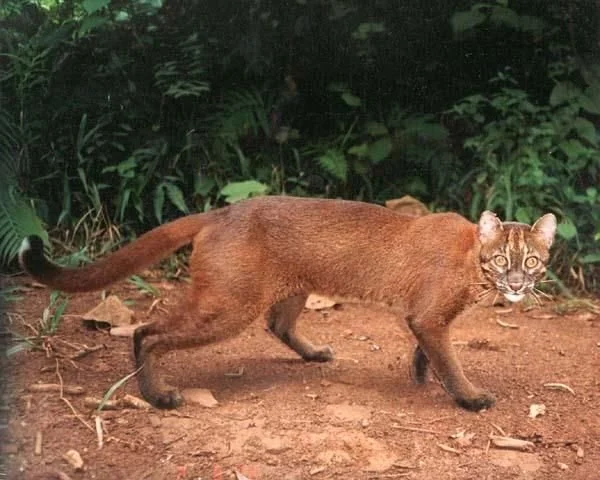
Asian Golden Cat Scientific Name: Catopuma temminckii
Conservation Status: Both species are currently listed as Vulnerable on the IUCN Red List.
CITES Listing: The Asian Golden Cat is under Appendix I; the African Golden Cat is under Appendix II.
Estimated Population: While African numbers are difficult to quantify, the Asian Golden Cat is estimated to have a global population of approximately 7,000 mature individuals.
Appearance
Golden cats are medium-sized felids celebrated for their extraordinary polymorphism, meaning they appear in several distinct color phases.
The African Golden Cat generally weighs between 24 and 30 pounds. Its coat typically transitions between a vibrant red-golden phase and a sleek silver-gray phase. Their markings are highly variable; some individuals are heavily spotted across the entire body, while others have spots restricted to the belly and inner legs. In some regions, they are known as "the Leopard's brother" due to their shared habitat.
The Asian Golden Cat is slightly more robust, with a weight range of 20 to 32.5 pounds. Their coats can feature at least six different color morphs, including fox-red, golden-brown, black, and gray. A distinctive characteristic of the Asian species is the striking white lines that run across the cheeks and from the inner corners of the eyes to the crown. Additionally, the underside of the tail tip is noticeably white.
Habitat and Range

Both species are primarily forest-dependent, though their specific territories span different continents:
African Golden Cat: This species is endemic to the equatorial belt of Africa. They thrive in primary moist forests, including mangrove swamps and high-altitude alpine bamboo forests. They have been recorded at elevations up to 3,600 meters.
Asian Golden Cat: Their range extends from the Eastern Himalayas through China and mainland Southeast Asia to the island of Sumatra. They inhabit a variety of environments, from tropical and subtropical moist evergreen forests to dry deciduous forests. They are remarkably adaptable in altitude, found from sea level up to 4,600 meters in the Himalayas. However, their range has become severely fragmented, and they are now considered extinct in Singapore and possibly extinct in Viet Nam.
Diet and Behavior
Golden cats are solitary and secretive hunters. The African Golden Cat is largely nocturnal and crepuscular, utilizing a "stalk and rush" technique. Their diet primarily consists of rodents, squirrels, and small antelope (duikers), but they also prey on primates and scavenge kills from larger predators like eagles.
The Asian Golden Cat is generally diurnal or cathemeral (active intermittently throughout the day and night). They are opportunistic hunters that target small to medium-sized vertebrates. While small rodents and birds are dietary staples, they are capable of taking down larger prey, including muntjac deer, wild pigs, and even young domestic buffalo calves.
Reproduction

Knowledge of their reproductive habits comes largely from captive individuals.
African Golden Cat: Following a gestation period of approximately 78 days, mothers typically give birth to a single kitten, though litters of two have been recorded. Kittens open their eyes within six days and reach sexual maturity at around 23 months.
Asian Golden Cat: This species has a gestation period of about 80 days. Litters usually consist of one to three kittens. They develop rapidly, opening their eyes by nine days. Females reach sexual maturity between 18 and 24 months, while males typically mature at two years.
Threats
Both species face a decreasing population trend driven by human activity. In Africa, the main drivers of decline are habitat fragmentation caused by mining and road development, as well as the bushmeat trade, which depletes their prey base. They are often victims of "empty forest syndrome," where forests remain standing but the wildlife has been hunted out.
In Asia, indiscriminate wire snaring is the single greatest driver of population decline. Even when they are not the intended target, golden cats are frequently killed in snares set for other animals. They also face severe habitat loss from industrial agriculture and infrastructure projects that destroy the functional connectivity of their territories.
Conservation Efforts
Conservationists are focused on expanding protected areas and improving the enforcement of existing wildlife laws. Big Cat Rescue plays an active role by providing conservation funding for field projects.
Specifically, in 2023, funding supported a critical project in the Tinjure-Milke-Jaljale area of Nepal to save the Asian Golden Cat. Key components of this work include:

Predator-Proofing: Installing secure goat corrals for local herders to prevent livestock loss and stop the "revenge killings" of cats.
Alternative Livelihoods: Establishing community greenhouses that offer residents a sustainable income, reducing the economic reliance on poaching.
Fire Prevention: Training local teams in fire-fighting techniques to protect the forest habitat from seasonal wildfires. Ironically, Asian golden cats appear in mythology in “some regions of Thailand” and are referred to as “Seua fai,” or “fire tiger”. This evocative name speaks to the animal’s striking golden-tan coat, which can appear to glow with an almost flame-like quality in certain lighting conditions.
Read more at: https://www.miamiherald.com/living/article314679599.html#storylink=cpy
Education: Conducting outreach programs for children to build long-term community support for golden cat protection.
Analogy for Understanding: Think of the Golden Cat as a "Forest Ghost." Just as a ghost is rarely seen but leaves traces of its presence, these cats are the invisible guardians of the deep woods. When we clear the trees or set snares, we aren't just taking away their home; we are "exorcising" a vital part of the ecosystem that keeps the forest healthy and balanced. Saving them requires us to protect the very shadows they hide in.

Asian Golden Cat


African Golden Cat
See Conservation Work Funded By Big Cat Rescue here:
2023 Saving Asiatic Golden Cats in Tinjure-Milke-Jaljale Nepal
This project is to install 20 suitable predator proof goat corrals, to support the establishment of 25 greenhouses to reduce poaching, to train communities in fire fighting and to reach out to children for conservation awareness. The goat corrals avoid the “revenge killings” of the cats that occur when cats prey on livestock. The greenhouses provide alternative sources of income to local residents in return for commitments not to poach cats for income. Forest fire is one of the biggest threats for this species and other wildlife and their habitat in this Tinjure-Milke-Jaljale Area.
All conservation insitu work: https://bigcatrescue.org/insitu/
