Tilcayo Tiger Cat Facts
Quick Facts
Common Name: Tilcayo Tiger Cat
Scientific Name: Leopardus tilcayo
IUCN Red List Status: Not Evaluated
Current Population:
Population Trend:
Weight: 4 to 8 pounds
Body dimensions: Head-body length as 425–505 mm (about 16.7–19.9 inches) and its tail length as 250–265 mm
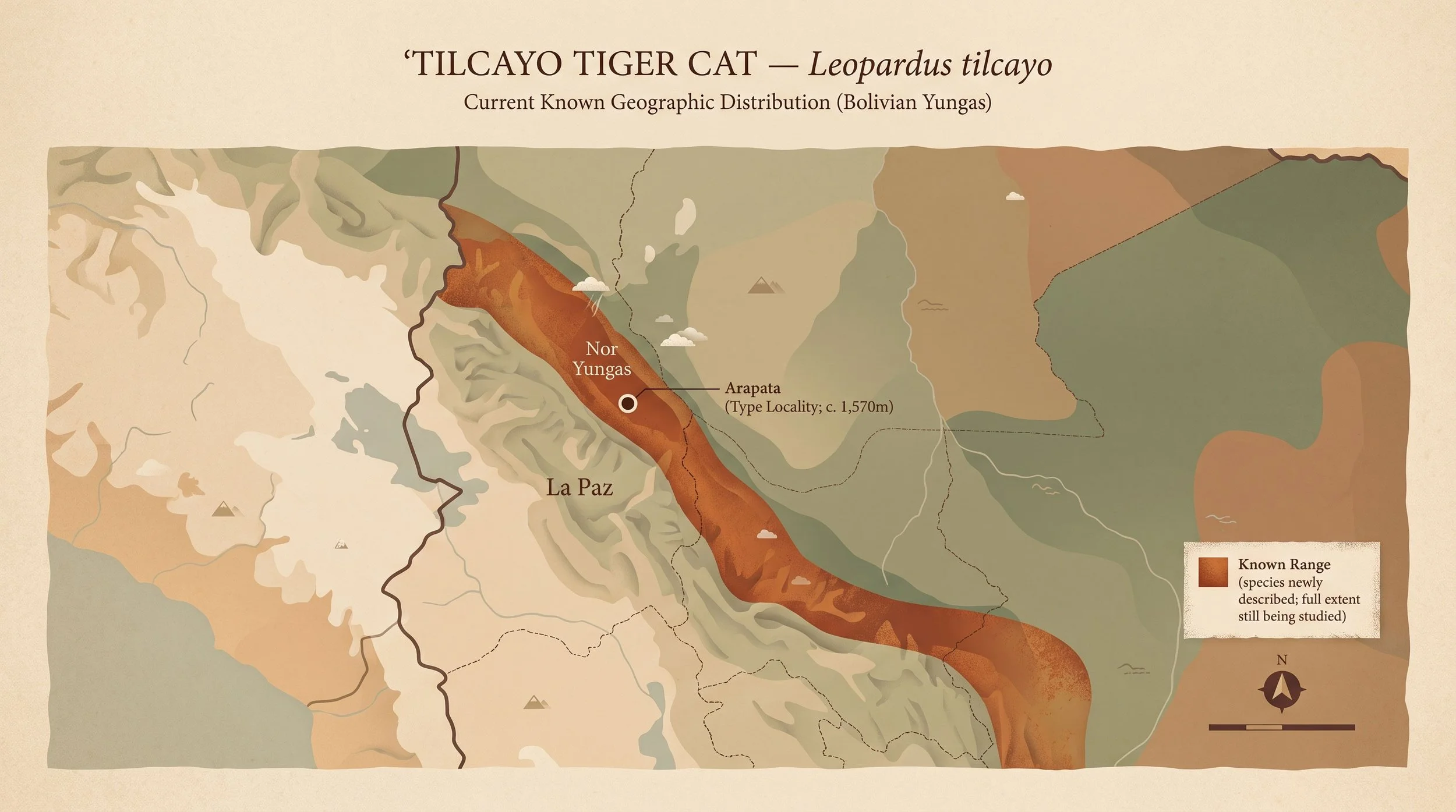
Tilcayo Tiger Cat Range Map
The Cat Science Missed for a Century: 5 Surprising Facts About the Tilcayo Tiger Cat
1. Introduction: A Relatable Curiosity
Imagine walking through the high-altitude mists of the Andes and spotting a small, dappled creature darting through the undergrowth. You would likely assume you had just seen a stray domestic kitten, a common mistake that has allowed a scientific bombshell to hide in plain sight for generations. In a revelation that has electrified the global feline research community, scientists have finally identified a completely new species: the Tilcayo tiger cat (Leopardus tilcayo).
This is the first time in over a century that a new wild cat species has been formally described, and it proves that our planet still guards profound secrets. Published in 2026, the research identifies a lineage that has been genetically independent for roughly 1.4 million years. It is a humbling reminder that even in an age of satellite mapping, an entire branch of the feline family tree remained "invisible" to modern taxonomy until now.
2. It Was Mistaken for a Kitten Eating Noodles and Rice
The story of how this species moved from the shadows of the forest into the light of science begins with a case of mistaken identity. A resident in the forest near La Paz, Bolivia, found a tiny, spotted cat and, assuming it was a lost domestic kitten, attempted to nurse it back to health. He fed the animal a diet of noodles, rice, and eggs, but the creature failed to thrive on human food and began exhibiting distinctly wild behaviors.
Realizing the animal belonged in the wild, the man brought it to the Senda Verde Wildlife Sanctuary, where it eventually caught the eye of researcher Paola Nogales-Ascarrunz. She immediately noticed that something was different; the animal was impossibly small, even for a wild cat. This extreme diminutive stature—smaller than a typical house cat—is precisely why the species escaped scientific notice for so long.
"I saw this cat. It was really, really small, and I couldn’t believe how small it was... I thought it was a kitten," recalls Nogales-Ascarrunz.
The discovery also highlights the power of modern "museomics." Unlike the Sunda clouded leopard, which was identified using existing museum specimens, the Tilcayo tiger cat was completely novel to science, as stated by Dr. Tadeu de Oliviera "We didn’t have specimens in museums. It had never been collected before." It was a true "ghost" of the cloud forest.
3. Science is Finally Listening to Indigenous Knowledge
While the academic world celebrated the discovery in 2026, the people of the Bolivian Yungas have known of this cat for centuries. The researchers made the intentional decision to formalize the local name, "Tilcayo," rather than imposing a traditional Latinized label. This choice represents a significant move toward integrating Traditional Knowledge into modern conservation efforts.
Interestingly, the etymology of "Tilcayo" is not rooted in a specific translation within Quechua or Aymara. When asked if the name held a linguistic meaning, local community members simply stated that it was the name passed down through oral history. It was a designation preserved purely by traditional verbal heritage, existing outside of known formal languages.
"My grandpa told me that’s the tilcayo... We want to preserve that knowledge and we didn’t want to give it another name," Nogales-Ascarrunz explains.
By keeping this name, we acknowledge that Indigenous communities are the original stewards of these ecosystems. Their observations provided the roadmap for a discovery that the laboratory is only now confirming.
4. An Ancient Lineage Hidden in the Clouds
The Tilcayo tiger cat is a specialist of the Bolivian Yungas, the unique "cloud forest" ecotone where the Andes Mountains meet the humid Amazon basin. Genetic analysis shows it diverged from its closest relatives during the Early Pleistocene, about 1.43 million years ago. This study has finally resolved the "tiger cat complex," proving it is not one species, but five distinct species.
Beyond the five species, the research also identified a "bonus" discovery: a new subspecies in Peru called the Antisuyo tiger cat (Leopardus tigrinus antisuyo). To separate L. tilcayo from its cousins, we look at the specific "Diagnosis" of its physical traits:
Pelage: It possesses shorter fur than the clouded tiger cat (L. pardinoides) with a lower contrast pattern.
Spots: The coat features large, irregular open rosettes on a light brown dorsum; crucially, these markings do not coalesce into solid bands.
Tail: Its tail is longer and fuller than that of the northern tiger cat (L. tigrinus), yet it is less bushy than the tail of the clouded tiger cat and lacks complete distal rings.
It is remarkable that a mammal with such a deep evolutionary history could remain hidden despite having such a clear, diagnostic appearance. This 1.4-million-year-old lineage has survived through glacial cycles and climatic shifts, persisting in its high-altitude refuge.
5. We Found It Just as It’s Disappearing
Finding a new species is a triumph, but for conservationists, this discovery is deeply bittersweet. Genomic data reveals that the Tilcayo tiger cat has suffered a staggering 63% population decline since the transition between the Pleistocene and Holocene epochs. This figure represents a drop in the species' effective population size (N_e), a critical metric for long-term survival.
The cloud forests the Tilcayo calls home are currently vanishing fast due to agricultural expansion and human development. While the broader tiger cat complex was previously evaluated as "Vulnerable," these newly identified units are in a precarious position. Formally, individual populations like the Tilcayo are currently NE (Not Evaluated), requiring immediate and separate assessments to ensure legal protection.
We have identified this cat just as its specialized habitat is reaching a breaking point. Because it is so highly adapted to the specific conditions of the Yungas, it cannot simply migrate if the forest is lost. It is a race against time to install camera traps and establish protected corridors before this ancient lineage is extinguished.
6. Conclusion: A Final Ponder
The resolution of the tiger cat complex into five distinct species—including the discovery of the Tilcayo and the Antisuyo tiger cat subspecies—has fundamentally changed our understanding of South American biodiversity. It serves as a powerful reminder that our "well-studied" world is still full of surprises. Every new species identified is a call to action for the preservation of the remaining wild places.
As we look toward the future of wildlife research, the words of Paola Nogales-Ascarrunz resonate with a new urgency:
"It’s a new reason to protect the world."
If a distinct, ancient wild cat could remain unknown to science for a hundred years in the Bolivian mists, it begs a final, haunting question. What other wonders are still hiding in the world's remaining cloud forests, waiting for us to notice them before they vanish forever?
See a playlist of tiger cats at https://bigcatrescue.org/videos
Source: https://www.cell.com/current-biology/fulltext/S0960-9822(26)01110-3
https://www.nbcnews.com/science/environment/new-wild-cat-species-identified-rcna598113
