



Tiger Facts
TIGERS
Common Name: Tiger
Kingdom: Animalia
Phylum: Chordata (Vertebrata)
Class: Mammalia
Order: Carnivora
Family: Felidae
Genus: Pantherinae Panthera
Species: tigris
Sub-species:
Bengal Tiger – Panthera tigris tigris 1200-1500 left
Siberian (Amurian) Tiger – Panthera tigris altaica 331 left
Sumatran Tiger – Panthera tigris sumatrae 136 left
Indo-Chinese Tiger – Panthera tigris corbetti
Malayan Tiger – Panthera tigris jacksoni **
South China Tiger – Panthera tigris amoyensis 37 left
Javan Tiger – Panthera tigris sondaica – extinct since early 1980’s
Bali Tiger – Panthera tigris balica – extinct since the 1940’s
Caspian Tiger – Panthera tigris virgata – formerly thought to be extinct since the early 1970’s *
*1/16/09 A team of scientists from Oxford University and the NCI Laboratory of Genomic Diversity in the USA have discovered that the Caspian Tiger and the Siberian Tiger have the same DNA. The tiger sub-species studied were the Caspian tiger (Panthera tigris virgata), the Siberian tiger (Panthera tigris altaica), the Indian – Bengal – tiger (Panthera tigris tigris) and the South China tiger (Panthera tigris amoyensis). The Caspian tiger was found to differ by only one nucleotide of its mitochondrial DNA from the Siberian tiger: other tiger sub-species differ by at least two nucleotides.
**In 2004, the tigers of Peninsular Malaysia were recognized as a new subspecies, Panthera tigris jacksoni, when a genetic analysis found that they are distinct in mtDNA and micro-satellite sequences from tigers of northern Indochina, P. t. corbetti (Luo et al., 2004). However, Mazak and Groves (2006) found no clear morphological differences (in cranial measurements or pelage characteristics) between tigers from Peninsular Malaysia and those elsewhere in Indochina, and argue for inclusion in P. t. corbetti. P. t. jacksoni is provisionally accepted here. The geographic division between P. t. jacksoniand P. t. corbetti is unclear as tiger populations in northern Malaysia are contiguous with those in southern Thailand (T. Lynam pers. comm. 2008).
Misc: This species has been (and is still) widely hunted throughout its range for sport, for the fur trade, and for the traditional Asian medicine market. For the medicine trade – no part of the Tiger’s body goes unused (see diagram below). The tiger is one of the best known mammals, and has become a symbol everywhere for conservation. Today, sadly, there are more tigers in captivity then exist in the wild. There are thought to be between 5,000 and 10,000 tigers in U.S. cages and 90% of them are in miserable roadside zoos, backyard breeder facilities, circus wagons and pet homes. Read about the conviction of those involved in canned hunts in the US.
The numbers on the tiger illustrate parts of the tiger that are traded on the black market. These myths are why the tiger has been hunted nearly to extinction.
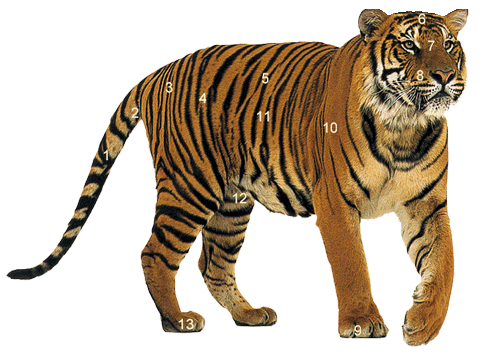
The tail can be ground and mixed with soap for applications as an ointment in the treatment of skin disease. The bones from the tip of the tail ward off evil.
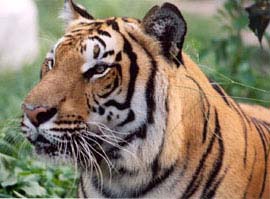
Size and Appearance: The largest of all the living cats, the tiger is immediately recognizable by its unique reddish – orange coat with black stripes. Stripe patterns differ among individuals and are as unique to the animal as are fingerprints to humans. The dark lines above the eyes tend to be symmetrical, but the marks on the sides of the face and body can be different. Males have a prominent ruff or collar, which is especially pronounced in the Sumatran tiger.
One single white cub was found in the wild and taken by a hunter who killed his mother and normal colored siblings. He was named Mohan and is the progenitor of most white tigers now in captivity. White tigers would never survive in the wild as the white coat is only produced through severe inbreeding. White tigers have brown stripes and crystal blue eyes, and some specimens in captivity have no stripes at all.
Black tigers have been reported, but only a single pelt from illegal traders remains the only evidence. The pelt shows that the black only occurs on the top of the head and back, but turns into stripes down the sides, unlike in other cats that are completely and truly black (or melanistic).
Body size of the tiger varies with latitude, the smallest occurring at low latitudes in Indonesia and the largest at high altitudes in Manchuria and Siberia. The largest, the Siberian tiger can reach weights exceeding 700 pounds and reach lengths of 10+ feet, and the smallest, the Indonesian or Bali tiger weighing a mere 200 pounds with a total length of 7 ft.
While Amur Tigers are usually the largest tigers in captivity the Indian tigers in the wild have proven to be larger than any recorded Siberian cats. Female Bengal tigers (panthera tigris tigris) will average 300 pounds and males 450. Several in Nepal have been recorded between 550 and 700. The largest Siberian on record is 845 pounds. The Guiness Book of Records has one tiger in India at 857 pounds, shot by a hunter from Philadelphia in 1967, near what is now Corbett Tiger Reserve.”
Scientists in Russia report that no tigers immobilized by the Russian team have weighed as much as those in Chitwan. It probably is a function of habitat quality. Siberian tigers have the potential for being the largest, and captive ones are larger than captive Bengals. But in the wild the prey base in Russia is not abundant enough for those tigers to realize their full potential. Prey is more scattered and the Russian tigers need huge territories to capture sufficient food, so much more energy is expended in the food quest.
In sanctuaries tigers have lived up to 26 years, as compared to 15 in the wild. Tigers only live 10-12 years in most zoos.
 Habitat: Tigers occupy a wide variety of habitats including tropical evergreen forests, deciduous forests, coniferous woodlands (Taiga), mangrove swamps, thorn forests and grass jungles. The factors common to all of the tiger’s habitats are some form of dense vegetative cover, sufficient large prey, and access to water. Tigers are extremely adept swimmers and readily take to water. They have been recorded easily swimming across rivers achieving distances of just under 20 miles. The tiger also spends much of its time during the heat of the day during hot seasons half submerged in lakes and ponds to keep cool. Indian tigers generally have a range of 8-60 square miles, based on availability of prey. Sumatran tigers have a range of about 150 square miles. Due to the severity of the climate and lack of prey, the Siberian tiger can require a range of 400 square miles. Tigers have lost more than 40% of their habitat in the past decade. (1)
Distribution: Indian subcontinent, Amur River region of Russia, China, North Korea, Sumatra, Indonesia, and Continental southeast Asia. In 2004, the Malayan tiger was declared a separate sub species from the Indochinese sub species of tiger. Found exclusively in the southern part of the Malay Peninsula. It is the third largest tiger population behind the Bengal tiger and the Indochinese tiger.
Reproduction and Offspring: Tigers will mate throughout the year, but most frequently between the end of November to early April. After a gestation of 103 days a litter of up to 7 cubs, although averaging 3, is born. Cubs will leave their mothers as young as 18 months old, or as old as 28 months old. During the first year, mortality can be as high as 35%, and of that 73% of the time it is the entire litter that is lost. The main causes of infant mortality are fire, floods, and infanticide, with the latter being the leading cause. Females tend to reproduce around 3 ½ years and males just under 5 years. In captivity, females have produced through age 14.
Social System and Communication: Tigers, like most cats are solitary, however, they are not anti-social. Males not only come together with females for breeding, but will feed with or rest with females and cubs. There have actually been reports of some tigers socializing and traveling in groups. Females with cubs have also been seen coming together to share meals. Most likely, in all of these cases they are somehow related. Males will kill cubs from other males, so it is likely that the offspring in question is his own. The females most likely are mother and daughter with overlapping home ranges. Hear our roars, chuffs, hisses, snarls, calls, and growl sounds HERE
Hunting and Diet: Tigers hunt primarily between dusk and dawn, and they attack using the same method as do the lions. They stalk, chase, and attack, bringing down and killing the prey with usually a bite to the nape of the neck or the throat. The bite to the throat allows the tiger the ability to suffocate the prey bringing death relatively quickly and painlessly. Smaller animals are often killed with the bite to the nape of the neck allowing the tiger to to fracture the vertebrae and compress the spinal chord of its victim. Once killed, the tiger either drags or carries its meal into cover. The tiger’s enormous strength allows it to drag an animal that would require 13 adult men to move. Tigers consume anywhere from 35 – 90 pounds of meat at one sitting, beginning at the rump of the prey. If undisturbed, they will return to the carcass for 3-6 days, feeding until it has completely consumed its kill. Because tigers are not the most successful of hunters, only killing 1 in every 10-20 attempts, it may be several days before it has its next meal. In the wild, cooperative hunting among tigers has also been observed where couples and families hunted like a pride of lions. This, however, is the exception not the rule. Unlike the other felids, man is a regular part of the tiger’s diet and has earned them greatest reputation as man-eaters. The most common prey items are various species of deer and pig, but they will also take crocodiles, young elephants and rhinos, monkeys, birds, fish, leopards, bears, and even their own kind. They have also been reported to eat carrion.
Status: IUCN: Endangered
Felid TAG recommendation: Tiger (Panthera tigris). The SSP for tigers supports a target population of 150-160 individuals for each of three subspecies. The Amur (formerly called the Siberian) Tiger SSP is nearly 20 years old, has functioned well with this target population, and has periodically obtained new founders from orphan situations or as F1 captive-born individuals from Europe. Its goals are not likely to change in the future. The Sumatran Tiger SSP is well under its target population, and additional spaces are readily available, especially in zoos located in warmer climates. Additional founders are periodically available from Sumatra via captive-bred individuals or wild-born tigers that must be removed from the wild. At this time, the Indochinese or Corbett’s tiger also is included in the RCP (albeit present in only four zoos). Given the small founder population presently in the North American population, additional animals from range-country zoos that are unrelated to those in North America are being sought. Although still present in large but declining numbers, no space is allocated for hybrid tigers (including white tigers, tabby tigers, “snow tigers” and ligers since they are all inbred, crossbred, and suffer congenital birth defects). No purebred Bengal tigers exist in North America because the zoos hybridized all of their stock trying to produce white tigers that could survive the inbreeding necessary to create the white coat. Due to this and a lack of space, this race will not be targeted by the Felid TAG for inclusion in its RCP. No one who breeds tigers outside of the Species Survival Plan which is only for AZA accredited zoos is really breeding for conservation.
How rare is this cat ? The largest wild population of tigers are in India. According to statistics released in 2009 there are 1,200 – 1,500 tigers left on 27 wildlife reserves in 11 states in India. Tigers are no longer “burning bright” in our world’s most famous tiger preserves.
Tiger numbers in the wild are thought to have plunged from 100,000 at the beginning of the 20th century to between 1,500 and 3,500 today. A century ago, India had some 100,000 tigers. Now, officials estimate they number about 1,200 – 1,500. The Bali, Javan, and Caspian subspecies, have become extinct in the past 70 years. The South China tiger is on the verge of extinction, with just 20 to 30 remaining in the wild. The International Species Information Service lists in captivity 1,098 worldwide in captivity with 256 being registered with ISIS in the U.S. as purebred tigers, as of 2009. There are NO purebred Bengal tigers in the U.S. The only purebred tigers in the U.S. are in AZA zoos and include 133 Amur (AKA Siberian), 73 Sumatran and 50 Malayan tigers in the Species Survival Plan. All other U.S. captive tigers are inbred and cross bred and do not serve any conservation value.
The rampant Pay to Play industry, that breeds these generic tigers solely to produce cubs that are marketed as “orphaned” or “rejected” to unwitting patrons is largely responsible for the decline of wild tiger populations. Cubs can only be used for public contact, according to USDA guidelines, until they are 12 weeks old. After that they are considered too dangerous and can bite off a finger. Animal exploiters constantly breed tigers to have plenty of profitable cubs on hand for petting and photo sessions. Once they reach maturity they are often relegated to tiny, barren breeding pens to create more cubs, or can end up in “canned hunts” and on the menu because lions are not currently a protected species and it is impossible to tell tiger meat from lion meat.
Update 1/4/2010: According to official statistics, as many as 59 tiger deaths were reported from across India in 2009 till December 8. Of the 59, 15 were “poached” while the remaining 44 died due to “illness and other causes”. Madhya Pradesh topped the charts with 13 tiger deaths followed by Assam (10), Karnataka (9) and Uttarakhand (7).
2009 saw the deaths of 85 tigers; more than a two-fold increase in the number of tiger deaths compared to 2008 and almost a two-fold increase compared to 2007. In all, 28 big cats were killed in 2008 and 30 in 2007. NGOs, nevertheless, peg the number of tiger deaths at more than 53 in 2010 which is approximately one per week.
2010 Tiger Census
Bangladesh 200
Bhutan 67
Cambodia 11
China 37
India 1,165
Indonesia 441
Lao PDR 30
Malaysia 300
Myanmar 100
Nepal 100
Russia 331
Thailand 250
Viet Nam 30
Total in the wild: 3,062 Total in cages in the U.S. in 2004 4,955 Note that there are NO legitimate reintroduction programs.
Watch the documentary The Tiger Next Door
Watch the documentary Tigers in the Suburbs part 1 and Tigers in the Suburbs part 2
(1) Natural World – Tiger Kill documentary aired 9/25/07 on Animal Planet
Meet the white tiger named Zabu who lives at Big Cat Rescue and Kenny, a white tiger who has passed on:
See Conservation Work Funded By Big Cat Rescue here:
All conservation insitu work: https://bigcatrescue.org/insitu/


I was looking for a tiger you had rescued that Rick Srickland had given you for rescue named Lucky. His name was T.J. son of Xena and Hercules both siberians. Please inform me that you might have some info on him. Thanks
There is no link to the sanctuary tigers anymore. ?
intresting
wow!! a great information on the tiger, i dont know these fact's about the tiger… Really these are amazing stuff…
Thanks
Ranthambore
Please am in tigers club in Nigeria I want to know more about tigers life send me more on my email ,oluwakayodealagbek@yahoo.com.Thanks
I have been doing a research paper on tigers and this is great because I got to voice my opinion. Jewel I agree people should show these cats a lot more respect all they have been doing is protecting their young!!! I mean if others had their kids taken away also their home they would fight too survive as well!!
I'm doing a debate essay on exotic pets. I'm saying that they do more harm than good, and this article was really helpful. Shame, though. People really ought to respect animals more.
nooooooooooooooooooo
Perhaps we should consider putting some of the poachers into their habitat without their guns,
Poor animals, not being able to be free in the wild!
ZABU IS BEUTIFUL…
I am doing a research paper on tigers and extinction. This is a very informative site and I enjoyed reading the materail.
did Tigers live in austrlia bush land?
thanks
thanks
Leopards Earn The Greatest Reputation As Maneaters, Not Tigers!
Actually There Are 3,275 Tigers In The Wild