Black Footed Cat Facts

Quick Facts
Common Name: Black-footed Cat (also known as the Small-spotted Cat)
Scientific Name:Felis nigripes
IUCN Status: Vulnerable
Population Trend: Decreasing
Estimated Mature Population: Approximately 9,707 individuals
Weight: Females average 2.8 lbs (1.3 kg); Males average 4.25 lbs (1.93 kg)
Lifespan: Around 5 years in the wild; up to 16 years in captivity
Appearance
The Black-footed Cat is the smallest wild cat species in Africa and one of the smallest in the entire world. Despite its name, only the undersides of its paws and the pads are actually black. Its coat is a warm buff color, adorned with heavy black oblong spots that transition into thick dark rings or "ring bars" on the legs, neck, and tail.
Unlike many other felids, the skin of this species is notably pink. They possess large, luminous eyes adapted for their strictly nocturnal lifestyle and a stocky build with a relatively short tail. Because of their body structure, they are poor climbers and spend almost all of their time on the ground.
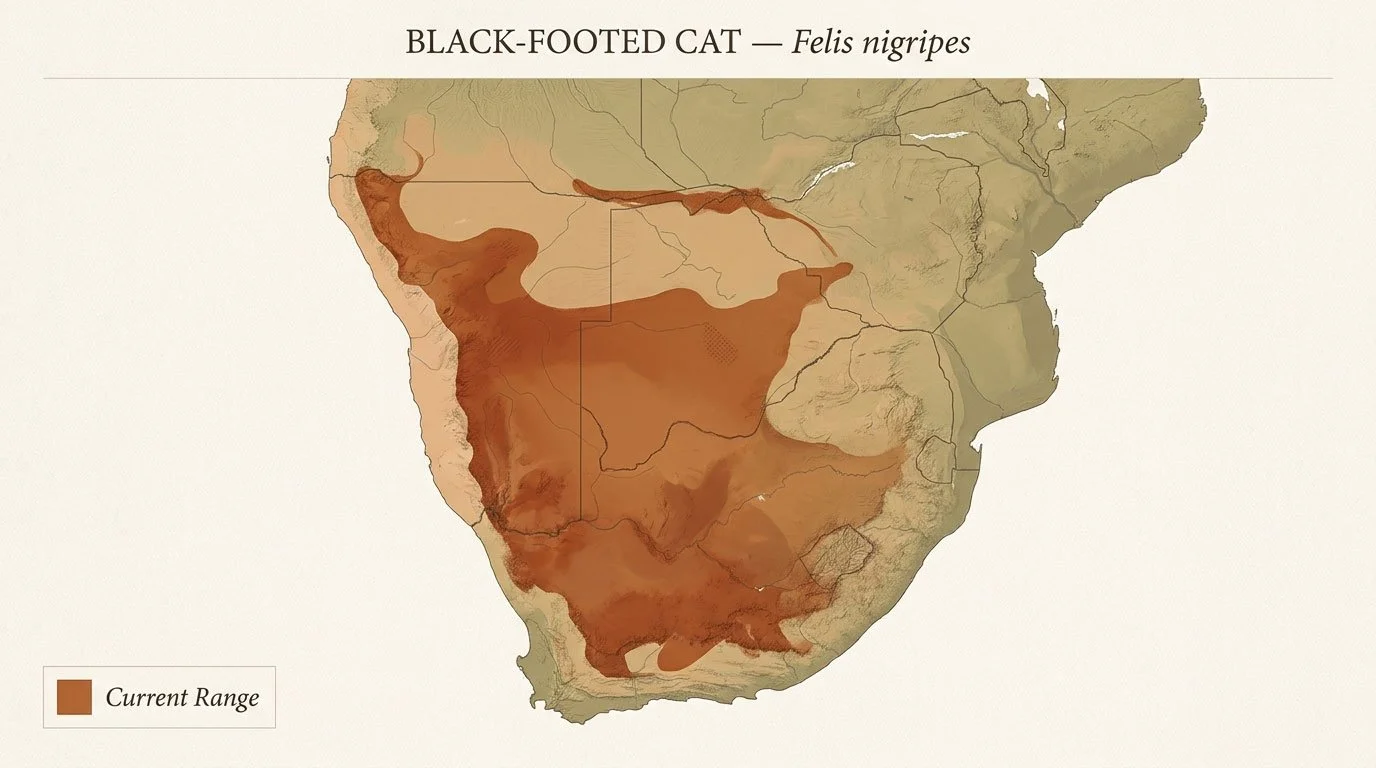
Black-Footed-Cat-Range-Map
Habitat and Range
This cat is endemic to the arid regions of southern Africa, with its distribution primarily centered in South Africa and Namibia. While historical reports suggested they had vanished from Botswana, recent data confirms they are still resident there. Their presence is uncertain or marginal in extreme southern Angola and Zimbabwe.
They thrive in open, dry habitats such as short-grass savannas, Karoo semi-deserts, and scrublands. They require areas with high densities of rodents and ground-roosting birds. Because they do not dig their own burrows, they rely on abandoned homes of other animals—specifically springhares, ground squirrels, and aardvarks—or hollowed-out termite mounds for shelter during the day.
Diet and Behavior
Known by the Afrikaans name miershooptier (anthill tiger), the Black-footed Cat is famous for its extraordinary bravery and tenacity. It is a solitary, strictly nocturnal hunter that becomes active after sunset.
Due to a very high metabolic rate, these cats have immense energy requirements. In a single night, an individual may travel over 5 miles and consume up to 14 small prey animals. Their diet consists mostly of small mammals (under 40g) and birds, though they are capable of taking down much larger prey, such as the Cape hare or the white-quilled bustard. They utilize three distinct hunting methods: a slow stalk, a fast "run and pounce," and a "sit and wait" tactic outside rodent burrows.
Reproduction
The breeding season typically runs from late winter through summer (August to March). After a gestation period of 63 to 68 days, a female usually gives birth to a litter of two kittens, though litters can range from one to four. To protect them from predators, the mother frequently moves her young between different burrows.
Kittens develop much faster than domestic cats to survive their harsh environment; they begin walking at two weeks and start eating solid food at one month. They are typically weaned by two months and become independent at four or five months old, though they may remain in their mother’s home range for some time before dispersing.
Threats
The Black-footed Cat faces a variety of complex threats that contribute to its decreasing population:
Predation and Competition: High mortality rates (up to 50%) are caused by larger predators like Black-backed Jackals and Caracals.
Loss of Shelter: The decline of springhare populations due to bushmeat hunting directly impacts the cats, as they lose the burrows they depend on for survival.
Human Impact: Indirect threats include accidental poisoning from locust control efforts, falling victim to traps set for other predators, and fatal collisions with vehicles.
Disease: A genetic condition called AA-amyloidosis is prevalent in the species, leading to organ failure and complicating both wild survival and captive breeding programs.
Habitat Degradation: Overgrazing by livestock reduces the availability of the small vertebrate prey that the cats rely on.
Conservation Efforts
Felis nigripes is protected under national legislation across most of its range, and international trade is strictly regulated. Conservation focuses on the following key areas:
Field Research: The Black-footed Cat Working Group (BFCWG) has conducted over two decades of research to understand the species' ecology, health, and distribution.
Private Stewardship: Since most of their range lies outside formally protected areas, conservationists work with private landowners to manage predators judiciously and maintain healthy prey populations.
Corridor Creation: Establishing large, connected conservancies is vital to prevent subpopulations from becoming isolated, which helps maintain genetic diversity and combat disease.
Citizen Science: Public awareness campaigns encourage people to report sightings, helping scientists build a more accurate map of where these elusive cats live.

Black Footed Cat at Peking Zoological Gardens
See Conservation Work Funded By Big Cat Rescue here:
All conservation insitu work: https://bigcatrescue.org/insitu/
