
Bay Cat
Bornean Bay Cat
Quick Facts
Scientific Name:Catopuma badia
Common Names: Borneo Bay Cat, Bornean Bay Cat
IUCN Red List Status: Endangered
Current Population Trend: Decreasing
Estimated Population: Approximately 2,200 mature individuals
Geographic Range: Endemic to the island of Borneo
Appearance
The Borneo Bay Cat is a master of elusiveness with a physical profile similar to that of a house cat, typically weighing between 5 and 10 pounds. It is recognized by its remarkably long body and tail, a combination that gives it an appearance similar to the New World Jaguarundi.
This species exhibits two distinct color phases: a vibrant chestnut-red and a more muted gray. Regardless of the phase, the coat is often lightly speckled with black markings. Notable features include rounded ears with darker backs and a distinctive long tail. The tail features a whitish stripe running along most of its underside, culminating in a pure white tip, while the top of the tail remains black.
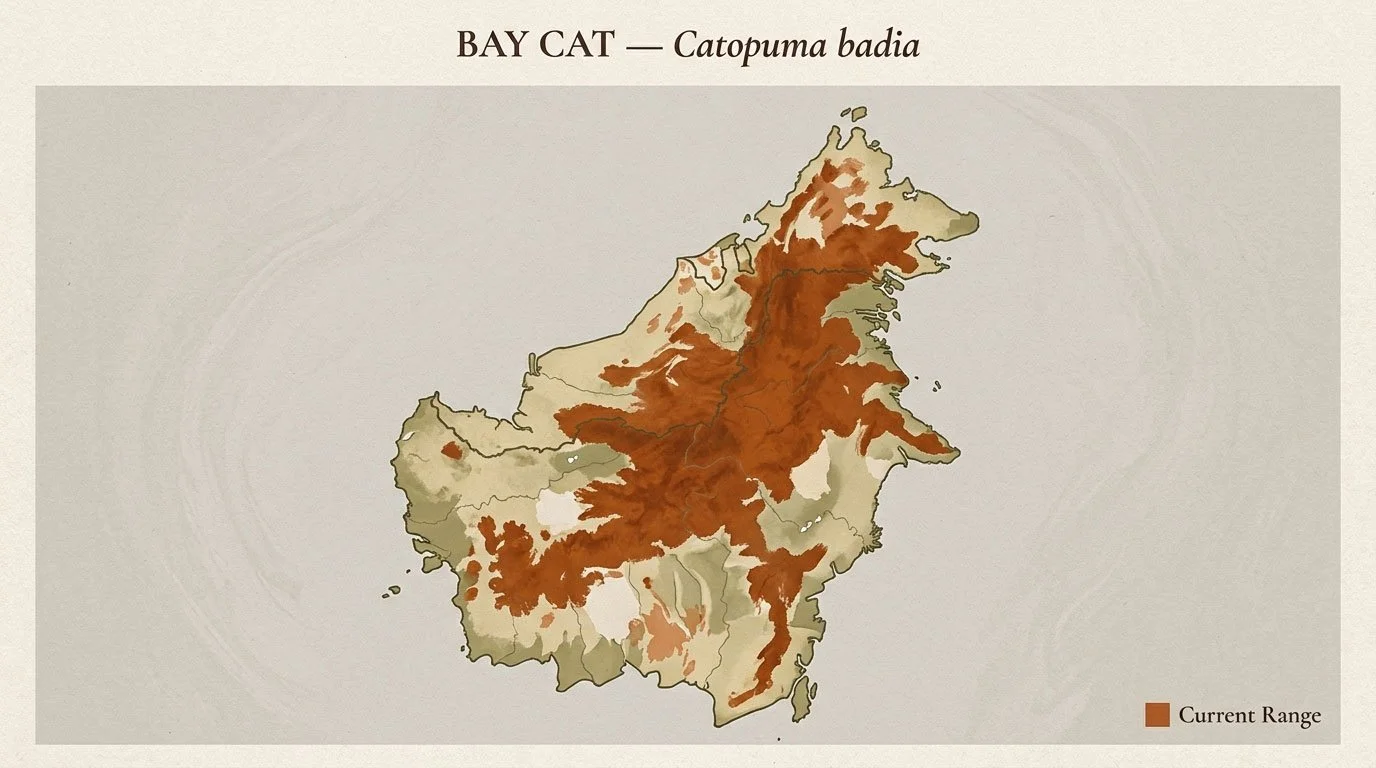
Bay-Cat-Range-Map
Habitat and Range
Strictly endemic to Borneo, this felid is found across the Indonesian provinces of Kalimantan and the Malaysian states of Sabah and Sarawak. While its presence in Brunei is suspected, it remains unconfirmed. The Bay Cat is heavily forest-dependent, favoring primary lowland forests and rocky limestone areas on the edges of dense jungles.
While the majority of sightings occur at elevations below 800 meters, researchers have recorded the cat at much higher altitudes, including sightings in the Kelabit Highlands at 1,460 meters and unconfirmed reports as high as 1,800 meters on Mt. Kinabalu. Crucially, studies suggest the species does not utilize oil palm plantations or extensive swamp forests, making it highly vulnerable to land-use changes.
Diet and Behavior
The Borneo Bay Cat remains one of the most mysterious members of the feline family. It is rarely captured on camera, even during intensive surveys. Current data suggests it is primarily diurnal—active during daylight hours—though it is not strictly limited to this pattern.
Despite its status as a subject of scientific interest for over a century, no specific ecological studies have been completed in the wild. Consequently, its exact hunting habits and diet remain a mystery to science. What is clear is its terrestrial nature and its reliance on natural forest cover for survival.
Reproduction
Knowledge regarding the life cycle of the Borneo Bay Cat is extremely limited. Scientists have determined that the species has a generation length of approximately six years. However, specific details regarding gestation, litter size, and the longevity of individuals in the wild are currently unknown. To date, no viable captive population exists to help bridge these knowledge gaps.
Threats
The primary threat to the Borneo Bay Cat is the rapid loss and fragmentation of its forest habitat. Commercial logging and the massive expansion of oil palm plantations have decimated large portions of its range. Between 2000 and 2010 alone, the estimated area of occupancy for this species decreased by nearly 30%.
In addition to habitat loss, the species faces significant pressure from:
Illegal Wildlife Trade: Bay Cats are targeted for the illegal pet and skin markets due to their rarity.
Incidental Snaring: Because they spend a great deal of time on the ground, they are frequently caught in non-targeted snares set for other animals.
Climate Change: Many protected areas where the cat resides are small and isolated, making them vulnerable to environmental shifts.
Question: Can I keep a Bay cat as a pet?
Conservation Efforts
The Borneo Bay Cat is currently listed on CITES Appendix II, which regulates international trade. It is also afforded full legal protection under national legislation in both Indonesia and Malaysia, where hunting and trade are strictly prohibited.
Conservationists have confirmed the species' presence in several key protected areas, including:
Sabah: Danum Valley Conservation Area and Tabin Wildlife Reserve.
Sarawak: Gunung Mulu National Park and Lanjak-Entimau Wildlife Sanctuary.
Kalimantan: Gunung Palung and Bentuang Karimun National Parks.
Current conservation priorities focus on gaining a deeper understanding of the cat's distribution and basic ecology. Researchers emphasize that targeted protection measures can only be developed once we understand how this elusive felid responds to the modification of its environment.
Sad Capture of Bay Cat
We have been unable to learn where this cat was being held, or what happened to her.
Photo Credits: Copyright Art Wolfe www.artwolfe.com from the book THE LIVING WILD
Voice talent by Bonnie-Jean Creais 2006

Bay Cat
See Conservation Work Funded By Big Cat Rescue here:
All conservation insitu work: https://bigcatrescue.org/insitu/
