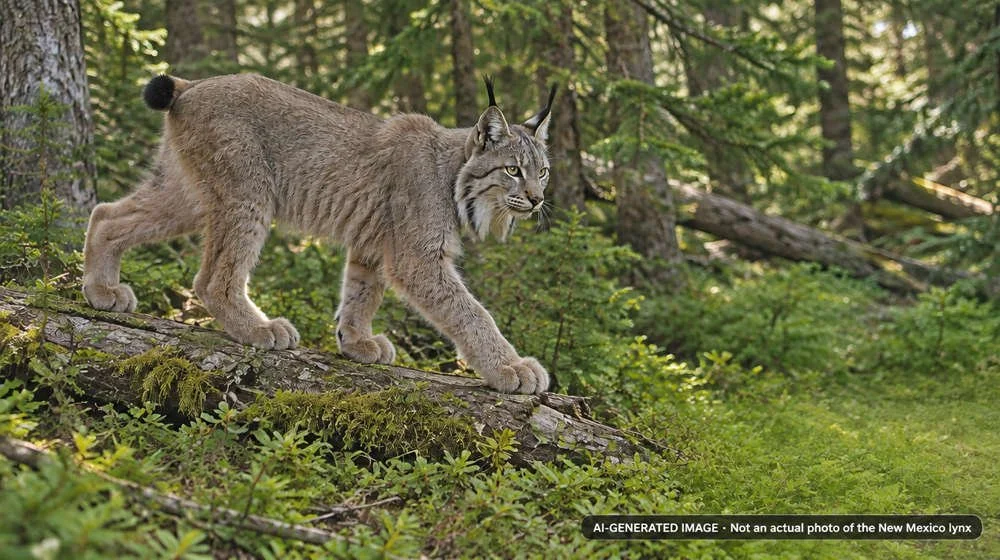
Photorealistic AI version of a Canada lynx
A Canada Lynx Returns to New Mexico's Forests: First Confirmed Record in About 25 Years
Nov 22, 2026
A trail camera in northern New Mexico's Carson National Forest photographed a Canada lynx (Lynx canadensis) in June 2026. New Mexico State University says it is the first confirmed record of the species in the state in roughly a quarter century. Image caption: AI-generated illustration of a Canada lynx in a summer spruce-fir forest. This is not a photograph of the New Mexico lynx.
A surprise in the camera data
The cat turned up in images collected by William Grooms, a Ph.D. student at NMSU working under mammalogy professor Jennifer Frey. Grooms had placed motion-triggered cameras at 120 sites across Carson National Forest, in the San Juan Mountains that run along the New Mexico and Colorado border. When he went through his first batch of photos months later, most frames held the expected squirrels, rabbits, black bears and foxes. One series held something nobody in the project expected to see. The pictures were taken on June 12, 2026. The study, a partnership between NMSU and the nonprofit Wildlands Network, builds on survey work Wildlands Network began in the area in 2022.
Lynx or bobcat?
In the Southern Rockies, the obvious lookalike is the bobcat, which is common in New Mexico. Both cats have ear tufts and a ruff of fur framing the face. Grooms worked through the field marks one at a time. This cat lacked the bold black spotting a bobcat usually carries. Its tail tip was solid black all the way around, while a bobcat's tail is black on top and white underneath. After that check, his team sent the images to other researchers, who agreed it was a lynx. Canada lynx are built for deep snow. They have long legs, very large fur-padded feet that work like snowshoes, and grayish to yellowish-brown coats. Adults can reach about 20 pounds. Their lives revolve around one prey animal, the snowshoe hare, and the dense young conifers, downed logs and thick understory that hares need for cover.
Where did it come from?
Researchers have not said where this individual originated, and a single photo series cannot show whether lynx are living in New Mexico or just passing through. The likeliest source is next door. From 1999 to 2006, Colorado wildlife officials released 218 wild-caught lynx from Canada and Alaska into the San Juan Mountains of southwestern Colorado. That population took hold, and Colorado Parks and Wildlife now estimates 150 to 250 lynx live in the state. Lynx from that program have wandered south before. Collared animals were tracked into northern New Mexico in the years after the releases, and some of those dispersers were killed there. There has been no evidence that lynx have raised kittens in the state.
Protected, but outside critical habitat
Canada lynx in the lower 48 states have been listed as threatened under the Endangered Species Act since 2000. Since 2014, that protection has applied to lynx wherever they occur in the contiguous U.S., including New Mexico, so killing one there is illegal. Habitat is a different story. In November 2024, the U.S. Fish and Wildlife Service proposed about 19,112 square miles of critical habitat that included northern New Mexico. The final rule, published in July 2026 and in effect since August 17, came in about 32 percent smaller than the earlier designation. It added Colorado for the first time and dropped the Greater Yellowstone unit entirely. The final map covers about 14,030 square miles in Colorado, Idaho, Montana and Washington. New Mexico is not on it. That matters because a critical habitat designation is what requires federal agencies to weigh harm to a species' habitat in their decisions. A lynx confirmed in Carson National Forest in 2026 is a lynx living in forest with no designated critical habitat.
The wildfire dilemma
The NMSU study was not designed to look for lynx. It examines how the structure of a forest, meaning how trees and other plants are spaced, layered and mixed, shapes which animals can live there. Grooms is tracking 10 species tied to closed-canopy conifer forest. The forests that hold snowshoe hares, and therefore lynx, are often the same dense stands that land managers thin, burn or log to lower wildfire risk. As the West dries out and fires grow more severe, that conflict is getting sharper. Grooms has said these treatments reduce the risk of catastrophic fire but also strip out habitat features wildlife depend on. The project's aim is to give forest managers evidence on how fuel reduction and timber harvest affect these species, so fire prevention does not erase the animals it is meant to protect. Frey has said the goal is to make sure lynx and other forest species have a future in New Mexico. Grooms will run a second season of camera surveys next summer, which will complete the two-year study. NMSU noted the find could influence how state and federal agencies manage lynx and their habitat.
Why one photo counts
A single trail camera image will not change a species' status. It does put a confirmed, dated record on the map at the southern edge of the lynx's range, in a state left out of the newest habitat protections. For a wild cat this secretive, proof is rare, and every confirmed record is evidence that decision-makers can no longer overlook. One camera, set for an unrelated study, found a cat no one was looking for. More cameras across these mountains, kept running for years, would show whether New Mexico has an occasional visitor or the start of a population.
Sources
Grad student finds New Mexico's first Canada lynx in 25 years, Popular Science
NMSU Ph.D. student finds proof of rare wild cat in northern New Mexico, New Mexico State University via EurekAlert
U.S. Fish and Wildlife Service revises Canada lynx critical habitat designation, USFWS, July 2026
Fish and Wildlife Service slashes Canada lynx habitat out West, E&E News
USFWS proposes revised critical habitat for Canada lynx, USFWS, November 2024
Lynx species page and Lynx reintroduction fact sheet, Colorado Parks and Wildlife
Linked Lynx, Santa Fe Reporter (lynx dispersal into New Mexico)
