Wild Cat Roundup 26-11-20
Wild cats were busy in November 2026. A rescued mountain lion went home. Small cats turned up in a big tiger survey. And our partners in the field kept sharing what they see every day. Here is a catch-up on the wild cat news we have not covered yet, plus two stories from earlier this year that came back around this month.
01 - A PARTNER IN THE FIELD
A Pallas's Cat Mother on the Mongolian Steppe
Mongolia
Otgonbayar Baatargal leads the Steppe Wildlife Research and Conservation Center in Mongolia. In November he shared video of a wild Pallas's cat mother on the open steppe, alert and protective. A day earlier he posted footage from snow leopard country as winter moved in.
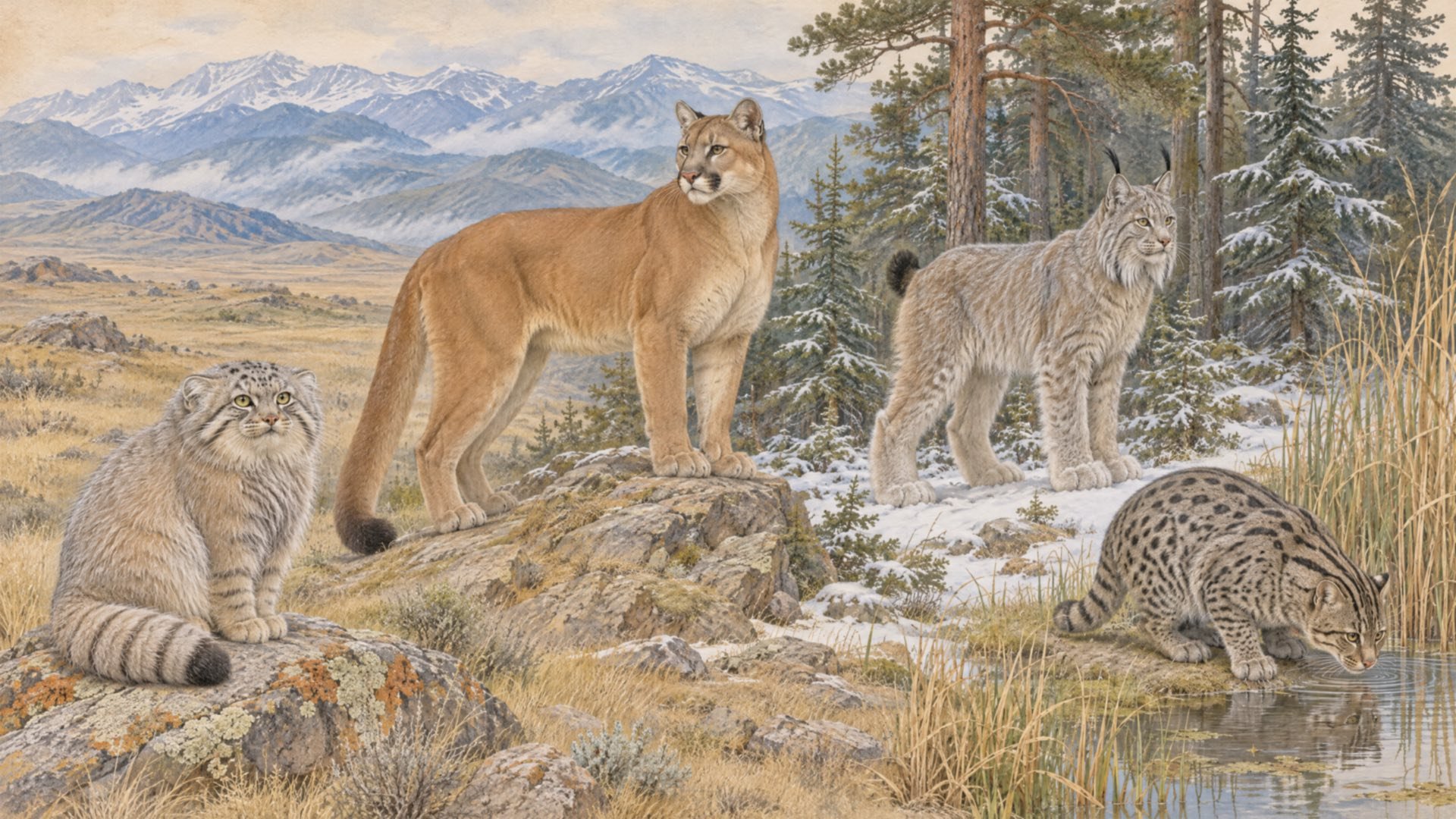
The Pallas's cat, also called the manul, is about the size of a house cat. Its long, thick fur makes it look much bigger. It lives in cold, dry grasslands and rocky hills across Central Asia. Its ears sit low on the sides of its head, which helps it peek over rocks without being seen while it hunts pikas and voles.
Big Cat Rescue connection: Big Cat Rescue funds Otgonbayar's team. In 2026 we gave $14,000 to build five to seven new rock dens for Pallas's cats. When a manul leaves to find a den of its own, it often has to travel a long way across open ground, where predators can spot it. The new dens are built closer to existing dens and to areas rich in rodents. Read more about protecting Pallas's cats.
Learn more: Pallas's Cat Facts
Source: Otgonbayar Baatargal, Facebook videos posted November 9 and 10, 2026.
02 - A SECOND CHANCE
Rescued Mountain Lion Cub F97 Returns to the Wild
Los Padres National Forest, California
In January, biologists with the California Department of Fish and Wildlife went to help an injured mountain lion cub on the side of a highway in Castaic, north of Los Angeles. The young female is known as F97. Veterinarian Dr. Rachel Sachar tried to reunite her with her mother, but the mother could not be found.
F97 went to Sonoma County Wildlife Rescue, where she was cared for with help from Flying Tails Wildlife Rescue. Rehab for an orphaned cub takes months. The goal is a cat that can hunt on her own and stays wary of people. In November, the department announced that F97 had been released into suitable habitat in the Los Padres National Forest, near where she was found.
Cars are one of the biggest dangers to mountain lions in Southern California. F97 was lucky that someone called for help. If you ever find a wild kitten that seems to be alone, do not pick it up. Mothers often leave their young hidden while they hunt. Call your state wildlife agency instead.
Learn more: Cougar Facts
Source: MyNewsLA, "Rescued Castaic Mountain Lion Cub Released Into the Wild," November 13, 2026, citing the California Department of Fish and Wildlife.
03 - IN CASE YOU MISSED IT
Wolf Cameras Catch Two Wild Cat Families in Minnesota
Voyageurs National Park area, northern Minnesota
The University of Minnesota's Voyageurs Wolf Project keeps hundreds of trail cameras in the north woods to study wolves. Lately, those cameras have been catching cats.
In late March, researchers followed the signal from a GPS-collared deer that had died. They found it buried under leaves on a hillside, a sign that a cat had made the kill. They set up two cameras. That evening a mother cougar and three large kittens came back to feed, and the cameras recorded about four hours of the family. The Minnesota Department of Natural Resources said it was the first proof in more than 100 years that cougars are raising young in the state. Most cougars seen in Minnesota are lone animals wandering in from the Dakotas. These kittens were about 7 to 9 months old, so they were born the fall before.
The same project made another first. In September 2025, one of its cameras caught a Canada lynx mother with two kittens. Project lead Thomas Gable said it was the first time lynx kittens had been documented in Voyageurs National Park. The family showed up again over the winter and into spring, so both kittens likely reached their first birthday. Gable has cautioned that this does not mean lynx are becoming common in the park. Canada lynx are listed as threatened in the lower 48 states.
Both stories were first reported earlier this year and were shared widely again in November. They show how much we learn when cameras stay in the woods year after year. Earlier this year we also wrote about cougar cubs in Michigan's Upper Peninsula.
Learn more: Cougar Facts and Canada Lynx Facts
Sources: MPR News, "Cougars in Minnesota: Trail cameras capture evidence of reproducing population in state," April 30, 2026; Outdoor News, "Lynx kits documented in Minnesota's Voyageurs National Park for first time," February 26, 2026; Voyageurs Wolf Project.
04 - SMALL CATS, BIG SURVEY
The Little Cats Hiding in Nepal's Tiger Survey
Parsa National Park, Nepal
When Nepal counts its tigers, the trail cameras catch much more than tigers. In 2022, Nepal's Department of National Parks and Wildlife Conservation and the National Trust for Nature Conservation set cameras across Parsa National Park, southwest of Kathmandu, as part of the National Tiger Survey.
Krita K.C., a zoology graduate student at the University of Wyoming, went back through those photos to look for two small cats: the jungle cat and the leopard cat. She found leopard cats at 99 camera stations and jungle cats at 94. Both were widespread in the park and the forests around it. She presented the work at The Wildlife Society's annual conference.
The two cats share the land in different ways. Jungle cats stayed close to roads, which they likely use to travel and hunt. Leopard cats stuck to thick cover, often in the same places as tigers, and they sometimes scavenge tiger kills. Both hunt mostly rodents at night. Both species are listed as Least Concern worldwide, but leopard cats are considered vulnerable within Nepal. K.C. says cameras set just for small cats would teach us even more. Until then, a tiger count can also help us learn about the small cats that are so easy to overlook.
Big Cat Rescue connection: Big Cat Rescue funds the Fishing Cat Conservation Alliance, whose partners work to protect fishing cats in Nepal's Terai lowlands, the same low-lying region where Parsa National Park sits.
Learn more: Leopard Cat Facts and Jungle Cat Facts
Source: The Wildlife Society, "TWS2026: Tracking small wild cats in Nepalese forests," November 5, 2026.
05 - BEYOND THE WETLANDS
A Fishing Cat Shows Up Away From the Water
Weliweriya, Sri Lanka
Fishing cats are wetland cats. They have partly webbed front feet, and they wade and dive to catch fish. So it got people's attention when FishCat.org shared a wild fishing cat documented at the Amandawa ecolodge in Weliweriya, Sri Lanka, away from the marshes most people picture.
The sighting is a reminder that fishing cats use more kinds of places than we might think. In Sri Lanka they have even been found living around the wetlands of Colombo, the country's largest city. Fishing cats are listed as Vulnerable. Loss of wetlands, traffic on roads, and conflict with fish farmers are among their biggest threats.
Big Cat Rescue connection: Big Cat Rescue funds the Fishing Cat Conservation Alliance, led by Ashan Thudugala. The alliance is a network of 15 partners in eight countries, including Sri Lanka, working to reduce conflict and roadkill and to build local support for fishing cats. Read more about the Fishing Cat Conservation Alliance.
Learn more: Fishing Cat Facts
Source: FishCat.org, Facebook post, November 15, 2026.
06 - A RARE GLIMPSE
A Jaguarundi Dashes Across a Road in Quintana Roo
Lázaro Cárdenas, Quintana Roo, Mexico
Visitors driving through the forest in the municipality of Lázaro Cárdenas, in northern Quintana Roo, got a rare surprise: a jaguarundi. The cat ran across the road and disappeared back into the forest, and the visitors caught it in a short video.
Jaguarundis look a little like an otter or a weasel. They have a long, low body, short legs, a small head, and a long tail. Their coats are one solid color, from reddish brown to dark gray. Unlike most wild cats, they are active mainly during the day, yet they are still very hard to see. In Mexico, the jaguarundi is listed as threatened under federal law. The newspaper that reported the sighting called for more road signs, wildlife crossings, and protected corridors so cats like this one are not hit by cars.
Big Cat Rescue connection: In Quintana Roo, Big Cat Rescue supports Proyecto AAk Mahahual A.C., which uses camera traps, coexistence work with local families, and education to protect wild cats around Mahahual on the Costa Maya. Our grant to the Ocelot Working Group in Mexico and El Salvador also pays for roadkill-prevention signs to protect small wild cats.
Learn more: Jaguarundi Facts
Source: Clic Noticias, "Avistan a un jaguarundi en la selva de Lázaro Cárdenas," November 3, 2026 (in Spanish).
07 - ONE CAT, A WHOLE LANDSCAPE
Protecting Java's Last Big Cat Could Protect a Whole Park
Baluran National Park, East Java, Indonesia
The Javan leopard is the last big cat left on the island of Java, since the Javan tiger disappeared. A new study in the journal Perspectives in Ecology and Conservation asked a practical question: if a park can only focus on a few animals, which ones would protect the most wildlife?
Researchers set camera traps on a grid across Baluran National Park in East Java. They recorded 13 kinds of ground-dwelling mammals and scored nine of the larger ones on seven measures, from how much land each animal needs to how easy it is to monitor. Two came out on top: the banteng, a wild cattle species, and the Javan leopard. Scientists call animals like these "umbrella species." When a park protects them, along with the savanna, water holes, and prey they need, many other animals are protected too.
Baluran faces real pressure from an invasive acacia tree, free-roaming livestock, and poaching. The park's long-term plan already aims to grow both banteng and Javan leopard numbers by 2033. The Javan leopard is listed as Endangered.
Big Cat Rescue connection: Elsewhere in Indonesia, on the island of Borneo, Big Cat Rescue funds Borneo Nature Foundation Indonesia's volunteer firefighting teams. They protect forests that are home to five wild cat species, including the bay cat and the Sunda clouded leopard.
Learn more: Leopard Facts
08 - GHOST OF THE MOUNTAINS
Snow Leopards of Manang
Manang, Nepal
Wildlife photographer Tashi R. Ghale spent November with snow leopards in the Manang area of Nepal's Annapurna region. On November 6 he followed fresh prints, then watched a wild snow leopard rest along a ridgeline for more than an hour. He counted it as his 65th snow leopard sighting. He also shared a rare encounter with a snow leopard in a juniper forest and a snow leopard on the cliffs of the Upper Manang Valley.
Snow leopards are built for steep, rocky ground. Their long, thick tails help them balance and keep warm. Their smoky gray coats blend into rock and snow, which is why people call them the ghost of the mountains. Snow leopards are listed as Vulnerable.
Learn more: Snow Leopard Facts
Source: Tashi R. Ghale, Facebook posts, November 9, 14 and 17, 2026.
09 - CLOSE TO HOME
Texas Trail Cams: Mountain Lions, Bobcats, and the Jaguarundi That Wasn't
Texas
Texas trail cameras were busy in November. Landowners shared mountain lions passing deer feeders, one that seemed to be hunting wild pigs, and one photographed near Newcastle in Young County. One man said a lion walked about five yards in front of him before showing up on his trail camera. Another family filmed a mother bobcat with her young, then a big male bobcat a week later. Others shared photos of cats near Big Bend and Fort Stockton and asked for help identifying them.
One photo in a Texas wildlife group was jokingly labeled a "central Texas spotted jaguarundi." It was a bobcat. That joke points to a real problem. People in Texas report jaguarundis often, but the last confirmed jaguarundi in the United States was found killed on a road near Brownsville in 1986. Experts now consider the species likely gone from the U.S. Jaguarundis have solid-colored coats with no spots, long tails, and short legs. Bobcats have spots, short "bobbed" tails, and tufts on their ears.
If you have a trail camera, you can help. Share clear photos and videos with your state wildlife agency. Good records help biologists learn where wild cats really live. Here is how your backyard trail cam can help a bobcat family. You can also read about the last ocelots of Texas.
Learn more: Cougar Facts, Bobcat Facts, and Jaguarundi Facts
Sources: Trail-camera posts shared on Facebook by Texas landowners, November 13 to 16, 2026; The Mammals of Texas, Texas Tech University, jaguarundi account.
HOW YOU HELP
Big Cat Rescue funds field partners around the world who protect wild cats where they live. They build dens, run trail cameras, spay and vaccinate pets to keep diseases away from wild cats, and work with farmers so cats and people can live side by side. See the conservation projects your support made possible in 2026.
