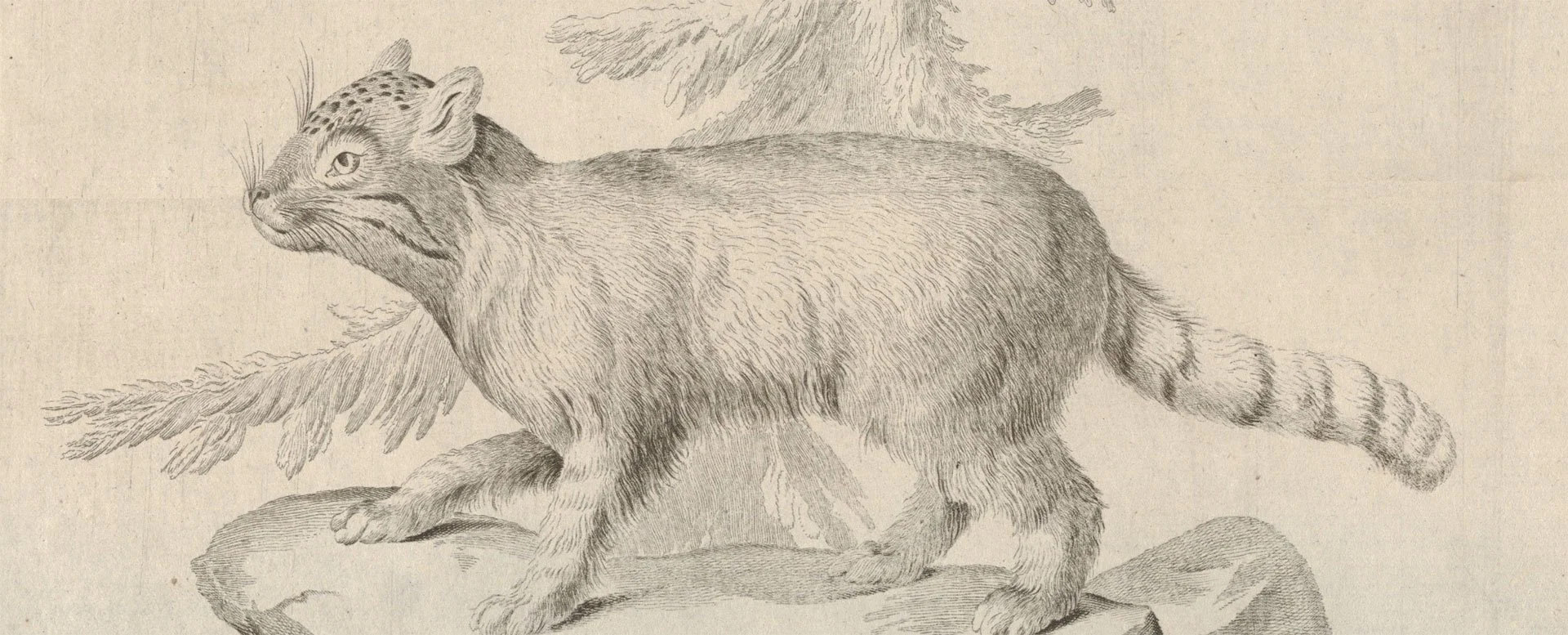
Clouded Leopard
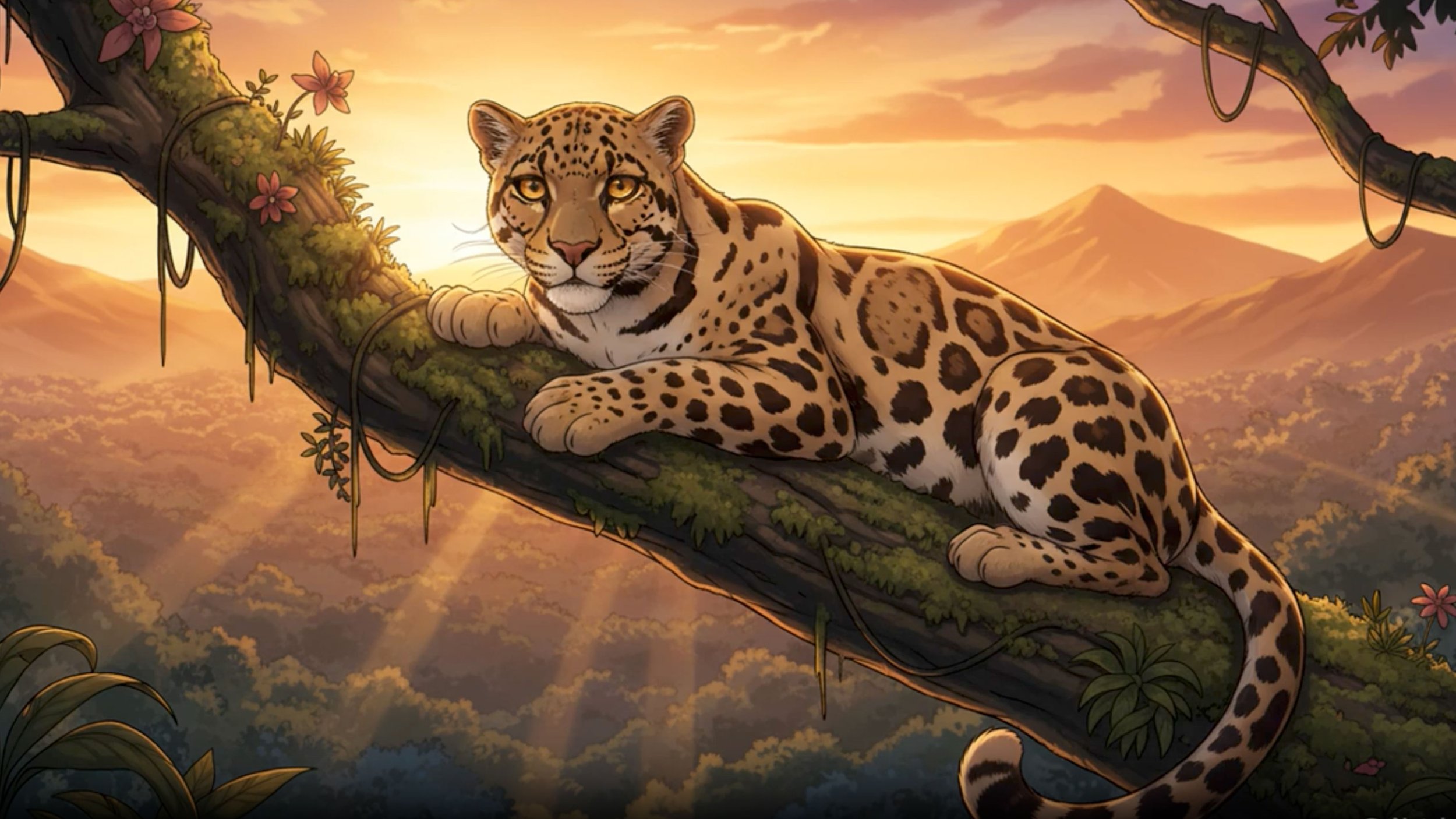
The Clouded Leopard is one of nature’s most enigmatic and beautiful wild cats. Often referred to as the "Ghost of the Canopy," this feline is famous for its striking pelt and remarkable acrobatic skills. Science now recognizes two distinct species: the Mainland Clouded Leopard (Neofelis nebulosa), found throughout Southeast Asia, and the Sunda Clouded Leopard (Neofelis diardi), which is native to the islands of Sumatra and Borneo.
Quick Facts
Common Name: Clouded Leopard (a.k.a. Mint Leopard, Tree Tiger)
Kingdom: Animalia
Phylum: Chordata (Vertebrata)
Class: Mammalia
Order: Carnivora
Family: Felidae
Scientific Name:Neofelis nebulosa (Mainland) and Neofelis diardi (Sunda)
Conservation Status: Vulnerable (IUCN Red List)
Total Wild Population: Estimated between 8,200 and 10,000 mature individuals across both species
Weight: 25 to 40 pounds (11 to 18 kg)
Lifespan: Average of 11 years in the wild; up to 17 years in captivity
Unique Feature: They possess the longest upper canine teeth relative to their skull size of any living feline.
Appearance
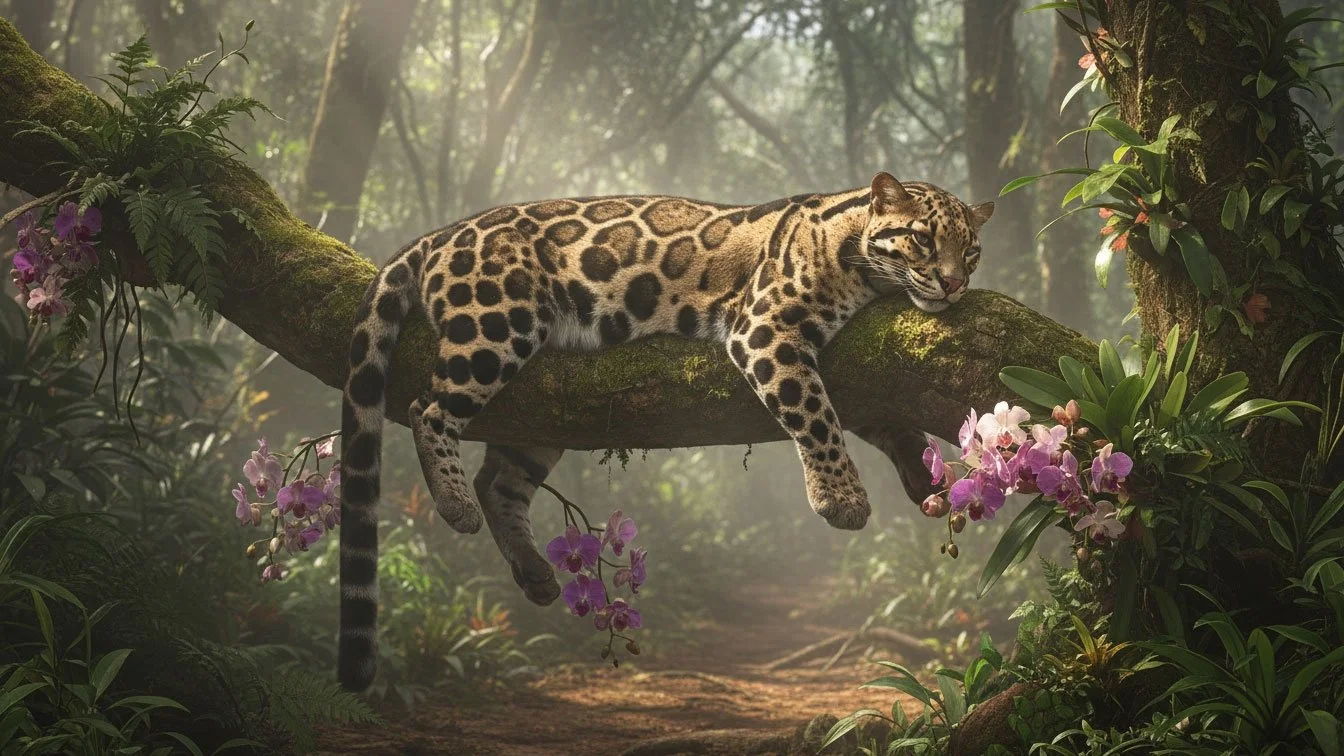
The Clouded Leopard is named for the large, cloud-like elliptical markings that cover its body. These patches have dark edges and lighter centers, providing perfect camouflage in the dappled light of the forest canopy. Their base coat varies from tawny to silver-gray.
Structurally, these cats are built for life in the trees. They have short, powerful legs—with the hind legs longer than the front—and large, broad paws for a secure grip on branches. Their thick tail, which can be as long as their body, acts as a critical balancing tool. Most notably, their massive canine teeth and wide gape have led some to compare them to modern-day "saber-toothed" cats.
See a playlist of this species at https://bigcatrescue.org/videos
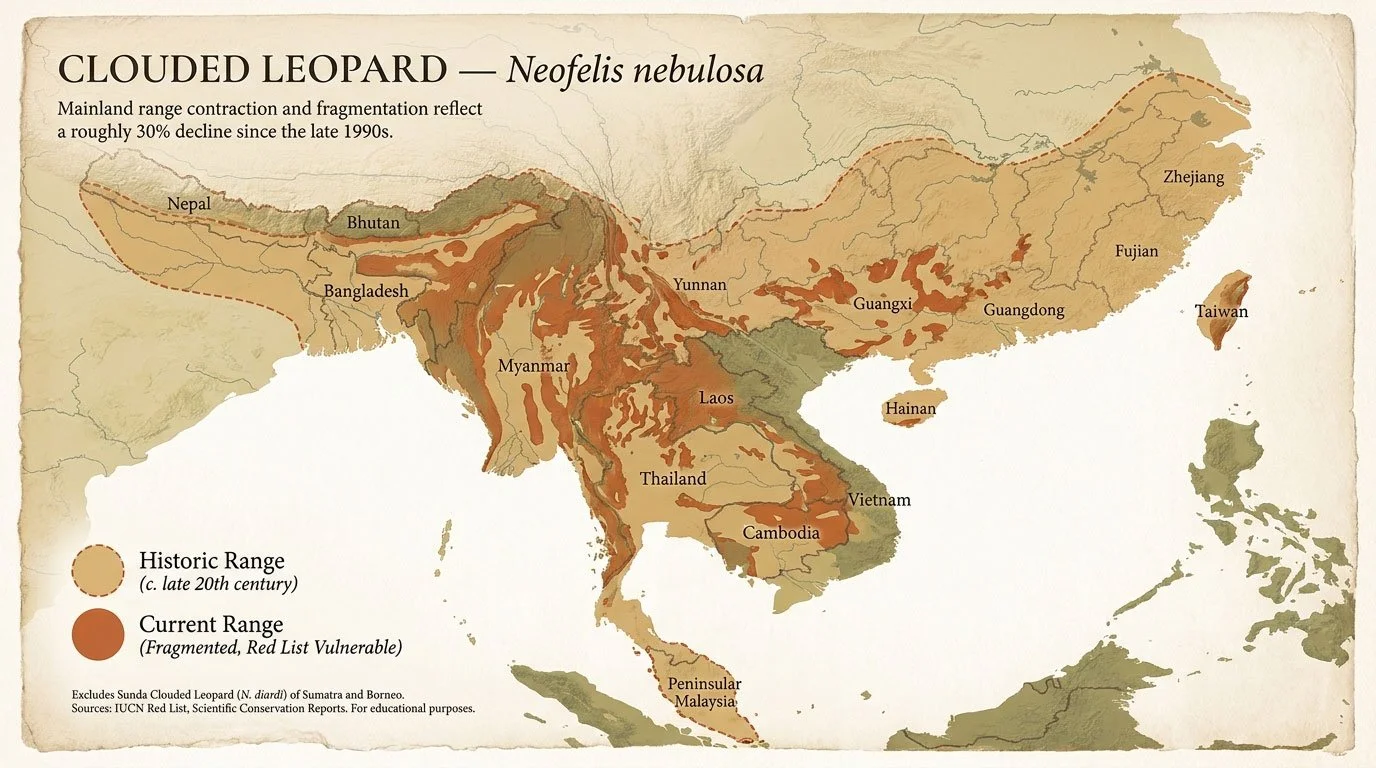
Clouded-Leopard-Range-Map
Habitat and Range
Clouded Leopards are forest-dependent species, primarily inhabiting evergreen tropical rainforests, though they are adaptable enough to reside in secondary forests, mangroves, and scrublands.
Mainland Clouded Leopard (Neofelis nebulosa): This species range extends from the Himalayan foothills of Nepal and Bhutan through India, Myanmar, Thailand, Peninsular Malaysia, Cambodia, and China. They have been recorded at high altitudes of up to 3,500 meters in the Himalayas. They are considered extinct in Taiwan.
Sunda Clouded Leopard (Neofelis diardi): Restricted to the islands of Borneo and Sumatra, and possibly the Batu Islands. They are extinct on the island of Java.
Diet and Behavior
Clouded Leopards are among the most talented climbers in the cat family. They are capable of running down tree trunks head-first, hanging by their hind legs, and even moving horizontally along branches with their backs to the ground. While they use trees for resting and traveling, they are equally effective hunters on the forest floor.
Their diet is diverse and includes primates (such as proboscis monkeys and loris), deer, wild boars, porcupines, birds, and small mammals. They are primarily nocturnal and crepuscular, meaning they are most active under the cover of night or during the low light of dawn and dusk.
Reproduction
Relatively little is known about their breeding habits in the wild. In captivity, females have a gestation period of approximately 93 days, typically giving birth to a litter of one to five cubs. Breeding these cats in a captive environment is notoriously difficult, as males can be aggressive toward females during mating. Conservationists are focused on research to improve husbandry and protect the genetic diversity of the species.
Threats
Both species face a precarious future due to human activity. The primary threats include:
Habitat Loss: Massive deforestation driven by the expansion of industrial oil palm plantations and commercial logging is shrinking their available home ranges and fragmenting populations.
Poaching and Illegal Trade: They are hunted for their beautiful skins, as well as their bones, which are often used in traditional medicines. In some regions, they are also captured for the illegal pet trade.
Incidental Snaring: Even when they are not the intended target, Clouded Leopards often fall victim to snares set for other animals like wild boars or deer.
Human-Wildlife Conflict: Retaliatory killings occur when cats prey on livestock, such as goats and poultry, belonging to local communities.
Question: Can I keep a clouded leopard as a pet?
Conservation Efforts
Conservation strategies focus on establishing wildlife corridors to reconnect fragmented habitats and implementing "Zero Poaching" protocols in protected areas.
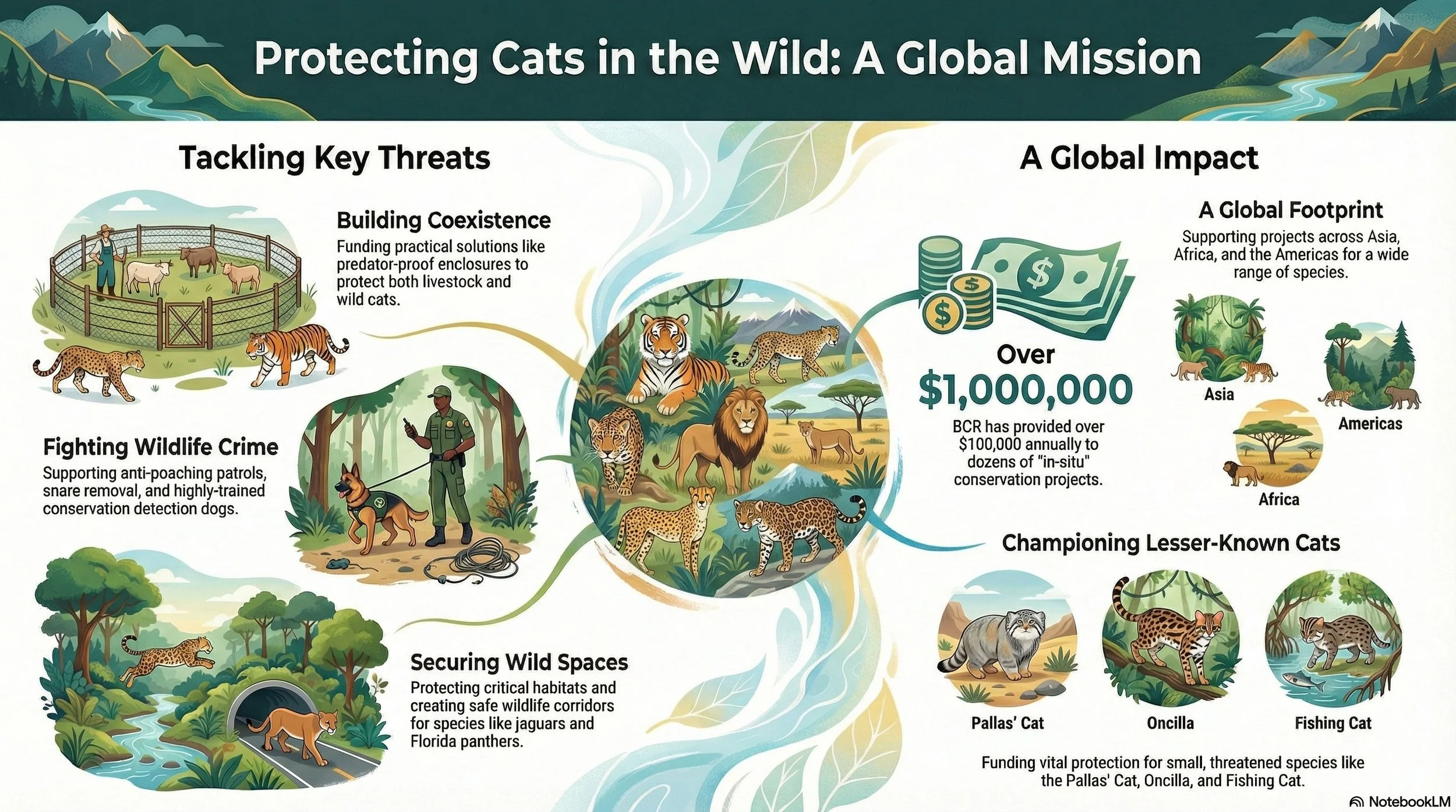
Big Cat Rescue has been deeply involved in supporting in situ conservation projects to protect Clouded Leopards across their range. Funding has been provided for numerous initiatives in Nepal and India, including:
Threat Mitigation in Nepal: Supporting the construction of predator-proof goat corrals and chicken houses to prevent retaliatory killings by farmers.
Community Engagement: Funding alternative livelihood programs such as beekeeping, medicinal plant farming, and greenhouse vegetable cultivation to reduce the local community's reliance on forest resources.
Education and Awareness: Developing school programs and conservation clubs for children to foster a culture of coexistence, as well as sensitizing tourists and forest visitors to the importance of the species.
Habitat Protection: Funding forest fire control tools and fire line construction to protect vital habitat in high-risk regions.
Monitoring: Providing camera traps and training for local "citizen scientists" and forest department staff to better track population trends and movement.
By addressing the root causes of poaching and habitat loss through community-led solutions, these efforts aim to secure a future for these "ghosts" of the Asian forests.
Analogy for Understanding: Think of the Clouded Leopard as the elite gymnast of the animal kingdom. Just as a gymnast uses a balance beam and specialized grip to perform gravity-defying feats, this cat uses its massive tail and flexible paws to navigate a high-altitude "tightrope" of branches, making it a master of an environment where most other predators would fall.
See Conservation Work Funded By Big Cat Rescue here:
2023 Saving Clouded Leopards from Fire & Human Conflicts
This project initiates Clouded leopard conservation in the adjacent forests of Kathmandu valley. Goals are: 1. To sensitize at least 5000 vistors/tourists of national park and surrounding forests on the importance of clouded leopard and its habitat through hoarding boards (billboards) and pamphlets. 2. Conduct conservation coaching classes in the schools, local organizations, community forest user groups and army personnel on the threat mitigation strategies of clouded leopard. 3. Establish forest fire control mechanism (awareness, forest fire control tools distribution and fire line construction) in the forested habitat of clouded leopard.
2023 Saving Clouded Leopards in Nepal – Ganga Ram Regmi
This multi-faceted project focuses on reducing threats to clouded leopards of retaliatory killings and poaching in Nepal. Part of the program focuses on educating school children to appreciate the majesty and importance of preserving the cats. This has the double impact of creating a supportive future generation while at the same time bringing this message home to their parents. A second part of the program involves funding the construction of predator proof corrals to prevent predation of the goats that local farmers depend on. Preventing predation removes the incentive for retaliatory killing of the cats. The third part of the program involves funding alternative sources of income in return for local support for preserving the cats. These include bee keeping, medicinal plant farming, and year round growing of organic vegetables in greenhouses both for consumption and to sell for income.
All conservation insitu work: https://bigcatrescue.org/insitu/