Iberian Lynx Facts

Iberian lynx
Iberian Lynx: A Masterpiece of Mediterranean Recovery
The Iberian lynx is one of the world’s most iconic success stories in modern conservation. Once teetering on the absolute brink of extinction, this elusive feline has become a symbol of hope and resilience. Through intensive international cooperation and dedicated reintroduction efforts, the Iberian lynx is reclaiming its ancestral home across the Iberian Peninsula.
Quick Facts
Scientific Name:Lynx pardinus
Conservation Status: Vulnerable (IUCN 2024)
Current Population: Approximately 1,668 individuals (648 mature adults)
Population Trend: Increasing
Common Names: Iberian Lynx, Spanish Lynx
Appearance
The Iberian lynx is a medium-sized cat with a striking, heavily spotted coat that ranges from yellowish to rusty-gray. While it shares the iconic flared facial ruff and long, black-tipped ear tufts of its relative, the Eurasian lynx, it is significantly smaller—roughly half the size of its northern cousin. Adult males typically weigh an average of 27.5 pounds, while females average around 20 pounds.
This lynx is built for the Mediterranean scrub, possessing long hind legs and a short, black-tipped tail that appears as though it were dipped in an inkwell. Its large paws are covered in fur, providing support even in rare snowy conditions. Unlike the similar-looking Bobcat, whose tail is white on the bottom, the Iberian lynx’s tail tip is black all the way around.
See a playlist of this species at https://bigcatrescue.org/videos
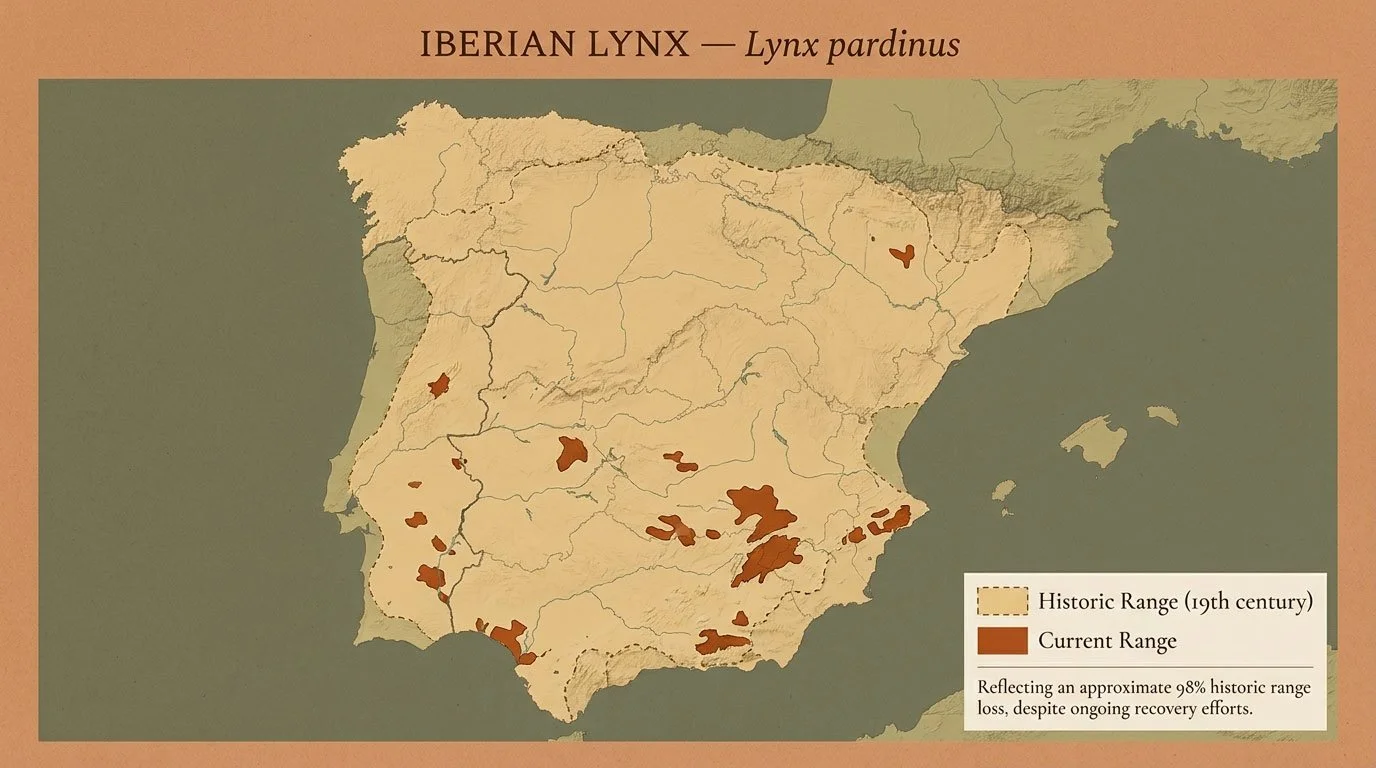
Iberian-Lynx-Range-Map
Habitat and Range
Endemic to the southern Iberian Peninsula, this species is found exclusively in Spain and Portugal. Following decades of range contraction, the lynx is now expanding through natural colonization and strategic reintroductions. Its current range is organized into five primary subpopulations: Sierra Morena, Doñana, Toledo Mountains, Vale do Guadiana (the primary Portuguese population), and Matachel.
These cats are specialized for life in Mediterranean forests and scrublands. They thrive in "dehesa" or "montado" habitats—rangelands with scattered oaks and a sparse understory—as well as agricultural mosaics that provide patches of dense woody vegetation for cover and open areas for hunting.
Diet and Behavior
The Iberian lynx is a trophic specialist, meaning its survival is intrinsically linked to a single prey species: the European rabbit (Oryctolagus cuniculus). For a female to successfully breed, a high density of rabbits is required—typically around one rabbit per day to meet energy needs. While they may occasionally hunt deer, ducks, or fish when rabbit populations dip, they remain highly dependent on stable rabbit numbers.
In terms of social behavior, these lynxes are solitary and territorial. They are primarily nocturnal, though they exhibit more daytime activity during the winter months. They are masters of the "stalk-and-pounce" hunting method, relying on thick vegetation for concealment before striking.
Reproduction
Reproduction is closely tied to the availability of territory and food. A female usually will not reproduce until she has secured her own territory, which can happen as early as her first winter or as late as age five. Following a gestation period of approximately 60 days, she will give birth to a litter of two to three kittens.
While the young reach independence between 7 and 10 months of age, they often remain within their mother’s territory until they are about 20 months old. This extended period helps them hone the specialized hunting skills necessary to survive in the wild.
Threats
Despite its recent recovery, the Iberian lynx faces several ongoing challenges:
Prey Instability: The greatest threat remains the potential collapse of rabbit populations due to diseases like myxomatosis and Rabbit Hemorrhagic Disease (RHD).
Habitat Loss: Large-scale wildfires, agricultural intensification, and the effects of climate change continue to threaten the quality and connectivity of their habitat.
Human Impact: Vehicle strikes remain a significant cause of non-natural mortality as roads bisect lynx territories. Illegal poaching and drowning in irrigation wells are also persistent concerns.
Genetic Diversity: Because the population reached such a low point in the early 2000s, the species suffers from low genetic diversity, which can impact reproductive health and disease resistance.
Question: Can I keep an Iberian lynx as a pet?
Conservation Efforts
The recovery of the Iberian lynx is nothing short of miraculous. In 2004, fewer than 85 individuals remained in the wild, leading it to be the first wild cat listed as Critically Endangered. However, aggressive conservation actions—including captive breeding, rabbit population enhancement, and the creation of "stepping stones" to connect isolated groups—have seen the species down-listed to Endangered in 2015 and further improved to Vulnerable in 2024.
Big Cat Rescue has been a proud supporter of these efforts, providing conservation funding to the IUCN/SSC Cat Specialist Group. This funding supports the critical work of expert biologists and researchers who monitor wild populations and implement the reintroduction strategies that have made this recovery possible. Today, with a population that has grown exponentially over the last two decades, the Iberian lynx stands as a testament to what can be achieved when the world decides a species is too beautiful to lose.

Recovery of the Iberian lynx from the edge of extinction
by Dr. Jim Sanderson (written when there were only 85 remaining Iberian Lynx)
In 1952, Professor P. F. Armand-Delille, a retired bacteriologist and member of the French Academy of Medicine, deliberately infected two European hares with Myxoma virus (the virus that causes myxomatosis in lagomorphs—hares and rabbits) and released them on his “enclosed” private estate in northern France. His eradication program was successful and within six weeks 98% of the hares on his estate were dead. Disastrously and presumably unexpectedly, at least one infected hare escaped the professor’s estate.
Within a year, nearly half of France’s wild hares were dead and the virus had spread across Western Europe and invaded the Iberian Peninsula. Hare populations were decimated. In the hunting season of 1952-53 more than 55 million hares were taken. A few years later in the 1956-57 hunting season just 1.3 million hares were harvested. As prey populations plunged, predator populations also declined.
Hunting hares and the occasional Iberian lynx is a way of life in rural Portugal and Spain and old ways die hard. While hare and Iberian lynx populations spiraled downward, hunting and trapping continued. Iberian lynx, fox, genet, and hares were also caught in traps. Vehicles also contributed to the death toll.
Biologists studying the Iberian lynx closely were acutely aware of the plight of the Iberian lynx but were slow to appreciate the gravity of the situation. By 1998, there were an estimated 500-600 Iberian lynx in Spain and still the alarm bells remained silent. None had been seen in Portugal since about 1990. One must wonder just how low the Iberian lynx population would have had to have fallen before biologists studying the Iberian lynx proclaimed a crisis. No captive breeding programs were producing offspring. No serious effort to reintroduce virus-safe hares was proposed. The population of hares and Iberian lynx continued to decline and by 2004 fewer than 85 Iberian lynx remained. Finally, conservation efforts were mobilized but responsibility and leadership were lacking. Captive breeding programs could not put a male and female Iberian lynx in the same enclosure. Fortunately, by 2008 the captive breeding program produced several offspring.
Under European Union and world pressure to reverse the population crash of the Iberian lynx, conservation efforts in Spain were fully mobilized. The European Union committed EU50,000,000 over 10 years to the Iberian lynx recovery program. Meanwhile, precious former habitat of the Iberian lynx is continuing to disappear and what is left is bisected by multi-lane roads. Perhaps the crisis has passed its nadir. Only with hindsight will we be certain. One lesson is transparent however: captive breeding programs must start well before a crisis begins.
In 2004, the Iberian lynx was the most threatened wild cat in the world. Because present conservation efforts are strongly supported by the European Union, the Iberian lynx is one of the best studied wild cats in the world. The Iberian lynx occurs in areas inhabited by humans where in the past lynx sport hunting was a favored pastime, education programs are an important aspect of aggressive conservation actions that also include captive breeding of Iberian lynx, prey population enhancement, and detailed studies of wild Iberian lynx.
In 2008, the first captive-born Iberian lynx gave birth. Moreover, captive births included births from parents from different Iberian lynx populations in Spain. Captive born individuals were used to start other captive breeding centers. Iberian lynx individuals were then reintroduced into the wild. As of late 2018 there were four captive breeding centers in Spain and one in Portugal. In 2019, captive breeding programs had 85 individual Iberian lynx.
Experience with other reintroduction programs showed that Iberian lynx reintroductions in Spain and Portugal required a determined, sustained, long-term effort that needed many captive-born individuals. Reintroduction programs also require enhancing environmental education in local communities and working with popular hunting organizations to replace rifles with cameras. Without the support of local people, Iberian lynx populations will never recover.
Efforts to re-establish the Iberian lynx in Portugal will be slowed but not compromised by construction of the Odelouca dam in what was once prime Iberian lynx habitat. Following intense negotiations with the EU, the company constructing the dam was encouraged to support Iberian lynx conservation efforts. Aggressive conservation efforts along a broad front are already underway in Portugal.
The European Union remained determined to increase the population of wild Iberian lynx in Spain and to re-establish wild populations in Portugal. The Iberian lynx was the first wild cat to be listed as Critically Endangered. In 2018, the Iberian lynx was downlisted to Endangered. If all goes according to plan, in 2025 the Iberian lynx will be downlisted to Vulnerable. Only then will the results of long-term conservation actions taking place now be fully appreciated.
See Conservation Work Funded By Big Cat Rescue here:
All conservation insitu work: https://bigcatrescue.org/insitu/
