Southern Tiger Cat Facts
Southern Tiger Cat (Leopardus guttulus)

Tiger Cat by TCCI
Formerly considered a subspecies of the Northern Tiger Cat, the Southern Tiger Cat (Leopardus guttulus) is now recognized as a distinct and unique species. This small, elusive feline is a master of the dense subtropical forests and savannahs of South America. Known for its striking spotted coat and remarkable adaptability, it remains one of the most intriguing yet threatened small cats in the Neotropics.
Quick Facts
Scientific Name:Leopardus guttulus
Common Names: Southern Tiger Cat, Southern Tigrina, Southern Little Spotted Cat
Conservation Status: Vulnerable
World Population: Approximately 6,047 mature individuals
Weight: 2 – 2.4 kg (4 – 5 lbs)
Lifespan: 15 – 21 years
Gestation: 75 – 78 days
Appearance
The Southern Tiger Cat is a masterpiece of natural camouflage. While often compared to a miniature leopard, its build is more delicate, with a weight and size similar to a domestic cat. Its fur features a yellowish-ochre background adorned with open rosettes and solid black spots that help it vanish into the dappled light of the forest floor. Its tail is proportionately long and ringed with black, serving as a balance tool during agile movements.
One of its most distinctive physical traits is its expressive face, marked by large eyes and a vocal complexity that is unusual among felids. Researchers have noted a diverse repertoire of sounds, including chirps and purrs, which are used to communicate social states and territorial boundaries.
See a playlist of this species at https://bigcatrescue.org/videos
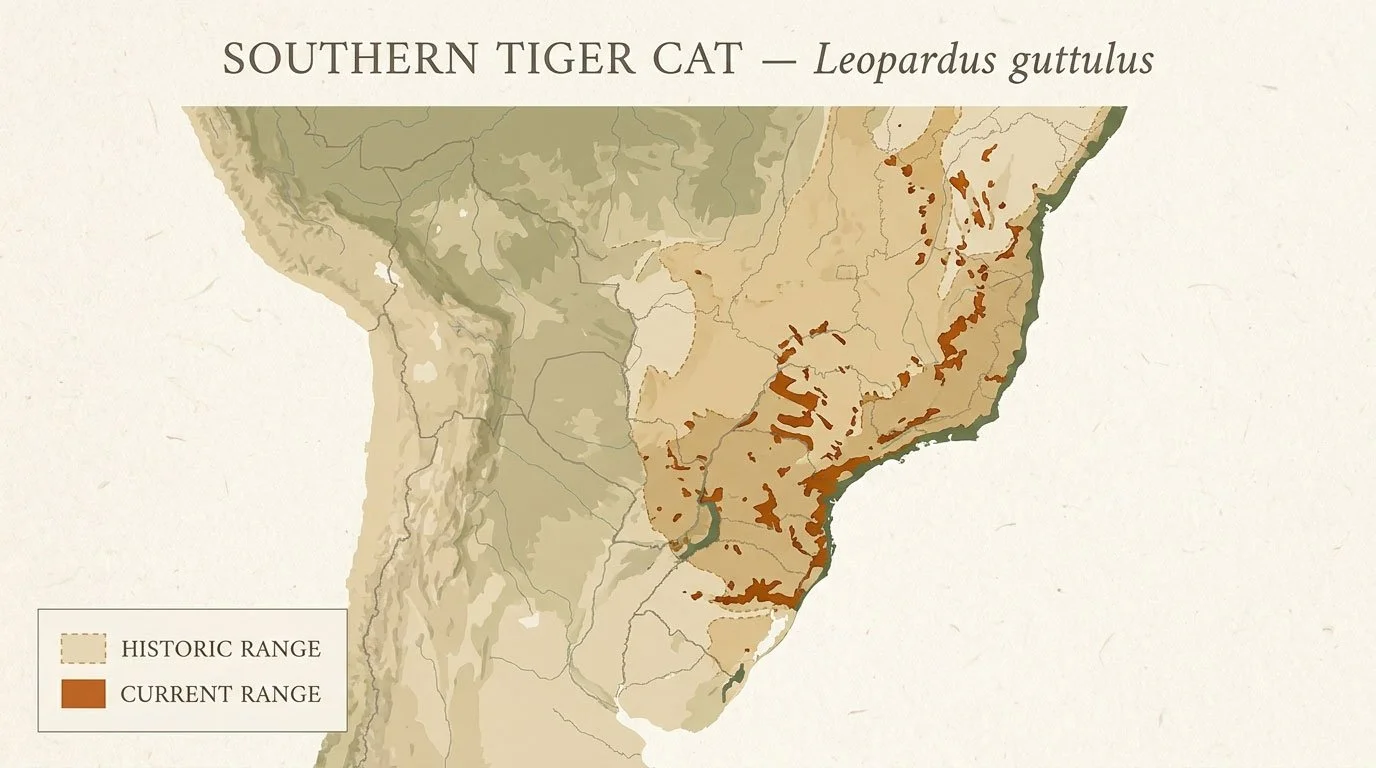
SouthernTigerCat-Range-Map
Habitat and Range
The geographic range of the Southern Tiger Cat is concentrated in Central and Southern Brazil, Eastern Paraguay, and Northeastern Argentina (specifically the provinces of Misiones and Corrientes). Unlike its northern relative, this species is largely absent from the Paraguayan Chaco and the deep Amazon basin.
It thrives in a variety of environments, including:
Atlantic Forests: Highly fragmented but critical subtropical rainforests.
Cerrado and Caatinga: Open savannahs and semi-arid shrublands.
Mixed Pine Forests: Often found in areas where ocelots are less prevalent.
Diet and Behavior
As a solitary and primarily nocturno-crepuscular (active at dawn, dusk, and night) hunter, the Southern Tiger Cat is an expert at taking down prey that is often larger than itself. Its diet consists mainly of:
Small mammals (weighing less than 100g)
Birds and reptiles (especially lizards)
Occasionally larger prey exceeding 1kg
Intriguingly, this cat often adjusts its activity patterns based on the presence of competitors. In areas with high ocelot populations—a phenomenon known as the "Ocelot Effect"—the Southern Tiger Cat may become more diurnal to avoid dangerous encounters with its larger cousin.
Reproduction
These cats are solitary by nature, coming together only for mating. Following a gestation period of roughly 75 to 78 days, females typically give birth to one or two kittens, though litters of up to three have been recorded. The kittens are altricial, meaning they are born in a highly dependent state and require significant maternal care before they can venture out as independent hunters.
Threats
The Southern Tiger Cat faces a daunting array of challenges that have led to a steady population decline:
Habitat Fragmentation: The rapid conversion of the Atlantic Forest and Cerrado for agriculture and ranching is its greatest threat, leaving populations isolated in small "islands" of habitat.
The Ocelot Effect: In protected areas where ocelots thrive, Southern Tiger Cat numbers often plummet due to intense competition and interspecific killing.
Hybridization: Significant genetic "blurring" occurs at the edges of its range, where the species frequently hybridizes with Geoffroy’s cat (Leopardus geoffroyi).
Human Conflict: Retaliatory killings for poultry depredation, roadkill on expanding highway networks, and diseases spread by domestic dogs continue to thin their numbers.
Question: Can I keep a southern tiger cat as a pet?
Conservation Efforts
The Southern Tiger Cat is protected under CITES Appendix I, which strictly regulates international trade. Hunting is legally prohibited in its native countries of Argentina, Brazil, and Paraguay. Because the majority of this species lives outside of formal protected areas, conservationists are increasingly focused on working with private landowners to maintain forest corridors.
Big Cat Rescue has played an active role in the survival of this species by providing vital conservation funding. Their support has historically aided field research, helped fund the development of local protection strategies, and raised global awareness about the plight of these "forgotten" small cats.