Andean Cat Facts
The Andean Cat (Leopardus jacobita)
The Andean cat is one of the rarest and most beautiful felines in the world. Often called the "ghost of the Andes," this small but sturdy predator is a master of survival in the high-altitude, rocky terrains of South America. While it was once considered a mystery to science with only a handful of sightings, two decades of research by the Andean Cat Alliance (AGA) have brought this elusive species into focus.
Quick Facts

Andean Cat photo by Dr. Jim Sanderson
Scientific Name:Leopardus jacobita.
Kingdom: Animalia
Phylum: Chordata
Class: Mammalia
Order: Carnivora
Family: Felidae
Status:Endangered (IUCN Red List).
Population: Approximately 2,177 mature individuals and decreasing.
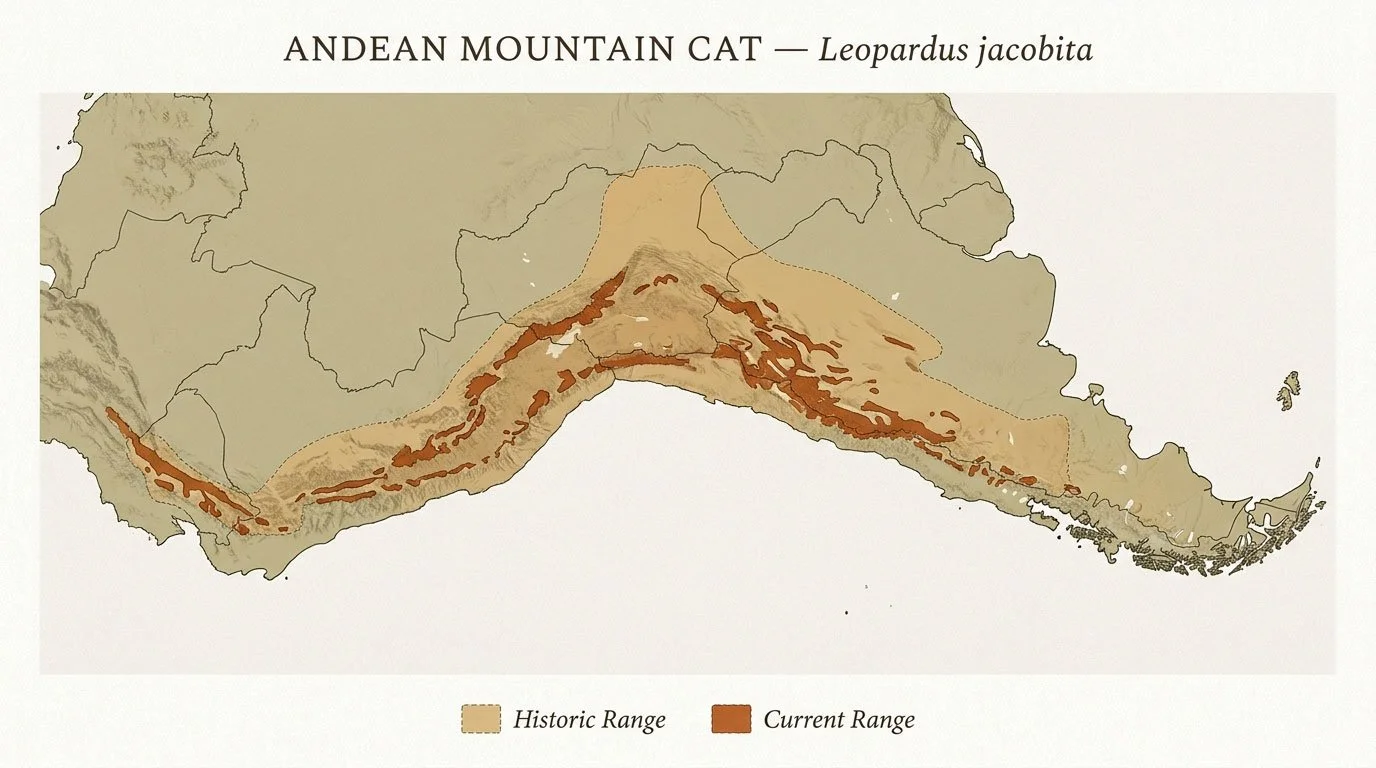
Range: Andes Mountains and foothills of Argentina, Bolivia, Chile, and Peru.
Appearance and Physical Traits
The Andean cat is a small, sturdy feline with long, soft, silvery-gray fur. Its body is marked with irregular brown or orange stripes running down its sides, while dark gray bars wrap across its chest and forelegs.
Its most striking feature is its extraordinarily long, thick tail, which is banded with dark rings. Scientists believe this tail is essential for balance, acting like a rudder to help the cat make sharp turns while chasing agile prey across steep, rocky cliffs.
See a playlist of this species at https://bigcatrescue.org/videos
Andean-Cat-Range-Map
Habitat and Geographic Range
The Andean cat has a patchy, fragmented distribution across its four range countries. While primarily found in rocky, arid zones above the timberline (usually over 3,600 meters), recent research shows they can adapt to lower elevations.
• Highest Record: 5,180 meters.
• Lowest Record: 650 meters in the Patagonian steppe of Argentina and 1,150 meters in central Chile.
They are most often found in steep, rocky environments near water sources like high-Andean peatlands (known as bofedales or vegas), which attract their primary food sources.
Diet and Behavior
These cats are specialists, occupying a very narrow ecological niche.
• Diet: Their most important prey is the Mountain Viscacha, a rodent that provides the bulk of their nutrition. They also hunt small rodents like Phyllotis species and have even been observed hunting the invasive European Hare.
• Activity: While they are primarily active at dusk and night, they are more active during the day than other predators in their region.
• Temperament: Interestingly, some individuals have shown little fear of humans, allowing researchers to follow and observe them for several hours at a time.
Reproduction
Our knowledge of Andean cat reproduction has grown significantly.
• Season: Evidence from camera traps suggests a birth season between January and March, though some records extend into July.
• Litter Size: Data indicates they typically deliver only one kitten per litter.
• Courtship: Mating calls and vocalizations have been recorded in October and January.
Principal Threats
The Andean cat faces a steep climb to survival due to several human-related pressures:
1. Mining and Industry: Large-scale mining for lithium (in the "lithium triangle"), gold, and other minerals, as well as shale oil/gas extraction (fracking), destroys habitat and consumes precious water sources.
2. Direct Mortality: Cats are frequently killed in retaliation for perceived livestock loss, and they face increasing threats from domestic dog attacks and roadkill on expanding industrial road networks.
3. Climate Change: Rising temperatures are shifting their habitat to higher altitudes, effectively shrinking the total area available for the species.
4. Population Fragmentation: No single subpopulation is estimated to have more than 250 mature individuals, making them highly vulnerable.
Conservation Efforts
Since 1999, the Andean Cat Alliance (AGA) has led the charge to protect this species through cross-border cooperation. Key initiatives include:
• Conflict Mitigation: Providing non-invasive tools to herders to reduce carnivore conflicts.
• CATcrafts: Supporting local women in creating alternative income sources through art, reducing the need for extractive land use.
• Community Education: Training "Andean Cat Guardians" and working with local schools to foster pride in this native feline.
To understand the Andean cat’s survival is to look at a complex puzzle: while the cat itself is highly resilient to the harsh mountain elements, it relies on a very specific set of environmental "pieces"—like the viscacha and high-altitude water—that are currently being pulled away by modern industrial growth.
Question: Can I keep an Andean Cat as a pet?
See Conservation Work Funded By Big Cat Rescue here:
2023 Saving Andean Cats
It has been a busy year full of field work in the Andes Mountains for the Andean Cat Alliance that is partially funded by Big Cat Rescue. Check out this report dated 6/2/2023:
I would like to inform you about the activities that I have generated with my group in local schools and communities. I will try to be short, but I think some of the stories will be interesting for you and your team.
During the first half of the year we completed our awareness activities related to art for conservation. We completed the first mural related to Pampas cat in a local school in the region (Coquimbo) and the country (Chile). We are proud to tell you that we worked for 1 week with local children to develop wild cats conservation awareness. The Pampas cat is locally called Colo-Colo, and it’s also the name of the most famous soccer team in the country. Unfortunately, the awareness related to the cat is poorly understood. Thus, this is our mission along the country.
At the same time, in another region of Chile (Santiago) we created the local group called "Guardianes del Gato Andino" (Andean Cat Guardians) in order to train local wild cat's enthusiasts with ecology and detection techniques for wild cats. This training has the goal to teach our volunteers to be local guides and monitors to value their heritage against any project that could destroy wildcat's habitat (e.g., urbanization and investment projects), and to start tourism activities around Andean wild cats. This training has the final goal to create a diploma that will be recognized by one of the most important universities in the country (Universidad de Santiago). We have a member (Darío Moreira, PhD in Ecology) who is a professor at this university.
In addition, we finished one of the best Andean cat murals in our history of art for conservation (pictures attached). We signed a deal with the principal local administration in the most human populated Andean cat habitat in Chile (Municipalidad de San José de Maipo, in the capital region). We performed this activity with local women and their children.
We will continue our conservation activities in these two regions, and we need to expand to another region, because of urbanization and mining pressure in Andean cat habitats.
Please see the attached video from yesterday that shows a young Andean cat looking for water in a local Andean school and with an interesting human habituation behavior.
Rodrigo Villalobos | Seeking Andean Wild Cats
The Wildlife Conservation Network is an organization that shares our belief that the money should go to the animals and not be wasted on salaries and benefits for those who are doing the fundraising. If you contact them and say you want 100% of your donation to go to the Andean Cats in the wild, that is exactly what will happen. Dr. Jim Sanderson has been responsible for igniting a passion in local peoples for the Andean Cats when he took the first photographs ever of them in the wild. He introduced us to Lilian Villalba who is currently camera trapping these elusive little felines in Bolivia. She and her team of researchers are supported in part by Wildlife Conservation Network.

Jamie Veronica with Lilian Villalba, head of the Andean Cat Project
Photos By: Jim Sanderson, Ph.D.
We wish to express our deep gratitude to Dr. Jim Sanderson for sharing these photos of the Andean Cat with us. Had it not been for Dr. Sanderson's dedication to this small cat we would never have had the opportunity to marvel at it's beauty. The cat showed no fear of humans and Jim was able to follow it for five hours.
All conservation insitu work: https://bigcatrescue.org/insitu/
