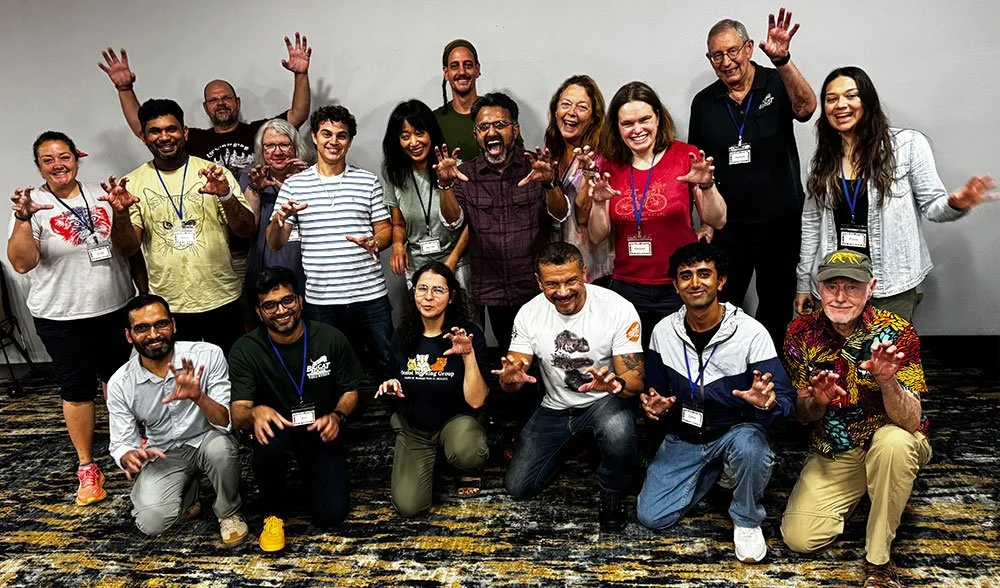
A MILESTONE FOR WILD CATS
We Just Got a Seat at the Table Where the World's Wild Cats Are Counted
On July 27, 2026, I was invited to join the IUCN Species Survival Commission Cat Specialist Group. Of everything Big Cat Rescue has done in more than three decades, I am not sure anything gives us more leverage to protect wild cats in the wild than this.
By Carole Baskin, CEO of Big Cat Rescue | Member, IUCN SSC Cat Specialist Group
There are moments in this work that feel like a door opening onto a room you have been trying to reach your entire life. This was one of them.
The IUCN SSC Cat Specialist Group is the body responsible for the global monitoring and conservation of every wild cat species on Earth. It brings together nearly 300 of the world's leading cat experts, including scientists, wildlife managers and conservationists from 65 countries, all working to advance the understanding and conservation of the world's 41 wild living cat species. It is one of more than 160 specialist groups that make up the Species Survival Commission of the International Union for Conservation of Nature.
41 wild cat species | 300 expert members | 65 countries
Why this matters more than a line on a resume
If you have ever wondered who decides whether a species is Endangered or merely Vulnerable, this is your answer. The Cat Specialist Group produces the Red List assessments for cats. Those assessments are not academic exercises. They determine which species get protection under national law, which get attention from CITES, which get written into recovery plans, and, very practically, which get money. A species that is assessed accurately gets help. A species that is undercounted, or assessed on thin data, quietly slips toward extinction while the paperwork says everything is fine.
The group also publishes Cat News, maintains the Digital Cat Library of research on wild cats, writes the conservation strategies and action plans that governments actually follow, and advises governmental and private organizations around the world on how to protect cats.
For most of my career, Big Cat Rescue has worked from the outside, pushing on that system through legislation, public pressure and funding for boots on the ground. That work mattered. Our campaign for the Big Cat Public Safety Act, which passed on December 20, 2022, ended the private ownership of big cats as pets in the United States and shut down the cub petting industry that had bred and discarded cats for decades. I believe every country should pass a law like it, and now I will be making that case in rooms where the people who advise those countries are sitting.
Being inside the Cat Specialist Group means our funding, our reach and our willingness to build things can be pointed at the exact gaps the world’s cat scientists say are holding them back.
I tried to give the invitation away
I will be honest about my first reaction, because it says something about how this work goes.
When co-chairs Dr. Tadeu de Oliveira and Dr. Sugoto Roy asked me to join, I tried to hand the honor to someone else. I wrote back:
That is such an honor that I hardly know how to respond, but since my name is so polarizing, especially in the zoo community where I am hated for my belief that all wild cats should live free if possible at all, I wonder if having Jamie accept on our behalf might be better? She’s more politically polite than I am, and is the up and coming generation, who is also taking over increasing responsibilities at Big Cat Rescue.
Tadeu would not hear of it.
“Noooo Carole, it’s YOU! The person, not the institution. We don’t care about the polarization you mentioned. YOU DESERVE IT, your body of work spoke for you, and Soggy said yessss too. We went over the list and I introduced those I knew! All is fine! Please do accept. Welcome to the CSG team!”
Tadeu G. de Oliveira, PhD, Co-Chair, IUCN SSC Cat Specialist Group
After I had filled out all the forms, he added something I will carry for a long time:
Your life-long battle for the cats deservingly got you there! Now at the CSG we sign "for the cats!" all because of you. Yours was the very first application accepted!
Tadeu G. de Oliveira, PhD
I have spent a lot of years being told that caring loudly about cats disqualifies you from being taken seriously about cats. It turns out the world’s leading cat scientists disagree. I still think Jamie Veronica is a better choice, for a lot of reasons, but she is already serving on the Fishing Cat Conservation Alliance’s executive board and she and at the Florida Wild Cat Conference, Dr. Flavia Tirelli invited both Jamie and Victor Alonso to the executive committee for the Pampas Cat Conservation Breeding Program. The Pampas Cats they are concerned about breeding for release are the nearly extinct Munoai. I have no doubt that Jamie will take my place with the IUCN SSC CSG one day.
What we are building next
An invitation is only worth what you do with it, so I got to work immediately on two problems that have frustrated wild cat researchers for years. Both are in development now. I am not ready to announce names or open the doors yet, because they belong to the Cat Specialist Group and its co-chairs, not to me, and they will be introduced when the group is ready to introduce them. But here is what I’m working on.
A research library you can actually search
Decades of wild cat science, more than sixteen thousand documents, with papers reaching back to 1551, has been sitting in an archive that was painfully difficult to use. Finding what you needed meant downloading software and wading through a catalogue that was missing thousands of records. So I rebuilt it. The result is a searchable, mobile-friendly library where a researcher can type in a species or a scientist’s last name and get answers in seconds, alongside the full run of Cat News and the group’s annual reports.
The intended outcome: every one of those 300 experts, in all 65 countries, can find the science they need in the time it takes to ask a question, instead of giving up on it. Knowledge that is locked away is not knowledge. It is inventory.
A global monitoring hub in every language
The second project came out of a conference conversation with Tadeu, who has been pushing to get global wild cat monitoring standardized. Right now, a field researcher in Brazil, a ranger in Uganda and a volunteer in Nepal are all recording what they see in different formats, different languages and different spreadsheets. Very little of it ever reaches the people writing Red List assessments in a form they can use.
The hub in development lets anyone in the field log an observation in their own language, drops it into a single synchronized database, translates it, and maps it. Because it maps everything, it also shows the holes, the places where nobody is looking and where the data is too thin to support an honest assessment.
The intended outcome: Red List assessors receive real, standardized, worldwide field data instead of educated guesses, and the conservation world finally knows where to send the next camera, the next researcher and the next dollar. Cats do not go extinct only because of poachers and bulldozers. They go extinct because systems haven’t kept up with technology.
What this means for you
Big Cat Rescue’s mission is wild cats in the wild. We closed the sanctuary chapter and moved our resources to the cats who still have a chance at a free life. That decision was hard, and this is the payoff.
Your support no longer stops at one fence line in Florida. It reaches into the machinery that decides how 41+ species are counted, classified, funded and defended, in 65 countries, and it pays for the tools that machinery has been missing. There are not many places in conservation where a dollar travels that far.
I will keep you posted as each of these projects is ready to be shown to the world. For now, know that the door is open, we walked through it, and we brought you with us.
For the cats,
Carole Baskin
CEO, Big Cat Rescue | Member, IUCN SSC Cat Specialist Group
