Leopard Cat Least Concern
The Ghost in the Oil Palm: Why Asia’s Most Common Wildcat is a Conservation Mirage
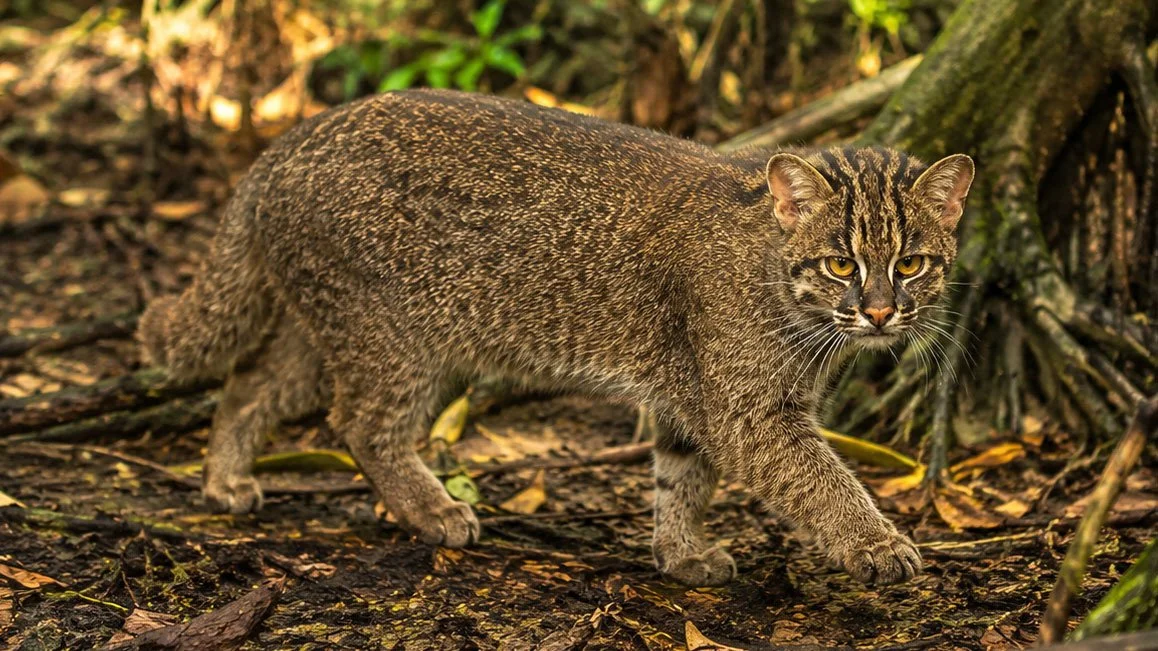
Across 19 countries, from the snow-dusted forests of the Russian Far East to the tropical heat of the Indian subcontinent, lives an animal that is simultaneously ubiquitous and invisible. The mainland leopard cat (Prionailurus bengalensis) is a biological masterpiece of adaptability. A generalist that thrives where others falter, it prowls through shrublands, primary forests, and even the monoculture rows of industrial plantations.
Yet, for a creature so widespread, it remains a profound scientific enigma. For years, the mainland leopard cat was lumped together with its island cousins, but it wasn't until 2017 that taxonomic rigor finally recognized it as a distinct species from the Sunda leopard cat (P. javanensis). Despite this newfound clarity, the species exists in a state of "abundant mystery." We see its silhouette on camera traps and its tracks in the mud, yet we possess startlingly little hard data on its population health, genetic connectivity, or the specific pressures mounting against it.
This cat is the victim of a dangerous paradox: its perceived success has become its greatest threat. Classified globally as a species of "Least Concern," the mainland leopard cat is being allowed to slip through the cracks of conservation priority, masking a series of local extinctions that are happening in real-time.
A Global Label for Local Erasure: The Green Status Gap
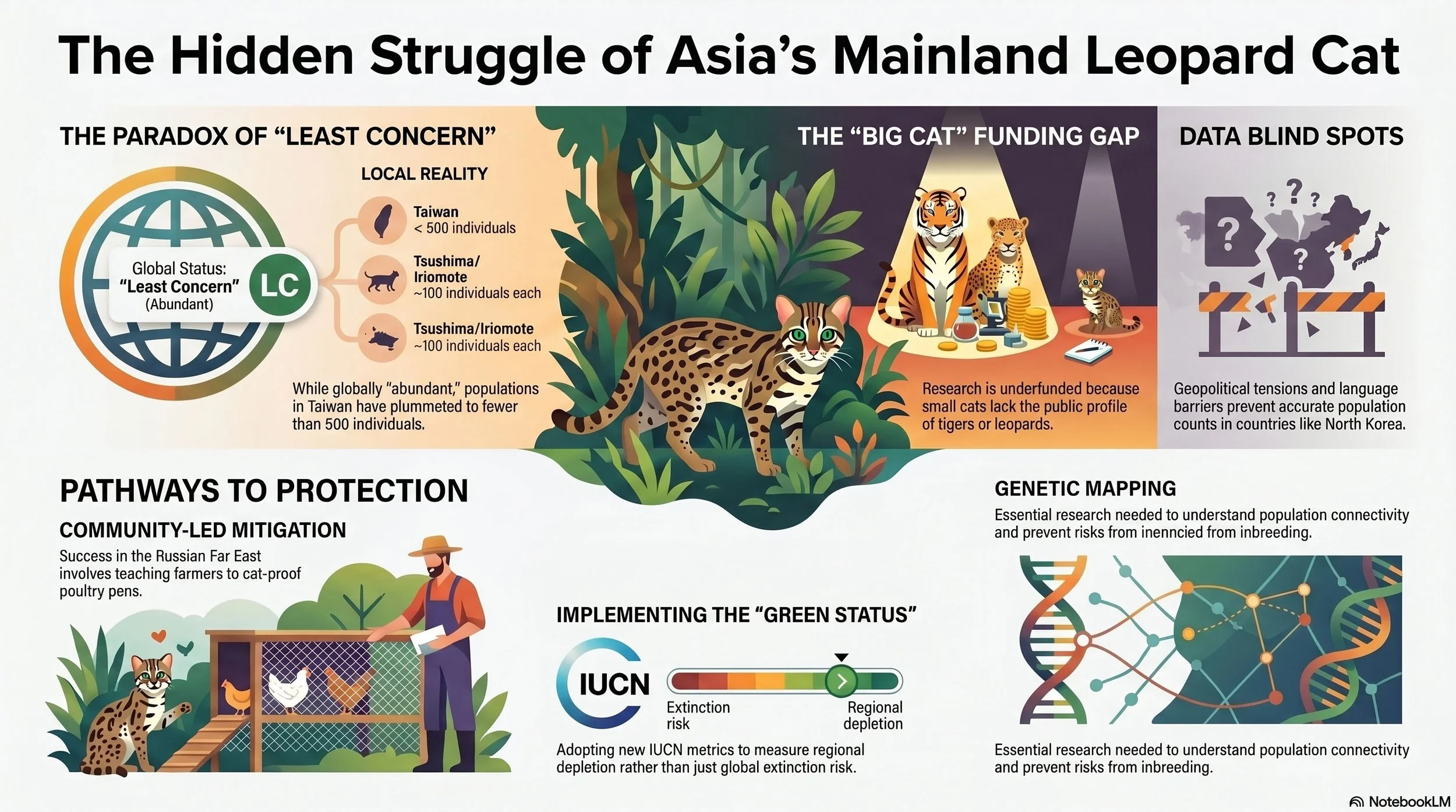
The "Least Concern" designation on the IUCN Red List is often a death sentence for local conservation funding. Because the Red List assessment focuses on global, range-wide trends over a narrow ten-year window—the species' three most recent generations—it is prone to the "shifting baseline" syndrome. This framework frequently ignores massive habitat losses and population crashes that occurred more than a decade ago, creating a sanitized version of the truth.
To combat this, the IUCN has introduced the Green Status of Species, a tool designed to measure how much a species has been depleted from its historical range. The need for this is best illustrated by the European wildcat, which holds a "Least Concern" Red List rating but is categorized as "largely depleted" under the Green Status. As Elliot Carlton, a species survival officer with the IUCN SSC Centre for Species Survival Cats, observes:
“Hopefully, the Green Status assessment will provide insights into the differences in status, threats, and data quality across the mainland leopard cat's range... [it] can highlight where further research efforts are needed and support planning for the species.”
Without this nuance, we miss the tragedies on the ground. In Japan’s Tsushima and Iriomote islands, populations have withered to roughly 100 individuals each. In Taiwan, fewer than 500 remain. These isolated populations face the silent rot of inbreeding and genetic isolation, yet their plight is drowned out by a global average. As Thomas Gray, tiger recovery lead at the WWF Tigers Alive Initiative, warns:
“You can have situations where a species may be critically endangered in a place, may be extinct in another place, but its global conservation status remains 'least concern' because what we are looking at is global, range-wide trends of population.”
The Tyranny of the Charismatic: Why Tigers Steal the Spotlight
In the hierarchy of conservation, the mainland leopard cat is a "low-profile" species competing for crumbs left by the "charismatic megafauna." Tigers and leopards monopolize the donor checks and the public imagination, leaving small cats to be studied as mere "bycatch." Most of what we know about the leopard cat is accidental—data points gathered by researchers who were actually looking for something bigger.
This funding vacuum forces scientists to operate on "intelligent guesses" rather than empirical rigor. Even in China, where the population is estimated at a seemingly robust 230,000 and the cat holds National Class II protection status, detailed surveys are still lacking across most of the country. This lack of dedicated attention leaves range maps riddled with "blank spots," an ecological irony considering that these small felids do the heavy lifting of pest control by regulating rodent populations across vast landscapes.
“We have standalone studies, which cover small areas, and then based on those studies we have to extrapolate and make intelligent guesses about what the population of that species would be at a larger level,” explains independent researcher Priya Singh.
The Last Cat Standing: The Ghost in the Anthropocene
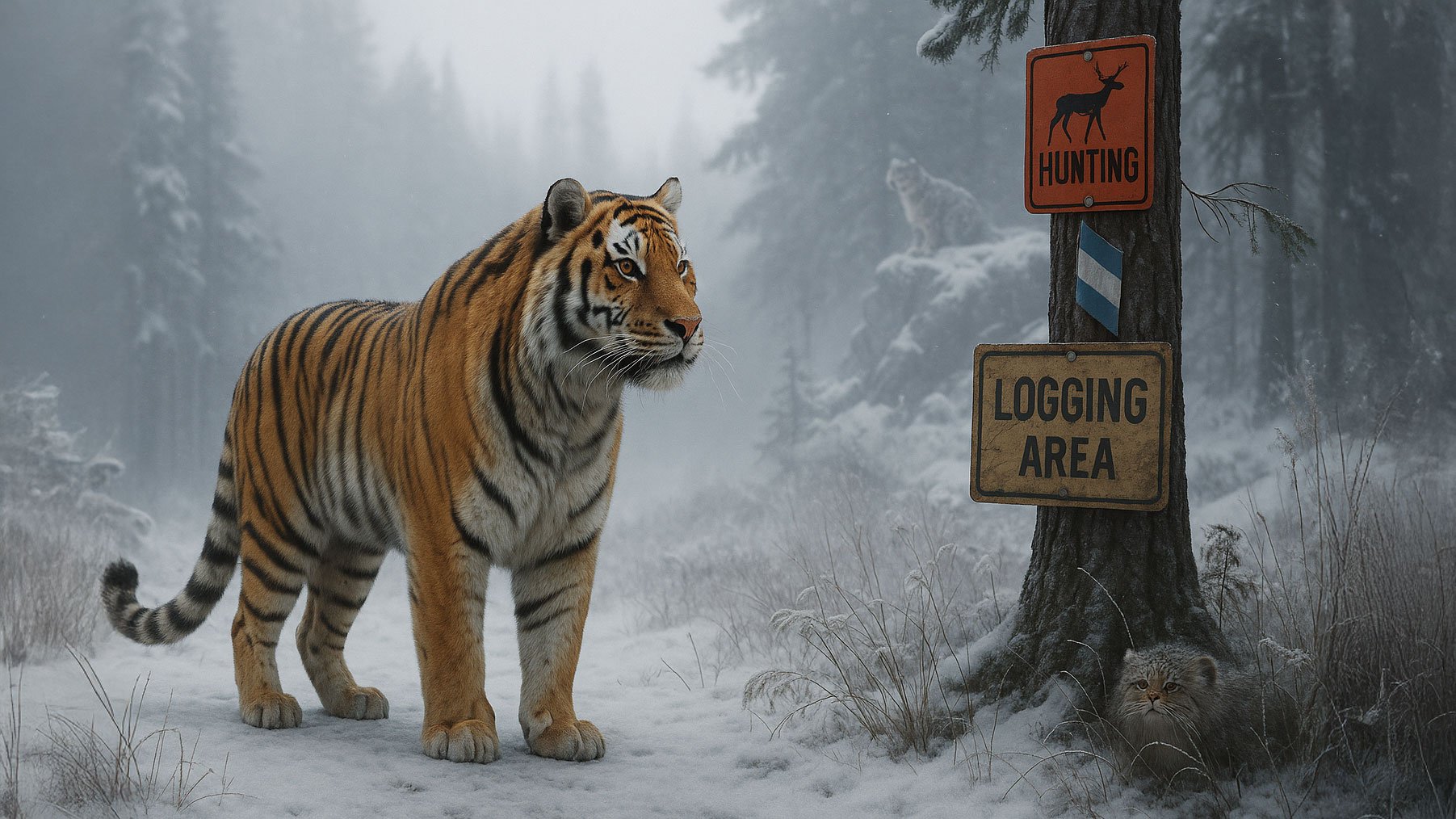
Despite the neglect, the mainland leopard cat is an elite ecological opportunist. In many regions, it is the "last cat standing"—the final wild felid left after human expansion has driven out the great predators. In South Korea, it is the sole surviving wildcat following the local extinction of the Siberian tiger and Amur leopard.
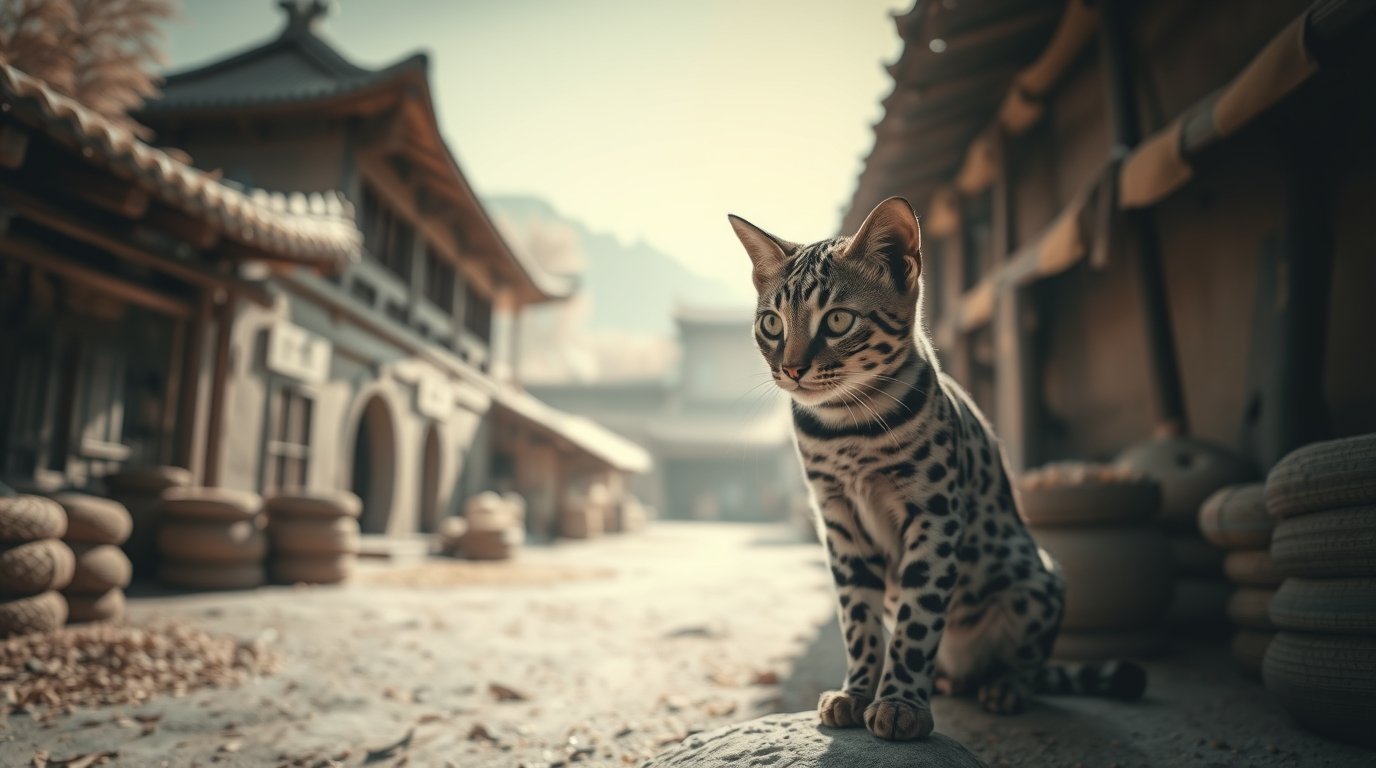
It has become the phantom of the anthropogenic landscape, finding a strange equilibrium within our industrial world. In Southeast Asia, leopard cats have been found in high densities within oil palm plantations, where they exploit the abundance of rodents. In 2021, a camera-trap photo of a leopard cat near the 2022 Winter Olympics ski slopes in Beijing went viral, a stark reminder that these animals are our silent neighbors, prowling the boundaries of our urban sprawl.
The Invisible Barriers: English-Centric Science and Geopolitics
The wall between us and a true understanding of this species is not just biological; it is human. Conservation is hindered by an English-centric bias in global assessment teams. While high-quality research is flourishing in China and Russia, much of it remains trapped behind language barriers, never fully integrated into the global Red List assessments.
Furthermore, geopolitical "blind spots" create massive data gaps. In North Korea, almost nothing is known about the species, though reports suggests that indiscriminate snaring is widespread and the cats are frequently caught as bycatch.
To break this data wall, we must demand transparency. Vast amounts of "bycatch data" currently sit in the archives of large NGOs, gathering digital dust. There is a moral and scientific imperative for these organizations to release this data to local students and researchers, turning incidental sightings into a roadmap for regional planning.
From Retaliation to Coexistence: The Russian Far East Model
The future of the mainland leopard cat will not be decided in a boardroom in Geneva, but in the poultry houses of rural villages. In the Russian Far East, conservationists are proving that conflict is not inevitable. Because leopard cats frequently encounter humans in "anthropogenic landscapes"—highways and farms—they are often targeted for raiding chicken coops.
The Land of the Leopard National Park team has moved beyond the rhetoric of policy, placing educational signboards in more than 10 villages. These signs don't just preach; they provide a lifeline. They offer contact information for "cat-proofing" poultry pens and facilitate requests for humane relocations. This approach transforms a "pest" into a neighbor worth reporting.
“[T]he leopard cat very often encounters people in anthropogenic landscapes... So it is very important to work with people to highlight the importance of preserving this species of small cat and its valuable place in the ecosystems,” says Ekaterina Blidchenko, a senior research assistant at the Kedrovaya Pad State Biosphere Nature Reserve.
Conclusion: Reversing the Shifting Baseline
We are currently living through a period of biological amnesia. As we reshape the planet, we risk accepting a "new normal" where the loss of local populations is ignored because the global total still looks acceptable on a spreadsheet.
To save the mainland leopard cat, we must move toward dedicated biological studies, comprehensive genetic mapping, and transboundary collaboration that ignores political borders. We must stop viewing them as the "common" cat and start seeing them as the vital ecological anchors they are. The mystery of the leopard cat is a challenge to our own perception: can we learn to value the nature that is still here before we are left with only the memory of what "abundant" used to mean?