Northern Tiger Cat Facts

Quick Facts
Common Name: Northern Tiger Cat (also known as Oncilla or Tigrina)
Scientific Name:Leopardus tigrinus
IUCN Red List Status: Vulnerable
Current Population: Estimated between 8,932 and 10,208 mature individuals
Population Trend: Decreasing
Weight: 4 to 8 pounds
Life Expectancy: Up to 20 years in captivity
Appearance
The Northern Tiger Cat is one of the smallest wild felids in the Americas. This dainty, delicately built cat measures between 15.5 and 21.5 inches in length, with a thick, ringed tail adding another 10 to 15.5 inches. Its coat is a beautiful tapestry of light to rich ochre, marked by organized rows of large dark spots and rosettes. Unlike the ocelot or margay, the Northern Tiger Cat’s fur is firm and lies close to the skin, with hair on the nape of the neck that flows backward.
Distinctive features include a narrow head accented by a white line above the eyes and large, rounded ears that are black on the outside with a bright white central spot. Interestingly, melanism is quite common in this species, with roughly one-fifth of all individuals appearing entirely black.
See a playlist of this species at https://bigcatrescue.org/videos
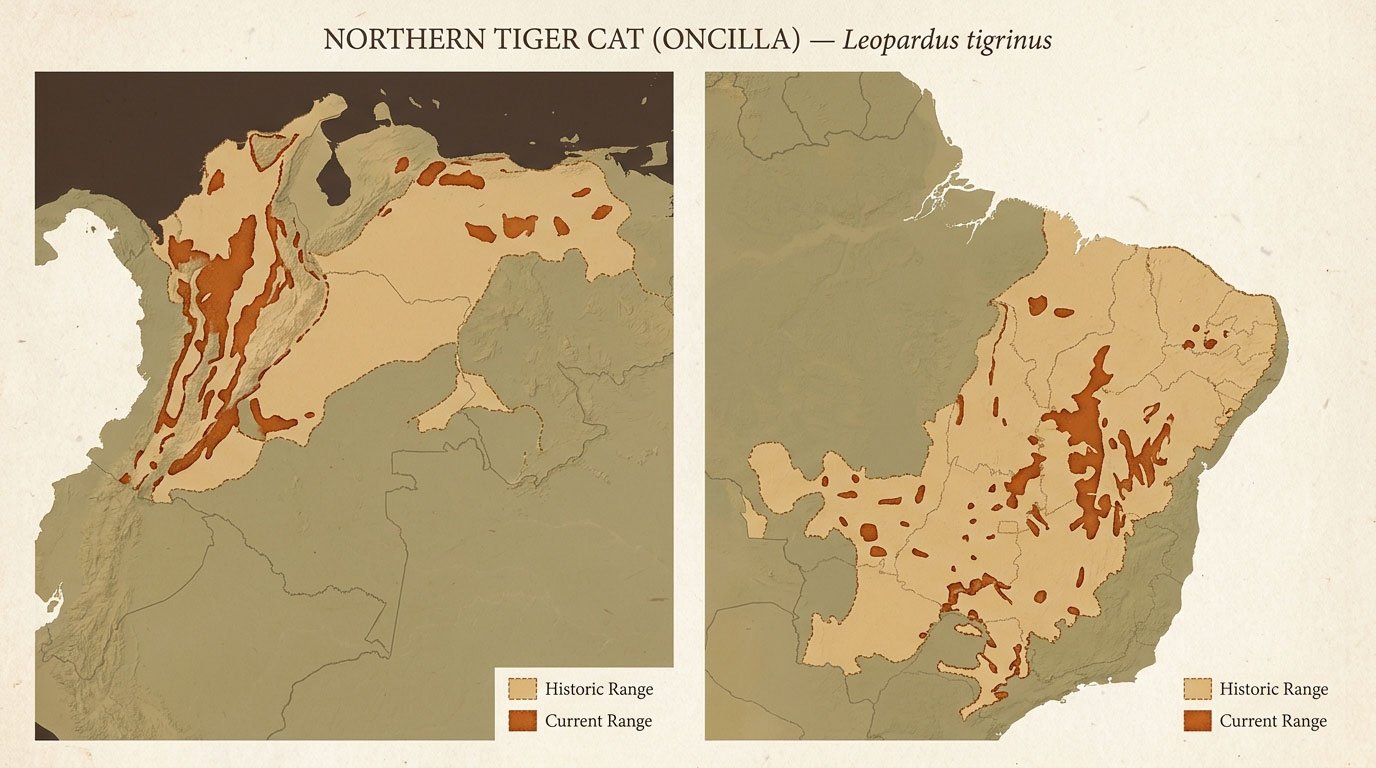
Northern-Tiger-Cat-Range-Map
Habitat and Range
The geographic range of the Northern Tiger Cat is more restricted than previously thought, following recent taxonomic splits. Its territory extends from the cloud forests of Costa Rica and Panama into northern South America, reaching as far as Central Brazil. It is notably absent from the Llanos and the core of the Amazon Basin, where it is considered exceptionally rare or restricted to isolated enclaves.
These cats are highly adaptable but show a clear preference for montane and cloud forests, often living at higher elevations than their cousins, the ocelot and margay—sometimes reaching as high as 3,600 meters. In Brazil, they also inhabit the semi-arid thorny scrubs of the Caatinga and the savannahs of the Cerrado. They generally avoid open landscapes and areas close to human settlements, requiring dense woody cover and a stable prey base to thrive.
Diet and Behavior
As a solitary and primarily nocturnal hunter, the Northern Tiger Cat is an elusive shadow in the wild. While it is a proficient climber, it spends most of its time hunting on the forest floor. Its diet is specialized for its small size, consisting mainly of rodents weighing less than 100 grams, small lizards, birds, and insects.
One of the most fascinating aspects of its ecology is the "Ocelot effect." Research suggests that Northern Tiger Cat populations are significantly lower in areas where ocelots are abundant. To avoid competition and the threat of being preyed upon by their larger relatives, these small cats often maintain very low population densities in ocelot-heavy territories.
Reproduction
Knowledge of Northern Tiger Cat reproduction comes largely from captive populations. Females have a gestation period of approximately 74 to 76 days, typically giving birth to a single kitten, though litters of up to four have been recorded.
The young develop slowly compared to other small cats; their eyes do not open until they are about 17 days old, and they begin to sample solid food at 55 days. They reach full maturity between 1.5 and 2 years of age. In the wild, the low reproductive rate and slow development make it difficult for populations to recover quickly from environmental stresses.
Threats
The Northern Tiger Cat faces a barrage of modern challenges that continue to drive its numbers downward:
Habitat Conversion: The greatest threat is the rapid loss of habitat due to agro-industrial farming, particularly for crops and livestock in Brazil’s Cerrado and Caatinga regions.
Hybridization: A significant and unusual threat is the high rate of hybridization with the Pampas cat (Leopardus colocolo). In some regions, nearly all evaluated specimens show signs of this genetic mixing, which threatens the species' unique identity.
Disease and Roadkill: Interaction with domestic dogs leads to the spread of fatal diseases, while expanding road networks through their habitat result in frequent and deadly collisions.
Retaliatory Killing: They are often targeted by farmers in response to the perceived or actual predation of small domestic poultry.
Historical Fur Trade: While international trade has largely ceased since the 1980s, the species was once the most heavily hunted small spotted cat, with tens of thousands of skins traded annually.
Question: Can I keep a northern tiger cat as a pet?
Conservation Efforts
The Northern Tiger Cat is listed under CITES Appendix I, which strictly prohibits international trade. It is also legally protected from hunting across much of its range, including Brazil, Colombia, Costa Rica, and Venezuela. However, because much of its population lives on private lands outside of protected areas, conservation relies heavily on community involvement and habitat preservation on a local scale.
Big Cat Rescue has been an active supporter of in-situ conservation efforts to protect these cats in their natural habitats. By providing vital funding for field research and conservation projects, Big Cat Rescue helps biologists better understand the species' ecology, monitor population trends, and implement strategies to mitigate the threats of habitat loss and human-wildlife conflict. These funded initiatives are essential for ensuring that the Northern Tiger Cat does not vanish from the wild.
Analogy for Understanding: Imagine the Northern Tiger Cat as a specialized boutique shop in a world of giant department stores. While the "department stores" (like the Ocelot) dominate the market and take up most of the space, the "boutique" survives by offering something different in a very specific niche—high-altitude forests and rugged scrubs. However, if the neighborhood is demolished for a new highway or the boutique starts losing its unique branding through mergers, it risks disappearing forever.
See Conservation Work Funded By Big Cat Rescue here:
All conservation insitu work: https://bigcatrescue.org/insitu/



Jose Ramirez Fernandez is a passionate conservationist working tirelessly to protect small wild cat species in the dense forests and rugged mountains of Costa Rica. As a native Costa Rican who is an expert in rodent biology, Jose brings a unique perspective and skill set to his mission of saving animals like the elusive oncilla, powerful ocelot, and the newly discovered clouded tiger cat.