Rusty Spotted Cat Facts

Quick Facts
Common Name: Rusty-spotted cat
Scientific Name: Prionailurus rubiginosus
Kingdom: Animalia
Phylum: Chordata (Vertebrata)
Class: Mammalia
Order: Carnivora
Family: Felidae
Genus: Felinae (Prionailurus)
Sub-species:
P.r. rubiginosa - India
P.r. phillipsi – Sri Lanka
World Rank: Smallest wild cat species on Earth
Weight: 2 to 4 pounds
Status: Protected throughout its range; listed under CITES Appendix I
Appearance
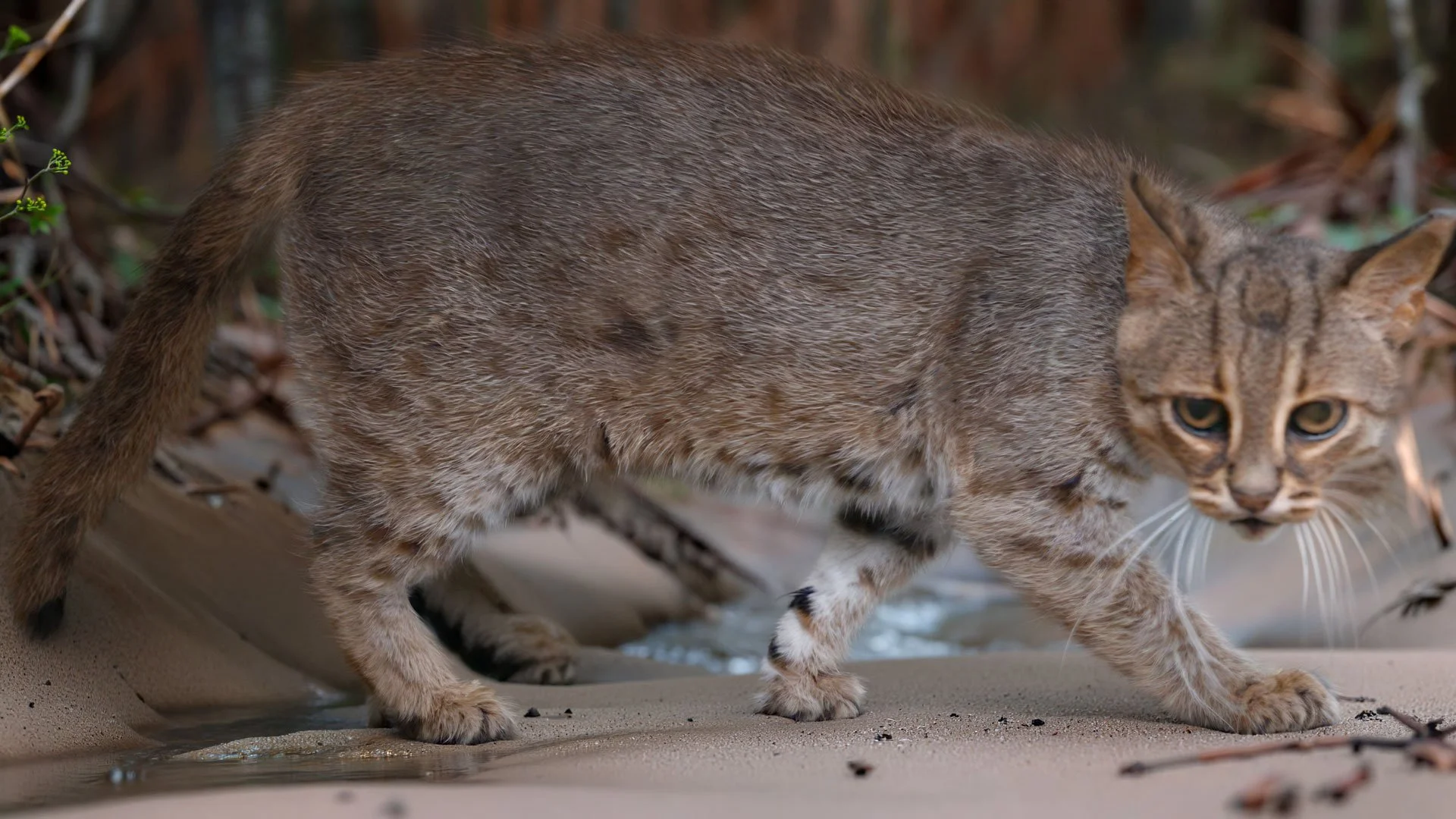
Often described as a smaller, more delicate relative of the leopard cat, the rusty-spotted cat is a marvel of feline evolution. Its short, soft fur is typically a brownish-gray, decorated with the characteristic rusty-brown spots that give the species its name. These markings form solid streaks along the head and shoulders before breaking into spots across the flanks.
Its underbelly and the inner parts of its legs are stark white, accented by large, dark spots. Distinctive dark lines frame its face, with four streaks extending from the eyes over the top of the head toward the neck. Despite its tiny stature—measuring only 20 to 29 inches in length—it is built for agility and stealth.
See a playlist of this species at https://bigcatrescue.org/videos
Habitat and Range
The rusty-spotted cat has a broader distribution than previously recorded, spanning India, Sri Lanka, and Nepal. In Sri Lanka, these elusive felines are primarily found in high-altitude montane forests and lush tropical rainforests. In India and the Terai regions of Nepal, they favor dry grasslands, scrub forests, and even degraded forest landscapes near human settlements. Recent sightings in places like the Sariska Tiger Reserve in Rajasthan and the Nallamala Forest in Telangana highlight their presence in diverse Indian ecosystems, while populations in Nepal are frequently found in the Western Terai Arc Landscape and the Banke-Bardiya Forest Complex.
Diet and Behavior

Extremely shy and primarily active at night, the rusty-spotted cat is a secretive hunter. Its diet is mainly comprised of rodents, frogs, and small birds. While they are master hunters of small mammals in the wild, they are occasionally drawn to human settlements where they may prey on domestic poultry. Because they are so elusive, much of their social communication remains a mystery to science, though they are known to be solitary and highly arboreal when necessary.
Reproduction
Knowledge of this species' reproductive habits is limited. Following a gestation period of approximately 67 days, a female typically gives birth to a small litter of one to three kittens, with single-kitten births being the most common. The kittens are born without the distinct rusty spots of the adults, developing their adult markings as they mature.
Threats
The survival of the world’s smallest cat is challenged by several human-induced factors:
Habitat Loss: Deforestation and the conversion of wild lands into agricultural fields reduce the available space for hunting and breeding.
Road Mortality: As infrastructure expands through feline habitats, road kills have become a significant threat.
Retaliatory Killings: When these cats prey on chickens, goats, or pigs to survive, they are often targeted by farmers protecting their livestock.
Poisoning and Environmental Hazards: Indirect poisoning and devastating forest fires further threaten local populations.
Question: Can I keep a rusty-spotted cat as a pet?
Conservation Efforts

Dedicated conservationists are working across South Asia to ensure this tiny cat has a big future. The Rusty-spotted Cat Working Group (RSCWG) leads many of these initiatives, which include:
Conflict Mitigation: Building predator-proof chicken coops for local farmers and introducing "organic barriers," such as farming garlic—a crop that is unpalatable to raiding animals—to help families maintain their livelihoods without harming wildlife.
Habitat Restoration: Programs in Nepal have successfully planted over 25,000 native trees to restore degraded forests.
Safety Infrastructure: The installation of billboards and warning signs in high-risk zones, such as Banke National Park, helps reduce speed-related road accidents.
Rescue and Rehabilitation: In Sri Lanka, efforts are focused on advancing specialized centers to rescue, rehabilitate, and release small wild cats back into their natural habitats.
Community Education: From decorating auto-rickshaws with conservation posters to training "citizen scientists," education programs are turning local communities into the cat’s greatest protectors.
Big Cat Rescue has played an active role in these efforts by providing vital funding for in-situ conservation projects. This support helps fuel the field research and community-based programs necessary to protect the rusty-spotted cat in its native range.
See Conservation Work Funded By Big Cat Rescue here:
All conservation insitu work: https://bigcatrescue.org/insitu/
2012 Conservation Work to Save Rusty Spotted Cats
The big cats of India received some unexpected, pint-sized visitors. According to the Deccan Chronicle, two rusty-spotted cats were seen pawing around the Sariska Tiger Reserve in Rajasthan.
Activists and wildlife officials are excited that this adorable duo was seen out and about, because rusty-spotted cats are extremely rare.
The smallest species of cat, the rusty-spotted cat measures around 13 to 18 inches long and weighs between two and three-and-a-half pounds.
Aside from being rare, this species is also very shy, which makes it even more surprising that two volunteers spotted these tiny animals wandering around a big-cat reserve.
The species is native to Sri Lanka and India, and is protected by both countries. Hopefully, conservation efforts will lead to more rusty-spotted-cat sightings in the future.
https://bigcatrescue.org/2012/worlds-smallest-cat-species-spotted-at-indian-tiger-reserve
