Making small cat conservation happen in NE India
Jim Sanderson
Thanks to SWCCF's generous financial partners, the Clouded leopard at the Nagaland Zoological Park in Dimapur, Nagaland has a new home. In fact, the modern enclosure has become a popular attraction at the zoo. Readers most likely recall the Cloudie's miserable conditions, housed in a barred cage with no enrichment (above left).
Volunteers from Port Lympne Safari Park, Wild Animal Reserve & Hotel in the UK added interior enrichment attractions, making the new home more interesting. Following my inspection, I recommended fast growing trees be planted around the exterior of the enclosure to provide shade, that portions of the walls be replaced with chain link fence to improve ventilation, and replacement of the front gass panels with chain link fence. Solid brick walls and front glass panels were not included in our original plans. At the back of the enclosure, two doors allow access to the rear of the enclosure where the Clouded leopard can elude public view.
The Marbled cat enclouse under construction at the Itanagar Zoo, Arunachal Pradesh, was delayed because the zoo intends to increase the footprint as well as height of the enclosure. The increased cost will be provided by the zoo. I declined to visit because I want to see the finished enclousure with the Marbled cat inside.
Conserving Choklangan's Marbled cats A community's commitment
Conserving Choklangan's Marbled cats
A community's commitment
Lemdumong Shiu, Nagaland, Eastern Himalayas Marbled Cat Project
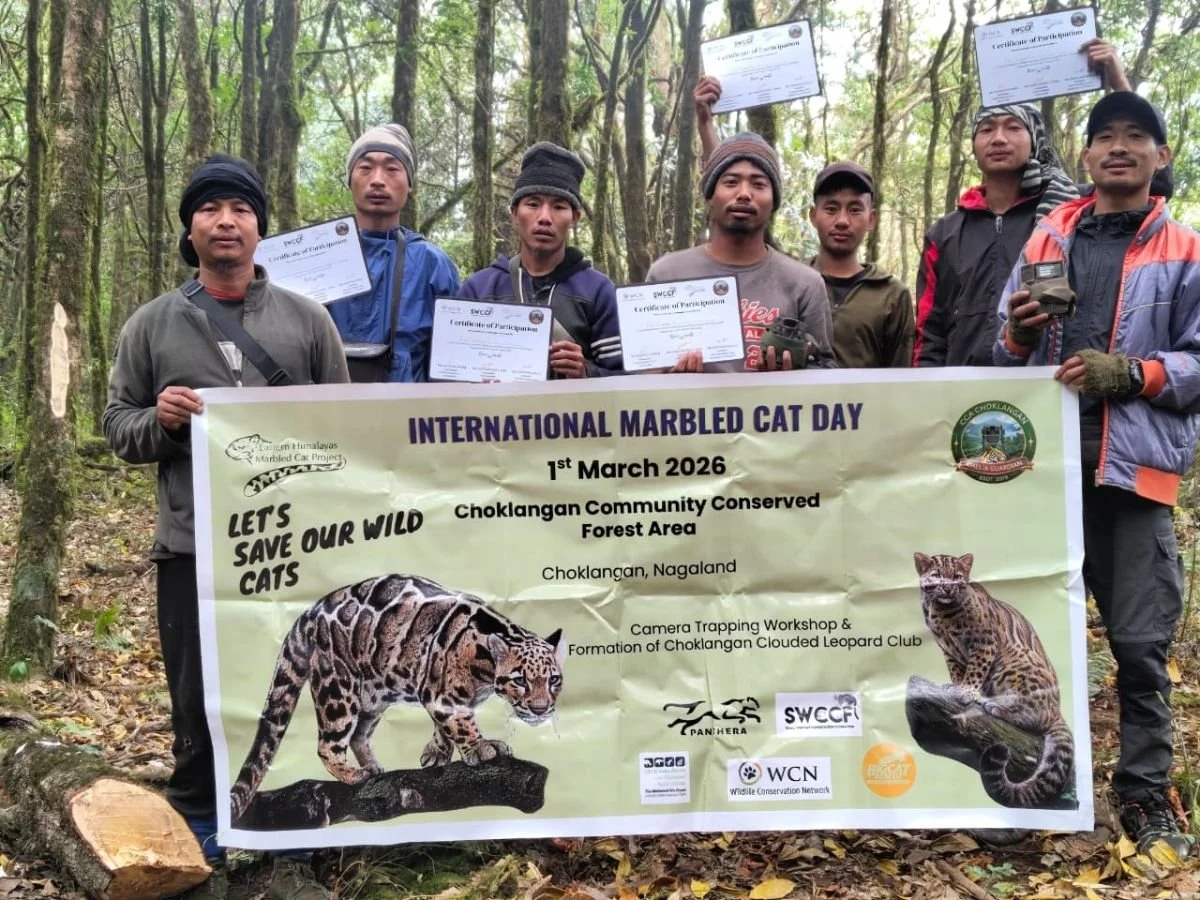
In Nagaland, NE India, on the border with Assam to the north, Meghalaya to the west, and Myanmar to the east, Choklanga village is just below the mountain ridge that separates India from Myanmar. Maybe 2500 people live here. We are all members of the Khiamniungan (Naga) tribe. Though my village is remote and the roads that connect us to the nearest town 60 km away are in awful shape, like all rural villages in India, we have electricity and a cell phone tower that work most of the time. Fresh air, cold, clear fresh water, and forests are abundant in the rugged landscape surrounding our village. So are frequent landslides that cover roads and isolate our vilage for days at a time. We grow and raise most of our own food. That's my team (above). I'm on the far right. We're the best mountain hikers in Nagaland.
It is not often that foreigners visit Choklangan. During Giri and Jim's visit, our village council leader, Mr. Kpatsou Shiu, officially declared 200 acres of his land as the Enshaoking Marbled Cat Community Area, demonstrating a remarkable personal commitment to protecting Marbled cats and their habitat. In another special gesture, he named the highest peak Marbled Cat Summit.
With generous support from Eastern Himalayas Marbled Cat Project (EHMCP), I've supplied pigs to my neighbors who agreed to stop hunting. I've also supported local vegetable nurseries. In return, my fellow community members are now actively supporting our conservation efforts, sharing their knowledge of the forests and helping us identify suitable locations for deploying trail cameras.
According to Giri and Jim, my cameras are recording more Marbled cats at a faster pace than any other locations where EHMCP uses trail cameras. As we looked through the pictures, one caused us to pause and consider our options. An unknown visitor carrying a rifle was recorded in our community forest just below Marbled Cat Summit. He did not see my camera.
The visitor was not from Choklangan so where did he come from? There are no villages within walking distance of Choklangan in Nagaland. He must have come from Myanmar. Aided by the additional 12 trail cameras Giri gave me, our team has work to do. Giri and Jim also gave me two other assignments: Recording the first videos of an Asiatic golden cat with a kitten and a Marbled cat with a kitten.
For me, working as a grassroots conservationist in a remote corner of the Eastern Himalayas, this encouragement means a great deal. Giri and Jim traveled 12 hours to reach my village. The support from EHMCP and my teammates, together with the commitment of our village leaders, youth and local community, have given me the confidence and motivation to pursue my new career in conservation. I believe that the future of Marbled cats and other wildlife in Choklangan depends not only on trail camera photographs, but also on the people who live here. I'm one of them.
When communities become partners in conservation, even the most remote landscapes can become strongholds for wildlife. This is our journey in Choklangan—a journey where a community's pride, local leadership and collective action are helping give the Marbled cat a safer future in the Eastern Himalayas.
Eastern Himalayas Marbled Cat Project
Clouded Leopard made state animal of Meghalaya
Clouded Leopard made state animal of Meghalaya
Mission Clouded Leopard launched
Jim Sanderson
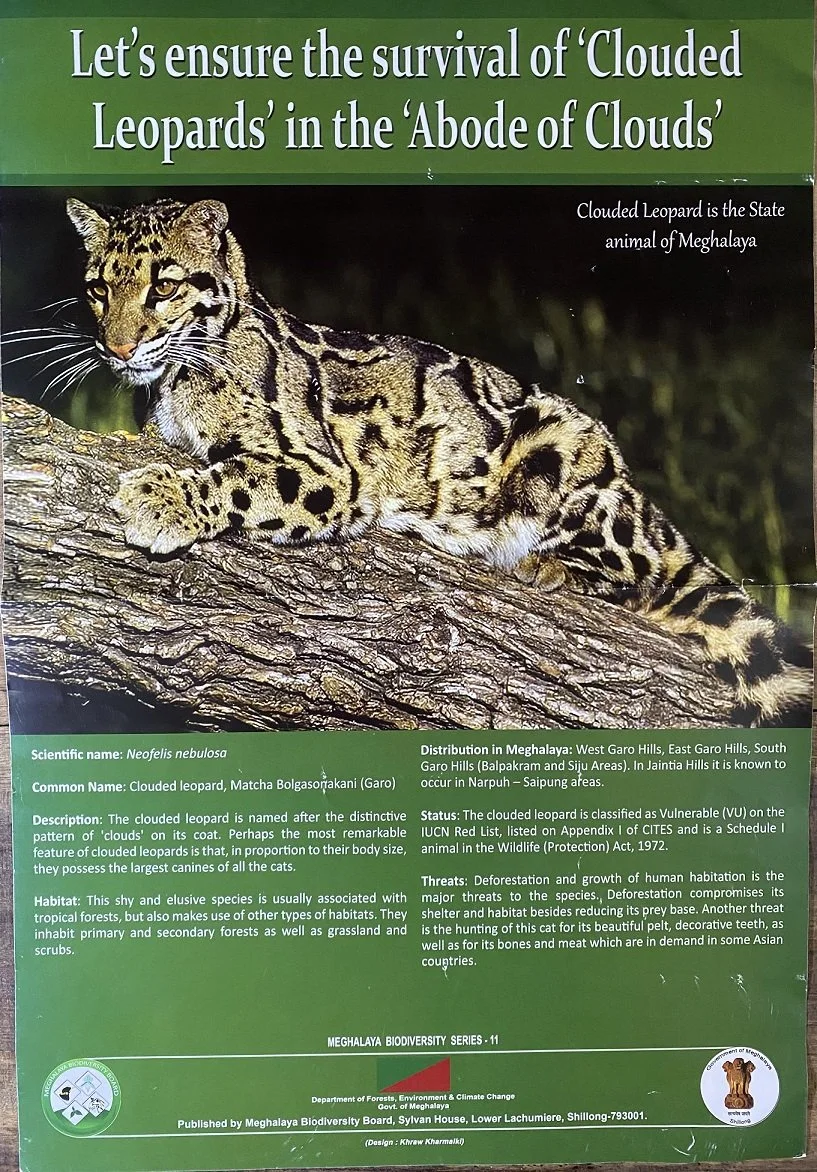
The Clouded leopard was officially recognized as the state animal of Meghalaya. On 4 August 2026 (International Clouded Leopard Day), Meghalaya Chief Minister Conrad K. Sangma launched Mission Clouded Leopard, a dedicated comprehensive conservation program to protect the state animal and its forest habitats. Led by Giri Mala, Eastern Himalayas Marbled Cat Project has several partners and threat reduction projects in Meghalaya.
Note that the Fishing cat is officially West Bengal's state animal. The national animal of India is the Royal Bengal Tiger. Can the Marbled cat and Asiatic golden cat be named state animals?
You can read more and see an attractive poster here.
Conflict need not end in persecution Making friends instead of enemies
Conflict need not end in persecution
Making friends instead of enemies
Felipe Peters, Brazil, Felinos do Pampa
Under the wing of Geoffroy's Cat Working Group (GCWG) in Brazil, the Felinos do Pampa project, flexibility is key to resolving human-wildlife conflicts. Sometimes renovating a hen house is all that is needed. Other times, building a new structure mitigates conflicts. And in some cases, simply compensating for a loss suffices. Three different solutions, but with important outcomes in common. In all three, a path to coexistence is found and the global small cat conservation network grows.
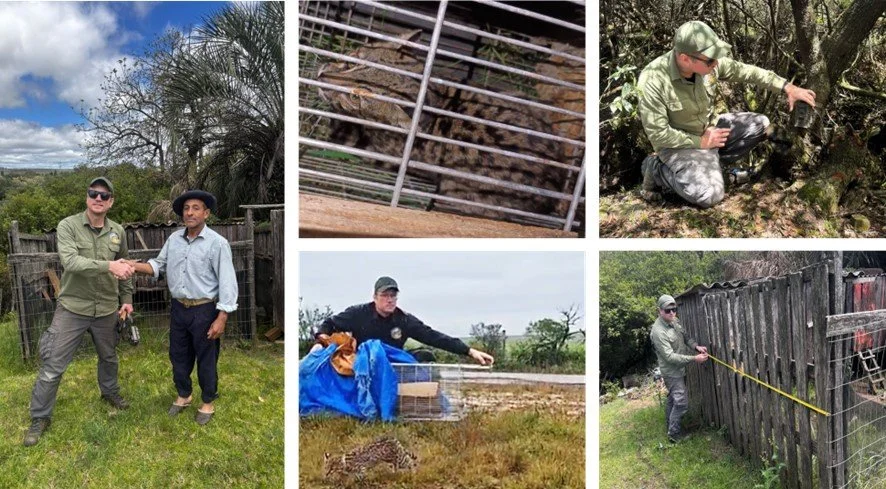
Near the rural village of Candiota, Seu João captured a Geoffroy's cat that had been “visiting” his henhouse. Even after losing 15 hens, he decided not to harm the offending Geoffroy's cat and to seek help from Felinos do Pampa. I safely released the cat back into the wild, and the henhouse was completely renovated and transformed into a reinforced anti-predation structure, protecting the hens and preventing future conflicts. Needless to write, Seu João is now a partner in our efforts and is helping his neighbors renovate their henhouses. He has also become a spokesperson.
Felinos do Pampa carried out another threat mitigation project in Candiota showing how resilience is built. Seu Odilon was receiving frequent visits from a Geoffroy's cat targeting his hens. Our team installed trail cameras to monitor attack patterns and entry points. As luck would have it, the old, rickety henhouse was ultimately destroyed by severe storms in September, clearing the way for a new structure. Instead of abandoning protection efforts, Seu Odilon and our team designed a modern, safe replacement. We purchased all necessary construction materials and delivered them to the site. We also helped Seu Odilon construct the henhouse he dreamed of having. Another conservation partner joined our efforts.
Sometimes, fostering human-wildlife coexistence requires a gentle touch. In Candiota, I learned that Dona Luísa's backyard hens were targeted by the usual suspect—Geoffroy's cat. The resolution was refreshingly straightforward. Without asking too many questions, I fully compensated her economic loss with new hens, thus removing incentives for retaliation. My quick support ensured Dona suffered no financial harm and allowed the offending Geoffroy's cat to continue living peacefully in its natural home range without being persecuted.
JGS: Felipe continues to change the hearts and minds of rural prople. His simple solutions seem so easy. What is so difficult to understand is why the big conservation NGOs have not figured them out. Where are they, what is their phone number, when rural people seek help? Thanks to Felipe's new friends, everyone has his number and they know who to call for help. Or they call to let Felipe know they solved the problem for their neighbor. Keep up the great work, Felipe!
Felinos do Pampa
Vaccination & neutering campaign in Sri Lanka
Vaccination & neutering campaign in Sri Lanka
Ashan Thudugala, Sri Lanka, Save Fishing Cats
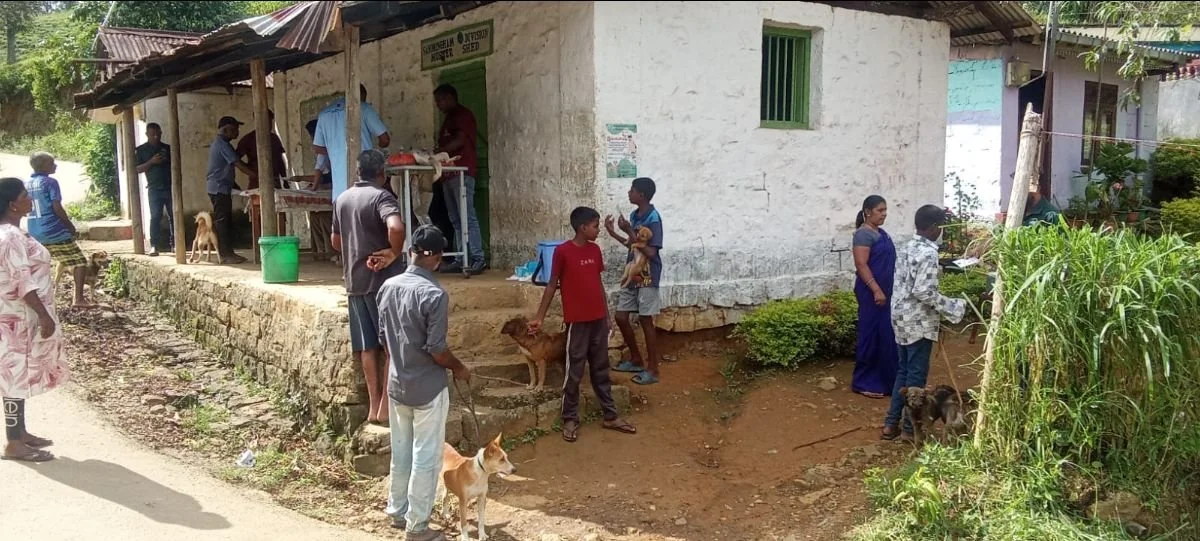
Our team successfully completed a mobile vaccination and neutering campaign around Agra-Bopats Forest Reserve in the Central Hills district. We collaborated with multiple local sources to do this event since some rural communities are not welcoming to outsiders. We reached them through their village committees and leaders. Now residents are glad we did.
During one long day, we worked at three locations vaccinating a total of 168 dogs and 20 cats. We neutered 23 dogs. Our program was a massive success and done with the community to protect their pets and wildlife. Based on feedback received from participants, and thanks to our generous financial partners, we will visit the same places again and add new locations.
Save Fishing Cats