AdvoCat 2026 09
The AdvoCat
September 2026 • Big Cat Rescue
Big Cat Rescuers,
This month held the best news and the hardest news at the same time. Scientists named the first brand new wild cat species in a hundred years. And we said goodbye to two cats who lived with us for years, Aria the tiger and Summer the bobcat. You will find all of it below, along with a book you helped put into Farsi, a tiny cat caught on video eating a swamp rat, and a smuggling bust that shows why the fight against the big cat trade is far from over.
For the cats, Carole
New Species
A Man Fed It Noodles and Rice. It Turned Out to Be a Cat Science Had Never Seen.
Near La Paz, Bolivia, a man found a tiny spotted kitten and tried to raise it on noodles, rice and eggs. It was not a kitten. It was a Tilcayo tiger cat, Leopardus tilcayo, the first completely new wild cat species described in more than a century. Grown cats weigh just 4 to 8 pounds, smaller than many house cats, which is how they hid in the misty cloud forests of the Bolivian Yungas for so long. The name comes from local people, whose grandparents always knew this cat as the tilcayo. The same study split the tiger cat into five separate species. The hard part: this cat’s numbers have already dropped by about 63 percent, and its forest is disappearing fast. Our partners at the Geoffroy’s Cat Working Group helped with the discovery, and on Tiger Cat Day, September 17, Tiger Cats Conservation in Brazil celebrated by returning a rescued tiger cat to the wild at Mirador State Park.
Conservation Funded
The World’s Most Used Guide to Living With Wild Animals Now Speaks Farsi
When a cat kills a farmer’s goat, what happens next decides whether that cat lives. The IUCN Guidelines on Human-Wildlife Conflict and Coexistence show communities how to solve those problems without killing the cat, and they are the most downloaded guidelines IUCN has ever made. On September 17, the Farsi edition went live. Zahra Ebrahimi and Mahmoud Soofi translated and typeset the whole book as volunteers. Big Cat Rescue paid the costs to publish it with a permanent ID marker called a DOI, so it can always be found and cited. Farsi is a Persian language spoken in Iran, Afghanistan, and Tajikistan where Pallas’s cats, snow leopards and the last Asiatic cheetahs still live, and now the people who share land with them can read the guide in their own language.
See the guidelines in every language →
Field Report
Nepal Names Its First Fishing Cat Friendly Village
The September roundup from the Small Wild Cat Conservation Foundation starts at Birja Lake in Kapilvastu, Nepal, where a fishing cat sculpture now stands and the village has been declared the country’s first Fishing Cat Friendly Village. Women who once saw the cat as a pest now earn a living with fishing cat handicrafts. In India, the state of Tripura invited the Eastern Himalayas Marbled Cat Project to survey its little-known wild cats for a full year. In Costa Rica, children learn why pet dogs and cats do not belong in the forest by playing a new version of musical chairs. And in the Krishna Wildlife Sanctuary, forest guards got raincoats and waterproof bags so they can keep patrolling fishing cat wetlands through the monsoon. Dr. Jim Sanderson also shares that 89 people from our network of conservationists around the world, who we help fund, have joined the IUCN Cat Specialist Group, and that he has been named its Global Small Cat Conservation Coordinator.
Read the September dispatches →
Small Cat Science
Caught on Camera: A Rare Pampas Cat Hunts at the Water’s Edge
Muñoa’s pampas cat lives only in the grasslands of southern Brazil, Uruguay and a sliver of Argentina, and it is so hard to see that scientists still know very little about what it eats. Then someone in southern Brazil happened to film one carrying off a swamp rat. It is the first time anyone has recorded this cat eating that prey, and it shows the cat hunting along the edges of wetlands, not just in open grass. Researchers Felipe Peters, Flávia Tirelli and their team published the record in August. They say it proves how much ordinary people with cameras can add to science, especially now that these native grasslands are being broken up so quickly.
Wildlife Trafficking
Big Cat Bones Hidden in Wax Inside Hollow Timber
At Quy Nhon Port in Vietnam, scanners found secret compartments carved inside 12 of 165 crates labeled as African sawn timber. Packed in wax were more than 2,600 pounds of elephant ivory and 175 pounds of big cat bones, shipped from the Republic of Congo. Trade expert Chris Shepherd explained why African cats are showing up in Asian markets: as tigers and leopards disappear from Southeast Asia, buyers look elsewhere, and lion bones now flow from Africa to feed demand for traditional medicine. Several suspects are being held. The United States closed its own back door to this trade in 2022, when the Big Cat Public Safety Act ended private ownership of big cats. Every country needs a law like it, so no captive cat anywhere ends up as a box of bones.
Read the report from Mongabay →
Around the World
Slow Down Signs, Spay Days and a Seat at the Table
Cars kill a lot of small wild cats, and this month our partners pushed back on the road. In Nepal, a Fishing Cat Conservation Alliance partner put up roadkill warning signs at two wetland crossings in Kapilvastu. In Chile, Fundación Con Garra asked holiday drivers to slow down for wildlife. In Morelos, Mexico, the Ocelot Working Group sterilized 55 dogs and cats in a village next to ocelot forest, so fewer strays hunt and spread disease there. Two more of our partners, the Geoffroy’s Cat Working Group and Fundación Con Garra, are now formally affiliated with the IUCN Cat Specialist Group. And Panthera’s Ronaldo Morato has been nominated for the Indianapolis Prize, one of the top honors in animal conservation.
In Loving Memory
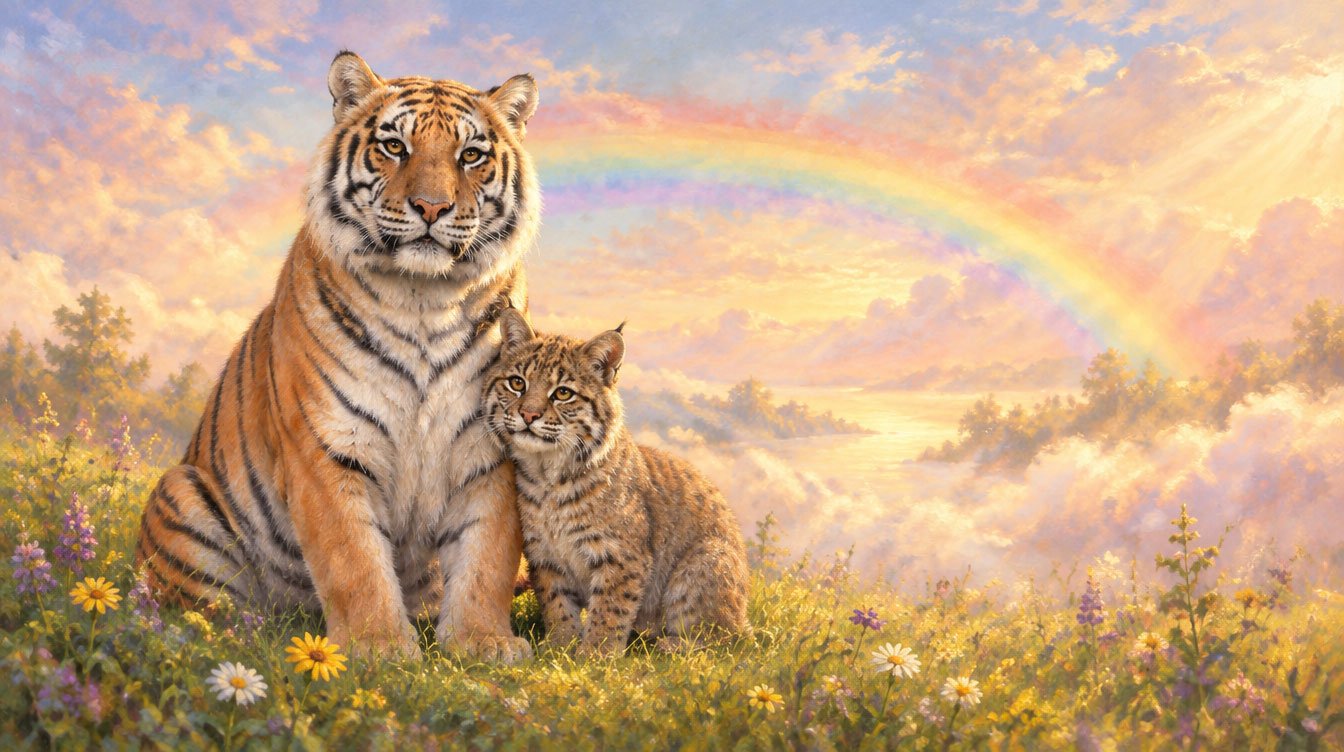
Farewell to Aria and Summer
Two of the cats we moved to Turpentine Creek Wildlife Refuge in 2023 passed away in the last few weeks. Both were loved to the end.
Aria Tiger, about 2005 to August 23, 2026
When Ohio officials seized Aria in 2019, she had spent four years in a pen so small and filthy that the ground had turned to concrete. Her hips and shoulders were open wounds, and her teeth were broken. Our vets were not sure she could be saved. She never stopped chuffing hello to the people caring for her, and when her wounds finally healed, her first steps on soft green grass made all of us cry. Aria was about 21 when she was gently let go. After 27 years of saying I had no favorite, I will admit it now. Aria was mine. She is exactly why the Big Cat Public Safety Act had to pass.
Summer Bobcat, July 2021 to September 17, 2026
Summer came to our bobcat rehab program at two and a half weeks old, too weak to stand on her front legs. Jamie Veronica nursed her around the clock through parasites, infections and scare after scare. Summer won every fight, but she was born with dwarfism and never grew past half the size of a normal bobcat, so she could not safely go back to the wild. She became our forever kitten, sassy and squeaky and adored by fans on her live cam. At just five years old, her heart gave out from complications of her condition. Run free, Summer girl.
Aria and Summer are why we fight to keep wild cats out of cages. The Tilcayo tiger cat is why we fight to keep their forests standing.
