Icarus - International Cooperation for Animal Research Using Space
When Space Becomes a Guardian:
How the Icarus Satellite System Could Change the Future for Wild Cats
For more than three decades, we at Big Cat Rescue have wrestled with one of conservation's most humbling questions: what happens to an animal after you let it go?
When we began rehabilitating bobcats here in Florida — taking in cats blinded by mange, orphaned by traffic, or weakened by disease — we poured everything into giving them a second chance. We built sprawling naturalistic enclosures spanning 4,600 square feet so they could rebuild their muscles. We observed strict protocols to prevent human imprinting. And then, with full hearts and genuine uncertainty, we opened the gates. The palmettos swallowed them up, and the story seemed to end there.
That is, until we partnered with the Florida Fish and Wildlife Conservation Commission (FWC) to change that. Using GPS and radio telemetry collars fitted to rehabilitated bobcats — including two mange-covered sisters named Pia and Venkman who were among our pioneers — we finally began learning what life after release actually looked like. Were these cats establishing territories? Were they breeding? Were they truly becoming wild again? The collars, designed with break-away leather bands so they would eventually fall away on their own, gave us those answers for the first time.
It was a meaningful step. And it also raised hard questions that have stayed with me ever since.
A Longstanding Concern — and a Welcome Evolution
I want to be honest with you, Big Cat Rescuers.
"I have never liked the idea of collaring wildcats, for fear of them getting entangled or causing the cat distress. But I appreciate that the work has continued and has reached a point where the technology can now truly benefit wildcat species — with far less risk of harm than ever before." — Carole Baskin, Founder and CEO, Big Cat Rescue
That tension — between the value of knowing and the cost of intervention — has shaped how I think about every tracking technology that has come along. Which is why the recent emergence of the Icarus satellite system feels genuinely different, and why I think every person who cares about wild cats needs to know about it.
The Internet of Animals: What Icarus Actually Does
Icarus — short for International Cooperation for Animal Research Using Space — is a project developed by the Max Planck Institute of Animal Behavior in Germany. At its heart, it is exactly what its creators call it: an Internet of Animals.
The system works through miniature tracking tags that animals carry. These tags are not the bulky radio collars of decades past. Today's versions can be as small as a grain of rice in some cases, capable of monitoring GPS location, movement patterns, heart rate, body temperature, and atmospheric pressure — transmitting all of it to satellite receivers orbiting in low Earth orbit. The shift from ground-based receivers to satellites is, as researchers describe it, like moving from landlines to mobile phones. Coverage expands from a handful of reserves to the entire planet.
The first Icarus satellite launched in late 2024 aboard a SpaceX Falcon 9 rocket. A second microsatellite, named Raven, followed in May 2026. By mid-2027, the project aims to have six receiver satellites in orbit, forming what is being called Icarus 2.0 — a constellation capable of delivering up to six data updates per day from tagged animals anywhere on Earth. The goal is to have 100,000 animals tagged globally by 2030, with all data published freely in a database called Movebank — a permanent, openly accessible record of animal life on this planet.
Reading the Language of Panic — and What It Means for Wild Cats
Perhaps the most striking application of Icarus is one that connects directly to the greatest threat facing wild cats today: poaching.
At Namibia's Okambara reserve, researchers spent days simulating poaching events while drones and sensors recorded how different species responded to human threats. The results were remarkable. Springbok scattered in one direction, zebras broke into full gallop, wildebeest fled for hundreds of meters across open salt plains, while giraffes held still and turned to face the danger. Every species had its own behavioral fingerprint — a unique signature of fear.
Scientists are now training algorithms to recognize these panic patterns in real time. When unusual behavior ripples through a tagged population, rangers receive an alert. The animals themselves become the alarm system.
At Kruger National Park in South Africa — home to the world's largest rhino population, where more than 10,000 rhinos have been poached over the past 15 years — roughly 3,000 ear tags have already been deployed across 1,500 animals. The system has helped rangers free 80 wild dogs from snares and reconstruct poacher movements ahead of rhino attacks.
Now imagine what this means for wild cats.
For cheetahs, whose ranges stretch across vast, unmonitored landscapes in sub-Saharan Africa and Central Asia, Icarus could provide the first comprehensive picture of how these cats move across borders, where they are most vulnerable, and when poachers are near. When Jamie, Victor and I visited projects in S. Africa, including Kruger, we saw some of this tech in action.
For leopards, who are notoriously secretive and difficult to study, continuous behavioral monitoring could reveal stress patterns, territorial shifts driven by habitat loss, and population pressures that would otherwise go unseen for years.
For tigers, whose fragmented forest habitats are riddled with snares, the panic-detection model pioneered in Namibia could help rangers respond to threats before an animal is lost — the same way it has already freed wild dogs at Kruger.
For lions in the Congo Basin and the Amazon's pumas, Icarus project leader Martin Wikelski has said the system's greatest impact will be in precisely these places — vast, remote landscapes where animals cross unmonitored terrain daily and conservationists have long struggled to keep watch.
For Florida panthers — fewer than 200 remain in the wild — and for bobcats rehabilitated and released right here in our home state, the prospect of satellite-scale monitoring without proportional increase in invasive intervention is transformative.
Why This Matters More Than Another Collar
What makes Icarus genuinely different from the tracking work we and other organizations have done is the question it answers at a systemic level.
Individual collaring tells you about individual animals. Icarus tells you about ecosystems. When thousands of species across a landscape are tagged simultaneously, their collective movements become a living map — of predator-prey relationships, of habitat corridors being lost or reclaimed, of climate pressures rippling through a food web in real time. As one researcher put it, every tagged zebra and giraffe becomes a sensor in a global early warning network. And every tagged wild cat becomes a sentinel for its own survival.
The data collected through Movebank will be freely available to scientists, conservationists, and governments worldwide. That means the knowledge gathered about cheetah movement in Namibia can inform protection strategies for lions in Tanzania, leopards in India, and clouded leopards in Borneo — all from the same constellation of satellites watching over them.
From Tampa's Palmettos to the Skies Above the Serengeti
When Pia and Venkman disappeared into the Florida scrub with their break-away collars, we were asking the smallest version of a very large question: does what we do here matter out there?
Icarus is asking that same question for every wild animal on Earth, all at once.
Big Cat Rescue has always believed that understanding is the foundation of protection. We spent years documenting the needs of cats in our care, lobbying with that knowledge to pass the Big Cat Public Safety Act, and funding conservation projects around the globe. We have always known that the wild cats who most need our help are the ones we can see the least — the ones slipping through unmonitored forests, crossing unmarked borders, living and dying beyond the reach of any ranger or camera.
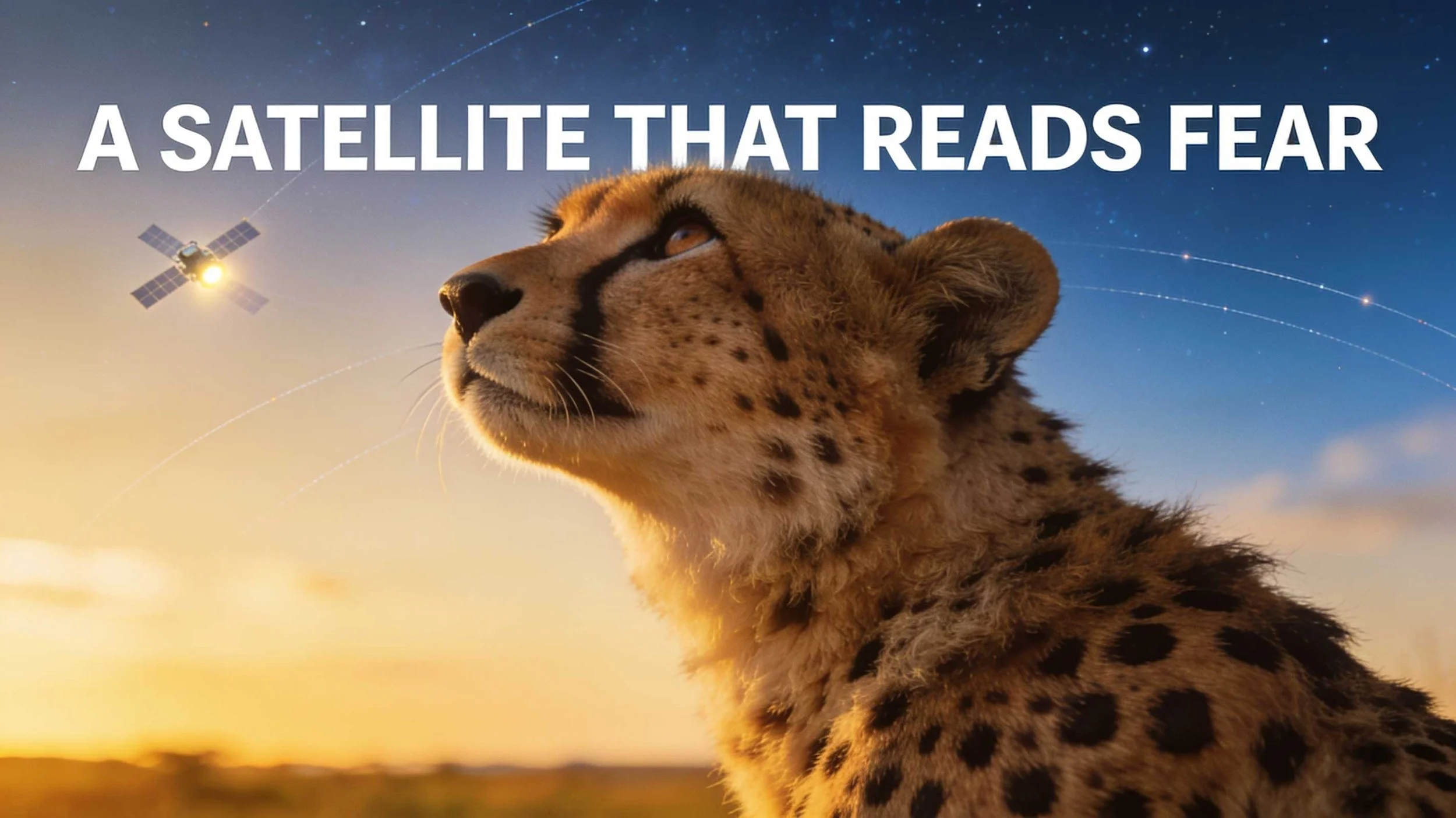
A satellite that reads their fear, maps their journeys, and alerts the people who can protect them in real time is not just a scientific tool. It is something closer to what we have always dreamed of: a world that watches over wild cats the way we would want someone to watch over them.
We will be following the Icarus project closely, exploring how BCR's conservation funding and partnerships can help bring this technology to the wild cat species who need it most. If you want to be part of that work, consider supporting Big Cat Rescue's global conservation fund — because the story doesn't end when the gate opens. It's just beginning.
---
Carole Baskin is the Founder and CEO of Big Cat Rescue, a nonprofit organization dedicated to protecting wild cats from poaching, trafficking, and habitat loss, and to educating the public about preserving nature. Learn more at BigCatRescue.org.
https://www.bbc.com/future/article/20260521-tracking-animal-panic-from-space
