The AdvoCat October 2026 Happy Halloween — from the cats.
Wild cats are nature’s original Halloween creatures: creatures of the night, silent hunters, eyes that glow in the dark. They have frightened and fascinated us for as long as we have been human. The trouble is that too many people still let that fear drive the relationship. Steel traps in Colorado. A century without legal protection for mountain lions in Texas. A fishing cat caught and injured before anyone intervened. The ghosts of bad policy haunt these animals for generations.
But this month also gave us reasons to believe the haunting ends. A fishing cat rehabbed by the Fishing Cat Conservation Alliance swam back into the wild this week. A Texas A&M study revealed that ranchers are far more open to coexistence than anyone assumed. On a Caribbean island, a young Oxford biologist is giving ocelots their first national protection program. And in southern Brazil, a farmer who lost 40 chickens to a wild cat became one of the most important citizen scientists in the region.
Not tricks. Treats.
From Tiger King to a Brighter Future for Big Cats
What happens when rescued tigers finally feel safe enough to relax? Join podcast host John Mingione as he visits Turpentine Creek Wildlife Refuge in Arkansas for heartfelt conversations with Howard and Carole Baskin and the dedicated team caring for rescued big cats. Hear the remarkable story of a traumatized tiger who learned to trust again, discover how the Big Cat Public Safety Act became law, and find out why Big Cat Rescue is now focused on keeping wild cats in the wild. It's an emotional, inspiring journey every cat lover should hear!
Listen to the podcast and discover how you can help create a world where all wild cats live free.
Conservation Win
A Fishing Cat Got a Second Chance — and Took It
The Fishing Cat Conservation Alliance announced this week that they have successfully rehabbed and released a fishing cat back into the wild. I found out when the post went up overnight and my first thought was exactly what I wrote back: so nice to see the cat getting a second chance at living free.
Fishing cats (Prionailurus viverrinus) are listed as Vulnerable on the IUCN Red List and are disappearing fast as the wetlands they depend on are drained, developed, and fished out. They are about twice the size of a house cat, built like swimmers, with partially webbed feet and a thick double coat. They live in mangroves, reed beds, and tidal creeks from India and Nepal through Southeast Asia — exactly the ecosystems that disappear first when human pressure builds.
The FCCA was founded specifically to fill the gap in fishing cat research and coexistence work, and stories like this one — a cat harmed by the world, healed by people who cared, and set free again — are what that investment looks like in the real world. One cat back in the water is one more chance for a breeding population that needs every animal it can get.
Urgent — Election Day November 3

Colorado Amendment 83: Vote No Before November 3rd
If you live in Colorado, or know anyone who does, please share this now: Colorado Amendment 83 would undo wildlife protections that took years to win. A yes vote brings back steel-jaw traps, wire snares, and bear baiting — methods banned because they are indiscriminate, cruel, and out of step with how science says wildlife should be managed.
Steel-jaw traps and wire snares do not care what they catch. They injure pets, raptors, and non-target species as readily as they catch the animals they were set for. A trapped animal can remain caught for days, in pain, before anyone checks. Bear baiting — luring bears with food piles to set up a killing shot — was eliminated because wildlife managers across the country recognized it as incompatible with fair-chase hunting and healthy bear behavior.
Amendment 83 is on the ballot November 3. Voting no costs nothing and protects the gains Colorado made. If you are in Colorado, vote. If you have friends there, forward this email. Wild cats in Colorado — mountain lions, bobcats — need every vote.
Learn more about why you should vote NO on 83 in CO →
Field Science
Texas Ranchers Are Not the Enemy of Mountain Lions. Here’s What the Data Show.
A new Texas A&M study just upended the assumption that ranchers are the biggest obstacle to mountain lion survival in Texas, and the finding matters for every state where cats and livestock share a landscape.
Here is the backdrop: 95 percent of Texas is privately owned land. Mountain lions have had essentially no legal protection in the state for over a century — they are classified as “nongame” animals with no regulated season and no harvest limits. They exist in two isolated populations in the Trans-Pecos and South Texas, and they have been hunted, trapped, and poisoned for generations with no meaningful oversight.
The researchers surveyed 1,069 Texans on their values, their trust in wildlife agencies, and how they perceive the risk mountain lions actually pose. The result is what they are calling the “paradox of domination”: people with a strong “domination” orientation — valuing wildlife mainly for human use and control — actually showed higher willingness to coexist with mountain lions than the researchers expected. Meanwhile, cattle producers specifically scored higher on mutualistic values (caring about wildlife on its own terms) than non-livestock owners, and they perceived less risk from mountain lions than the general public did.
Field diet studies backed this up: on private ranch land, even where cattle were available, researchers found no evidence of mountain lion predation on livestock.
The takeaway is one worth remembering the next time someone says conservation is about winning an argument. It isn’t. It is about building trust. The study found that agency trust — whether people believe Texas Parks and Wildlife is straight with them — predicted management preferences far more than values did. Share transparent data, provide non-lethal conflict tools, and treat ranchers as partners rather than suspects, and the cats have a future on private land. That is the framework.
Conservation Watch
Trinidad’s Ocelots Have Been Alone for 11,000 Years. Meet the Program Working to Protect Them.
When the last Ice Age ended and sea levels rose, the ocelots of Trinidad were cut off from mainland South America. That was roughly 11,000 years ago. Since then, they have lived and evolved in complete isolation — no jaguars, no pumas, no other large predators to compete with. Trinidad’s ocelots function as the island’s apex predators, filling an ecological role that no other cat fills anywhere else in the Caribbean.
That isolation may also have made them genetically distinct from mainland ocelots — a possibility that needs research, and research that did not exist until now.
Tyler Murray-Ramcharan is an Oxford-trained biologist who grew up in Trinidad. He founded TTOcelots — the Trinidad and Tobago Ocelot Project — to give the island’s ocelots something they have never had: a national conservation program built specifically for them. Jim Sanderson connected Tyler with BCR, calling the program “unique to Trinidad.” Our own Deb is now following their social media channels and has been watching their work unfold in near real-time.
The threats the ocelots face are familiar from everywhere we work: habitat fragmentation as forests are cleared, roadkill as traffic increases, hunting and poaching, and conflict with farmers over livestock and poultry. What is unfamiliar is the absence of any prior program. TTOcelots is the first. Tyler is building from scratch — genetic sampling to understand the population, corridor mapping to identify what can be protected, engagement with hunting groups who historically saw ocelots as targets, and fencing assistance for farmers to reduce conflict before it starts.
They are also building public connection to the cats. TTOcelots recently opened a public vote to name a female ocelot they have been monitoring. If you want to follow along: @ttocelots on Instagram, or Trinidad and Tobago Ocelot Project on Facebook.
Field Innovation — Brazil
They Needed a Vet Clinic. So They Built One. Wild Cats Are Winning Because of It.
In Brazil’s Maranhão state, deep inside what field biologists call Tiger-Cat Kingdom, one conservation program just reached a milestone that almost never happened.
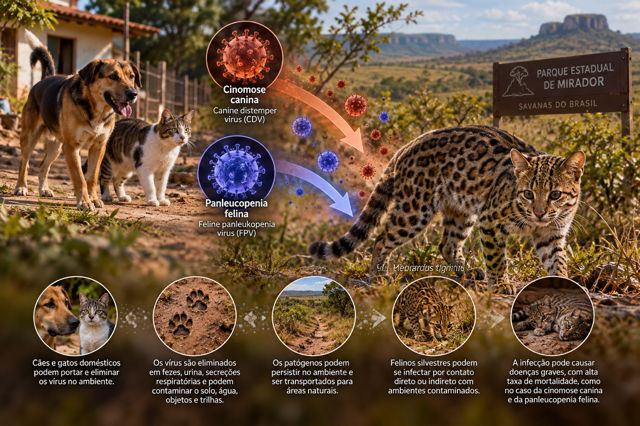
Mirador State Park is one of the most remarkable wild cat habitats on earth. Seven felid species have been documented there — a density of wild cat diversity that is, globally, nearly unmatched. The Tiger Cats Conservation Initiative (TCCI) has been running the Mirador Tiger Cat Conservation Program here with one central goal that is unglamorous but essential: reducing the disease spillover risk that domestic dogs and cats pose to wild felids in the surrounding communities. The way you do that is by spaying and neutering. Get the domestic animal population under control, cut transmission risk, and the wild cats have a cleaner environment to survive in.
Simple in theory. Nearly impossible in practice — because TCCI was depending on the veterinary hospital at Maranhão State University (UEMA) to do the surgeries, and the hospital kept getting delayed. Administrative issues. Scheduling conflicts. Year after year, their sterilization numbers barely moved: an average of 58 animals per year. For a park surrounded by communities with free-roaming pets, that was not nearly enough.
TCCI’s answer was to stop waiting and build their own solution. They designed a fully-equipped mobile surgical unit, capable of matching hospital-level protocols, that could go directly to the communities that needed it instead of requiring those communities to come to the hospital. They named it the Mohamed bin Zayed Mobile Vet Clinic, in homage to the Mohammed bin Zayed Species Conservation Fund that provided the primary funding to make it possible.
The results were immediate and dramatic. In 2024, their first full year of operation with the mobile clinic, they sterilized 97 animals. In 2025, they reached 105 — and 2025 was also the year TCCI lost its dedicated financial support for several months. This is the number that matters most to BCR: a new partnership with Big Cat Rescue allowed them to sustain the program through that funding gap and keep expanding. They reached 105 animals that year despite the disruption.
In 2026, with the program stable and growing, TCCI sterilized 100 animals in the first half of the year alone. Their projection for the full year is more than 200. That is a 3.4× increase over the UEMA era — achieved not by finding a better hospital, but by building a better system.
TCCI’s published account of the clinic’s journey closes with a line worth carrying with you: “Conservation does not always move forward according to the original plan. Sometimes, when the road becomes difficult, the solution is not to stop; it is to build a new road.” BCR is proud to be listed as a funder of this program, alongside the Mohamed bin Zayed Species Conservation Fund, the Barrett Foundation, and SWCCF. For the cats.
Around the World - Brief Notes from the Field
Brazil — Geoffroy’s Cat Working Group
When a farmer loses 40 chickens, he could retaliate. This one became a scientist instead. In southern Brazil, a farmer named Fernando had 40 chickens killed by a Geoffroy’s cat. That is a real loss. That is income, protein, and months of work. For many farmers in the region, the cat would have been dead within the week.
Instead, Fernando contacted the Geoffroy’s Cat Working Group and started talking. Flávia Tirelli, the BCR-supported GCWG coordinator, reached out. The Felinos do Pampa team came in. Fernando became a monitoring partner — someone with eyes on a stretch of habitat that the researchers could not cover alone.
And then Fernando filmed something remarkable. On his land, in broad daylight, a Pampas cat (Leopardus munoai) hunted and killed a rodent on camera. Pampas cats are cryptic, rarely documented on video in the wild. Fernando did not set a trap or a camera station. He just watched, and filmed. The footage became part of a published scientific paper by Felipe Peters et al. A chicken farmer turned field researcher — because someone asked instead of accused.
Fernando’s Pampas cat video is at youtube.com/shorts/Y9jTv1xkFdM.
South Africa — African Wildcat
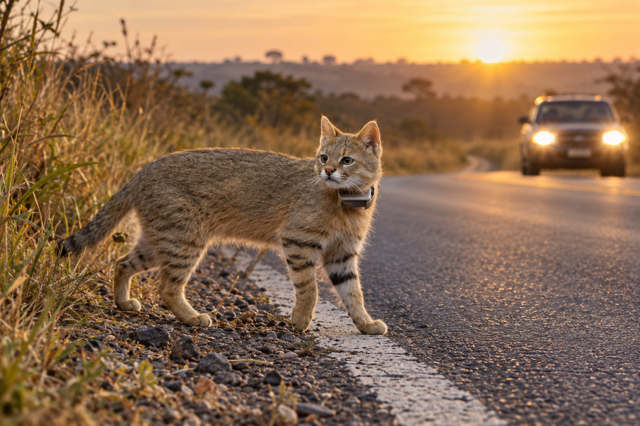
She was ten feet away, hunting insects, and none of us moved. A small team from Alley Cat Rescue traveled to Kruger National Park this month to do two things: observe African wildcats in the wild, and meet with the veterinarians who quietly protect them by sterilizing domestic cats in the villages near the park boundary.
The cats did not disappoint. The team filmed at least two different wildcats — possibly more. One young female came out before sundown, settled within ten feet of the group, and hunted insects in the beam of their flashlights while car motors idled nearby. She was, the team wrote, “completely unfazed” and “such an elegant little creature.”
Why does sterilizing domestic cats save African wildcats? Hybridization. When free-roaming, unsterilized domestic cats interbreed with Felis lybica — the African wildcat, ancestor of every house cat on earth — the wild gene pool is diluted. Over time, genetically pure wildcats disappear. Alley Cat Rescue runs a Trap-Neuter-Return program focused on villages and settlements near Kruger, where the overlap between the two populations is greatest. Their veterinary team works out of the Hans Hoheisen Wildlife Research Station near Orpen Gate, spaying and neutering cats and vaccinating them against disease. More than 6,000 cats sterilized so far, with the program growing every year. BCR supported this work last year with a $15,000 gift — our first conservation project of 2025.
Louise Holton, founder and president of Alley Cat Rescue, has said it simply: “The African wildcat is the ancestor of our domestic cats.” Protecting it is, in the most literal sense, protecting where we came from.
Patagonia — Puma Coexistence
Blink+A: still in development, still promising. Nicolás Lagos at Panthera Chile is continuing work on the Blink+A predator deterrent, a device designed to protect livestock from puma predation without harming the cats. Weatherproofing is working; final lab testing on extreme conditions is ongoing. The goal remains to have devices ready for worldwide field testing by year end 2026. Howard has been following up and we will share a field report when the first units deploy.
Your support reaches into farms in Brazil, corridors in Trinidad, fields in Chile and Peru, forests in Uganda — and on November 3rd, 2026 into a Colorado ballot box. Every part of this work matters.
