01 — HEALTH & WILDLIFE
H5N1 bird flu detected in a wild cat in Seosan, South Korea
South Korea has confirmed highly pathogenic H5N1 avian influenza in a wild cat found dead near Ganwol Lake in Seosan, South Chungcheong Province. The animal — a leopard cat, listed in Korea as an endangered Level II species that feeds mainly on rodents and birds — was reported by a visitor on October 23, 2026 and confirmed positive on November 2, 2026 after testing by the National Wildlife Disease Control Institute. It is the second confirmed H5N1 case in a wild mammal in South Korea, after a wild cat in Hwasun last March, and the first such detection this winter.
Officials say surveillance has stepped up within a 10-kilometre radius of where the cat was found, including searches for other dead wild mammals. The case matters beyond one animal: Korea tested 245 wild-mammal samples between January and October this year as part of monitoring around migratory-bird habitats, and mammal cases like this are watched closely as an early signal of how widely the virus is moving through wild bird populations.
Read the original: “H5N1 Highly Pathogenic Avian Influenza Detected in Wild Cat in Seosan” — Aju Press, Nov. 2, 2026
02 — LIVING ALONGSIDE BIG CATS
Nepal tests artificial scent markers to steer tigers and leopards away from villages
What if a tiger could be turned away from a village not by a fence or a flashing light, but by a smell — the scent of another big cat that seems to have already claimed the ground? That is the idea being tested in Nepal’s Khata Corridor, where dispensers release laboratory-made versions of chemicals found in big-cat scent markings. In March 2025 a camera trap filmed a Bengal tiger approach one of the small scent stations, sniff it carefully, and then turn back the way it came — one of several similar encounters recorded with both tigers and leopards.
The team behind the work, which grew out of earlier trials in Botswana and involves Cornell wildlife veterinarian Martin Gilbert, is careful not to over-claim. Nepal’s tiger population has more than tripled since 2010, a conservation success that has also pushed more tigers — and, in turn, leopards — into buffer zones and community forests where people graze livestock. The open question is a basic one: can these compounds reliably change a predator’s behaviour at all? If they can, a scent “bio-boundary” could become a low-cost, non-lethal way to protect both livestock and the cats themselves.
Read the original: Nepal Tests Artificial Scent Markers to Keep Tigers and Leopards Away from Villages” — EnviroLink, Oct. 31, 2026
03 — TRAIL CAM ACTION
A snow leopard mother and her three cubs, caught on camera in Sailugemsky
Snow leopards are famously hard to see — solitary, mountain-dwelling, and active when people are not — which is why footage from Sailugemsky National Park in Russia’s Altai Mountains drew so much attention. A trail cam there captured a mother snow leopard traveling with three cubs, a generous litter for a species that more often raises one or two young at a time in some of the harshest terrain on earth.
Moments like this are more than charming. Every confirmed litter helps researchers piece together how Altai snow leopards are faring, where mothers are successfully raising young, and which ridge corridors the cats use to move through the park and across the nearby Mongolian border. For an animal nicknamed the “ghost of the mountains,” a few seconds of camera-trap video is real evidence of a breeding population holding on.
Read the original: A snow leopard mother and her three cubs caught on a camera trap in Sailugemsky National Park” — Nevsedoma, Oct. 27, 2026
04 — CLOSE TO HOME — FOR THE CAT
A jaguar turns up in South Ambergris Caye, Belize
Residents in South Ambergris Caye were urged to stay vigilant — and to keep pets safely indoors at night — after a jaguar was reported in the area and captured in surveillance footage. The South Ambergris Caye Neighborhood Watch issued the notice and contacted ACES Wildlife Rescue, which noted that tracks and other signs of jaguar activity have been found on the island before. In other words, this was not necessarily a lost visitor; it was a reminder that the island is shared habitat.
Belize’s Forest Department makes the same point: jaguars, pumas, ocelots, and margays all live on Ambergris Caye, and this jaguar may have swum over from Bacalar Chico Nature Reserve on the mainland side, where jaguars are regularly recorded. The sighting also landed alongside a sharper local worry — the pace of construction and land clearing on the caye, and what it means for the wild residents who were there first. Anyone who encounters the cat is asked to keep their distance and report the time, place, and behaviour to the Forest Department.
Read the original: Jaguar Sighting in South Ambergris Caye Prompts Call for Vigilance” — Ambergris Today, Oct. 28, 2026
05 — A RECOVERY STORY
Trail cams catch tiger mother Mae Kaew leading her cubs, as Thailand’s tigers grow
Night-time camera-trap footage in Thailand shows a tigress named Mae Kaew moving through the forest with her cubs — and her story, pieced together camera trap by trap, is remarkable. Mae Kaew left Huai Kha Khaeng Wildlife Sanctuary in 2021 and settled in the Upper Western Forest Complex, where she has since raised three litters totaling nine cubs: two in 2022, three in 2023, and four in 2026. One of her 2022 daughters has now had cubs of her own, which makes Mae Kaew a grandmother — the clearest possible sign that protection is turning into a self-sustaining population.
Her family is part of a bigger national picture. On July 29, 2026, the Thai government announced a new wild tiger estimate of 210 to 257 animals, based on trail cams across 30 protected areas that found tigers in 26 of them, with Huai Kha Khaeng still the stronghold at around 100 tigers. Conservation groups working alongside the parks department have also been restoring the prey tigers depend on, moving sambar deer and banteng into habitat and tracking them by GPS collar — the unglamorous work that makes footage like Mae Kaew’s possible.
Read the original: Camera traps catch a tiger mother leading her cubs as Thailand’s tiger population grows” — The Cool Down, Oct. 31, 2026
06 — A FIRST
The World's First Reserve for the Asiatic Golden Cat
Peren District, Nagaland, India
In the forested hills of northeast India, the people of Bamsiakilwa (Hebamlo) village have done something no community had done before. They set aside a forest specifically to protect the Asiatic golden cat. The new Daukeling-Hebamlo Community Conserved Area is described as the world's first community conserved area dedicated to this species, one of the least-studied wild cats in Asia.
Dr. C. Zupeni Tsanglai, Wildlife Warden of the Dimapur Division, formally inaugurated the reserve and unveiled a stone monolith and a statue of the golden cat to mark the occasion. The villagers agreed to enforce strict rules inside the reserve, including a ban on hunting and on anything that disturbs wildlife habitat. Village chairman Pauka urged residents to stop hunting and to work together to protect the golden cat and the other animals that share its forest.
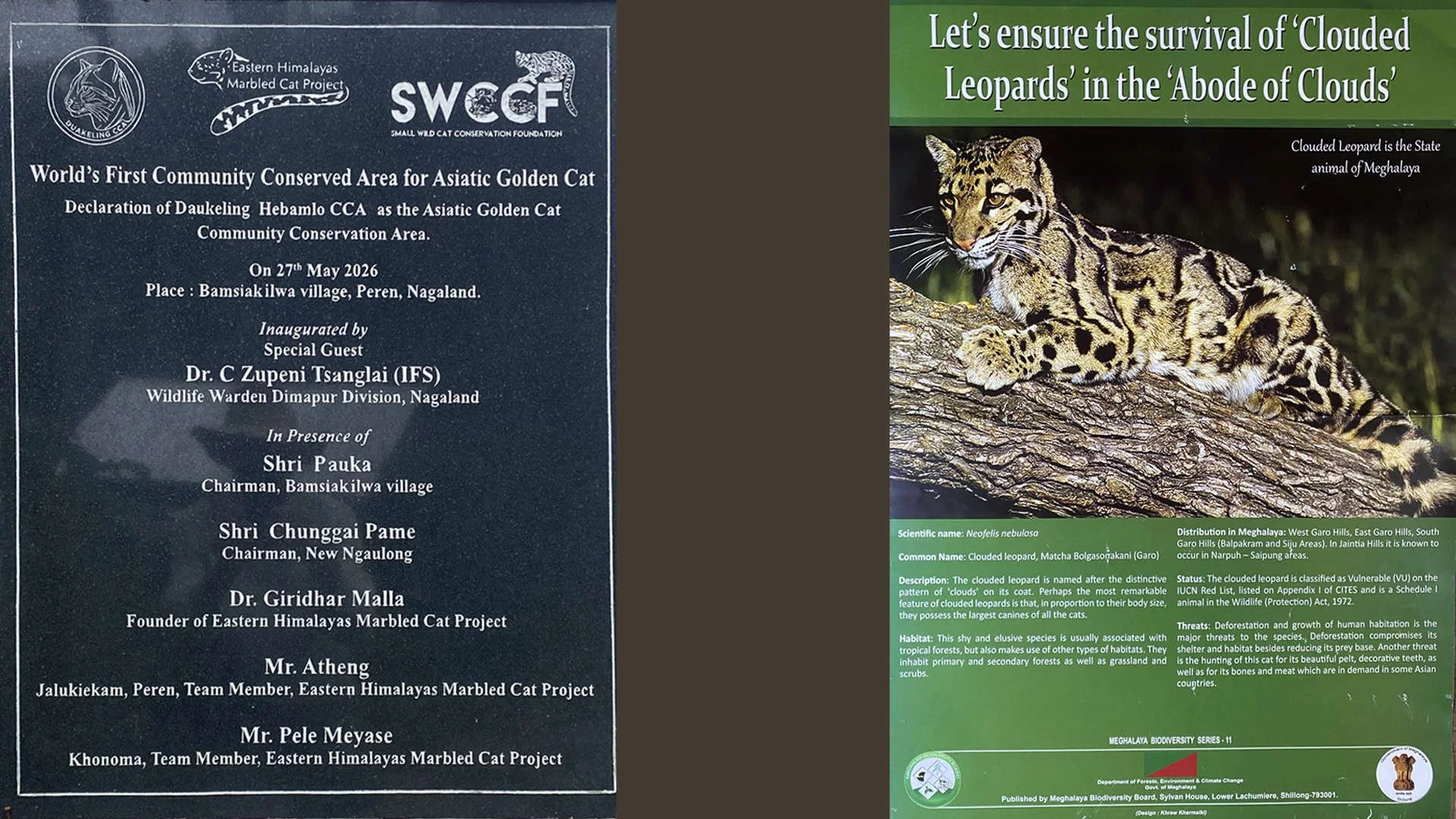
Asiatic Golden Cats Conservation Area and Clouded Leopards on the Cover
The reserve is a partnership between the Bamsiakilwa community, the Eastern Himalayas Marbled Cat Project, and the Small Wild Cat Conservation Foundation (SWCCF). Dr. Jim Sanderson of SWCCF has just shared new photos from the reserve with our team, and seeing them was a reminder of how much can change when a single village decides a wild cat is worth more alive than dead.
The Asiatic golden cat (Catopuma temminckii) is a medium-sized wild cat, roughly two to three times the size of a house cat, and one of the most variable cats on earth in color. Individuals can be golden, fox-red, gray, black, or even spotted. It lives in forests from the eastern Himalayas through Southeast Asia and Sumatra, and is listed as Near Threatened on the IUCN Red List because of habitat loss, hunting, and snaring. Laws on paper only go so far in remote hill country. What makes this reserve special is who is doing the protecting: the people who live alongside the cat every day.
Source: EastMojo, "Nagaland: Peren village creates a reserve for Asiatic Golden Cat," June 5, 2026; Eastern Mirror Nagaland.
07 — A REPORT FROM THE FIELD
Black-Footed Cat Field Report: Tracking Africa's Smallest Cat
South Africa
The Black-Footed Cat Working Group has released its third quarterly field report of 2026, covering fieldwork through the end of September. The report was compiled by field technician Nanti Strydom, and the project is led by Dr. Alexander Sliwa, curator at Cologne Zoo, who has studied this species for decades. Big Cat Rescue is proud to be among the supporters who follow this work closely.
This quarter was a hard one in the field. The team's three remaining radio-collared males have been difficult to follow. Some transmitter signals have not been picking up, and the cats keep leaving the farms where they were originally captured. Every time a cat crosses onto a neighboring property, the team has to get the landowner's permission before they can follow, and access is often limited to daylight hours, when signal range is reduced, or to specific days. As a result, the team collected fewer location points than in previous years, despite spending more time and more money trying.
Sadly, a roaming male the team calls Magnum has still not been found, even after a search flight in August. On the bright side, the working group received additional funding for flights, telemetry equipment, vehicle running costs, and field allowances, all of which were badly needed. Dr. Sliwa thanked the sponsors who stepped up and asked that the report be shared as widely as possible.
The black-footed cat (Felis nigripes) is the smallest cat in Africa and one of the smallest in the world, with adults weighing only about 1 to 2.5 kilograms (2 to 5.5 pounds). Despite its size, it is often called the deadliest cat on earth because of its remarkably high hunting success rate. It lives only in the dry grasslands and semi-desert of southern Africa, mostly South Africa, Namibia, and Botswana, and is listed as Vulnerable on the IUCN Red List. This quarter's report shows why the species is so hard to study and protect: a cat that weighs less than a bag of sugar can cover long distances at night, across land owned by many different people. Its future depends on farmers and landowners who are willing to open their gates to the researchers working to save it.
Source: Black-Footed Cat Working Group, Third Quarter Field Technician Report, N. Strydom, September 2026.
07 — A NEW VIDEO FROM THE FIELD
New Video from the Tiger Cats Conservation Initiative
Brazil
Our partners at the Tiger Cats Conservation Initiative (TCCI) released a new video on YouTube on October 30. Led by Dr. Tadeu de Oliveira, TCCI is a network of conservation projects across the Americas devoted to tiger cats, some of the smallest and least-known spotted cats in the world, and to all the other small wild cats that share their habitat. Because their work benefits every small cat in the region, the group also calls itself the Tropical Cats Conservation Initiative.
One of TCCI's flagship efforts is in Mirador State Park in Brazil's Maranhão state, where seven wild cat species have been documented. A major threat there is disease passing from free-roaming domestic dogs and cats to wild felids. When the university hospital they relied on for spay and neuter surgeries kept facing delays, TCCI built its own fully equipped mobile surgical unit, the Mohamed bin Zayed Mobile Vet Clinic, named for the Mohamed bin Zayed Species Conservation Fund that provided the primary funding.
Sterilizations rose from an average of 58 animals a year to 97 in 2024 and 105 in 2025, and they reached 100 in just the first half of 2026.
Big Cat Rescue is proud to be a funder of this program, alongside the Mohamed bin Zayed Species Conservation Fund, the Barrett Foundation, and the Small Wild Cat Conservation Foundation. Our support helped keep the clinic running through a gap in funding in 2025.
Source: Tiger Cats Conservation Initiative; TCCI Annual Report; The AdvoCat, October 2026.
