Wild Cat Roundup 26-
Our field partners had a busy fall. This post catches up on their news from September and October, starting with a big change for one of the most overlooked wild cats in the Americas. Several of the people behind that change are partners Big Cat Rescue funds.
01 - A STATUS CHANGE
The Jaguarundi Is Now Near Threatened
Mexico to Argentina
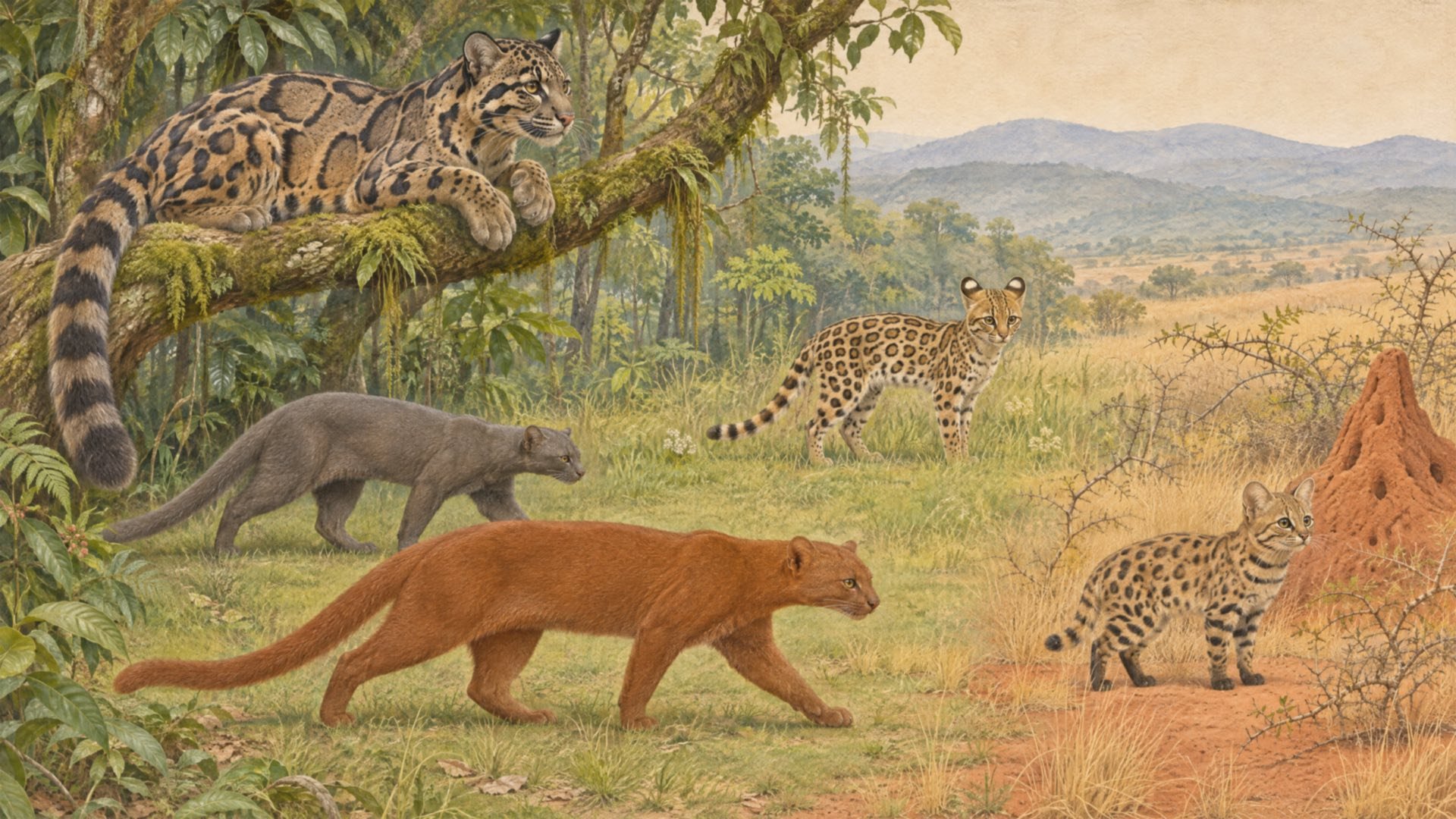
For years, the jaguarundi was listed as Least Concern on the IUCN Red List. In 2026 that changed. The jaguarundi is now listed as Near Threatened, one step closer to being endangered.
The new assessment was led by Tadeu de Oliveira, co-chair of the IUCN Cat Specialist Group. The team estimates there are only about 13,000 mature jaguarundis left. Across much of their range, they are among the rarest wild cats.
So why did people think they were doing fine? Jaguarundis are active in the daytime and often cross open ground, so people see them more than most wild cats. That made them seem common. But when researchers looked at the numbers, the picture was different. As Tadeu put it, "when you quantify it data-wise, it shows to be otherwise."
Jaguarundis face many threats at once: people who kill them for taking chickens, cars, attacks by dogs, and diseases like rabies and mange. Flávia Tirelli, who led Brazil's last assessment of the species, says the change is a warning to pay closer attention to cats that live across huge areas but may be disappearing in many places. Mariam Weston-Flores, who chairs the Ocelot Working Group, helped write the assessment and says jaguarundis have been left out of most wild cat research.
Big Cat Rescue connection: Big Cat Rescue funds all three of these partners' programs: the Tiger Cats Conservation Initiative, led by Tadeu de Oliveira; the Geoffroy's Cat Working Group, led by Flávia Tirelli; and the Ocelot Working Group. This year we also paid for Tadeu's travel as co-chair of the Cat Specialist Group, so he can carry out Red List assessments like this one. Their field programs take on the same threats this assessment names. They spay, neuter, and vaccinate dogs and cats to stop the spread of disease, build predator-proof chicken coops so farmers do not lose birds to wild cats, and put up signs to prevent roadkill.
Learn more: Jaguarundi Facts
Sources: The Cool Down, "Long-overlooked wild cat ranging from Mexico to Argentina now listed as near threatened," September 1, 2026; Mongabay, "Increasingly rare: Jaguarundi moves up a notch on the endangered species list," August 2026.
02 - CAUGHT ON CAMERA
A Clouded Leopard Family in the Eastern Himalayas
Eastern Himalayas
In late October, we shared trail-camera video of a clouded leopard mother with two cubs, credited to the Eastern Himalayan Marbled Cat Project and the Clouded Leopard Working Group. Clouded leopards are among the hardest cats on earth to see. They live in thick forest and move quietly through the trees. Seeing one with cubs is a rare gift.
A few weeks earlier, a partner of the Clouded Leopard Working Group shared another kind of work that protects these cats: vaccinating and neutering village cats and dogs in the Eastern Himalayas. Free-roaming pets can spread disease to wild cats and compete with them for food. Fewer strays means a safer forest for wild cats.
Clouded leopards have the longest canine teeth for their size of any living cat. Their long tails and flexible ankles let them climb down trees headfirst and even hang from branches. They are listed as Vulnerable.
Big Cat Rescue connection: This year Big Cat Rescue gave $15,000 toward buying about 10,000 acres of forest near Tuting, in Arunachal Pradesh, India. The purchase is coordinated by Malla Giridhar of the Eastern Himalayan Marbled Cat Project. The land will be handed to the local community council to become a community conserved area for marbled cats, clouded leopards, and the other wildlife that live there. Read more about the Eastern Himalayan Marbled Cat Project.
Learn more: Clouded Leopard Facts
Source: Eastern Himalayan Marbled Cat Project and Clouded Leopard Working Group, shared on Facebook, September 27 and October 28, 2026.
03 - TIGER CATS ON CAMERA
Tiger Cats Up Close in Brazil
Brazil
Our partners at the Tiger Cats Conservation Initiative (TCCI) shared some wonderful footage this fall. In the Caatinga, the dry scrub forest of northeastern Brazil, a camera at a waterhole in the Jamacaii Refuge caught a savanna tiger cat mother with her kitten.
TCCI also shared footage of Howie, a tiger cat that was released back to the wild wearing a tracking collar. The collar lets the team follow how a released cat settles in. Their trail cameras also caught jaguarundis, southern tiger cats, and pampas cats.
At Mirador State Park, biologist Vítor Moura took viewers along on a camera-trap check. It is slow, careful work: hiking to each camera, changing batteries and memory cards, and making sure the cameras keep running. Without it, there would be no footage to share.
Tiger cats are some of the smallest wild cats in the Americas, about the size of a house cat or smaller. Scientists have recently learned that what was once called one species is really several, and many of them are still poorly known.
Big Cat Rescue connection: Big Cat Rescue funds the Tiger Cats Conservation Initiative, led by Tadeu de Oliveira. Our support helps pay for camera-trap monitoring, spay and neuter clinics for village dogs and cats, predator-proof chicken coops, and community workshops. Read more about TCCI.
Learn more: Northern Tiger Cat Facts and Southern Tiger Cat Facts
Source: Tiger Cats Conservation Initiative, shared on Facebook, September 27 to October 7, 2026.
04 - FISHING CATS IN NEPAL
A Fishing Cat Project at Nepal's National Conservation Forum
Lumbini, Nepal
In September, the Fishing Cat Conservation Alliance shared that Prativa Kaspal and the Lumbini Fishing Cat Project presented their work at Nepal's National Conservation Forum.
Prativa has spent years working with communities in the wetlands of southern Nepal to protect fishing cats. Her team blends field research with local action, so the work can keep going with little outside help. She is part of Women for Conservation, a small team of women conservationists. She also teaches at Bhaktapur Multiple Campus of Tribhuvan University, where she brings her students into research and outreach.
Fishing cats live in wetlands, where they wade and dive for fish. In Nepal, they often come into conflict with people who farm fish in ponds. Earlier this fall we also shared news of Birja Lake, Nepal's first Fishing Cat Friendly Village.
Big Cat Rescue connection: Big Cat Rescue funds the Fishing Cat Conservation Alliance, a network of 15 partners in eight countries, including Nepal. Read more about the Fishing Cat Conservation Alliance.
Learn more: Fishing Cat Facts
Sources: Fishing Cat Conservation Alliance, Facebook post, September 28, 2026; Fishing Cat Conservation Alliance, "Fishing Cat Conservation in Lumbini Wetlands".
05 - THE SMALLEST CAT IN AFRICA
Meet Ego, a Wild Black-Footed Cat
Nama Karoo, South Africa
In October, Dr. Alexander Sliwa, who leads the Black-Footed Cat Working Group, shared a photo of a wild black-footed cat named Ego in the Nama Karoo of South Africa. In late September he also shared the working group's 2025 annual report.
Black-footed cats are the smallest cats in Africa. Adults weigh only about 2 to 5.5 pounds. They hunt at night and catch prey far more often than most cats, which is why they are sometimes called the deadliest cat on earth. They live only in the dry grasslands and scrub of southern Africa and are listed as Vulnerable.
Big Cat Rescue connection: Big Cat Rescue supports the Black-Footed Cat Working Group. Read about their work in our June post and their latest field report in our November 2 roundup.
Learn more: Black-Footed Cat Facts
Source: Dr. Alexander Sliwa, Facebook posts, September 26 and October 21, 2026.
06 - ON EXPEDITION
Snow Leopards and Pallas's Cats in Mongolia
Mongolia
All through October, Otgonbayar Baatargal shared short videos from his Steppe Wildlife Tour expeditions in Mongolia, featuring wild snow leopards and Pallas's cats. Otgonbayar leads the Steppe Wildlife Research and Conservation Center and has spent more than a decade photographing and studying Mongolia's wild cats.
Wildlife tours done well can do a lot of good. They can help pay for conservation and show local families that wild cats are worth more alive than dead.
Big Cat Rescue connection: Big Cat Rescue funds Otgonbayar's team. In 2026 we paid to build new rock dens for Pallas's cats. Read more about protecting Pallas's cats.
Learn more: Pallas's Cat Facts and Snow Leopard Facts
Source: Otgonbayar Baatargal, Facebook videos posted October 11 to 28, 2026.
07 - CLOSE TO HOME
A Young Bobcat Gets Help in Florida
Florida
On October 18, Owl's Nest Sanctuary for Wildlife took in a young bobcat for rehabilitation. Owl's Nest, run by Kris Porter, cares for injured and orphaned wildlife in Florida, including bobcats.
Bobcat rehab is close to our hearts. For years, Big Cat Rescue cared for orphaned and injured bobcats and released them back to the wild. The goal is always the same: a healthy cat that can hunt on its own and stays wary of people. If you find a bobcat that is hurt, or a kitten that has been alone for a long time, do not pick it up. Call a licensed wildlife rehabilitator or the Florida Fish and Wildlife Conservation Commission.
Big Cat Rescue connection: In 2026, Big Cat Rescue gave Owl's Nest $7,950 for its bobcat hospital: $7,000 to replace the hospital's air conditioning and $950 to help clear land for a new hospital. Read more about bobcat rehab.
Learn more: Bobcat Facts
Source: Owl's Nest Sanctuary for Wildlife, Facebook post, October 18, 2026.
08 - A NARROW ESCAPE
Cheetahs Chase an African Wildcat, and the Wildcat Gets Away
Kgalagadi Transfrontier Park
In October, Ester Janzen Van Vuuren reported seeing cheetahs near Tierkop chase an African wildcat. The wildcat escaped.
African wildcats are the wild ancestors of the house cat. They look a lot like a tabby, but with longer legs and reddish backs on their ears. One of their biggest threats is house cats. When wildcats mate with domestic cats, their kittens are hybrids, and over time pure wildcats can disappear.
Big Cat Rescue connection: Elsewhere in South Africa, Big Cat Rescue funds Alley Cat Rescue, which spays and neuters free-roaming house cats in villages near Kruger National Park to reduce interbreeding with African wildcats.
Learn more: Wildcat Facts
Source: Ester Janzen Van Vuuren, Facebook post, October 20, 2026.
HOW YOU HELP
Every story above has people behind it: biologists checking cameras, villagers protecting forests, and rehabbers caring for kittens. Big Cat Rescue funds this work so wild cats can stay wild. See the conservation projects your support made possible in 2026.
