Beyond the Mane: What a New Study of Zambia’s "Overlooked" Small Cats Reveals About the Wild
1. The Hook: Beyond the "Big Five" Bias
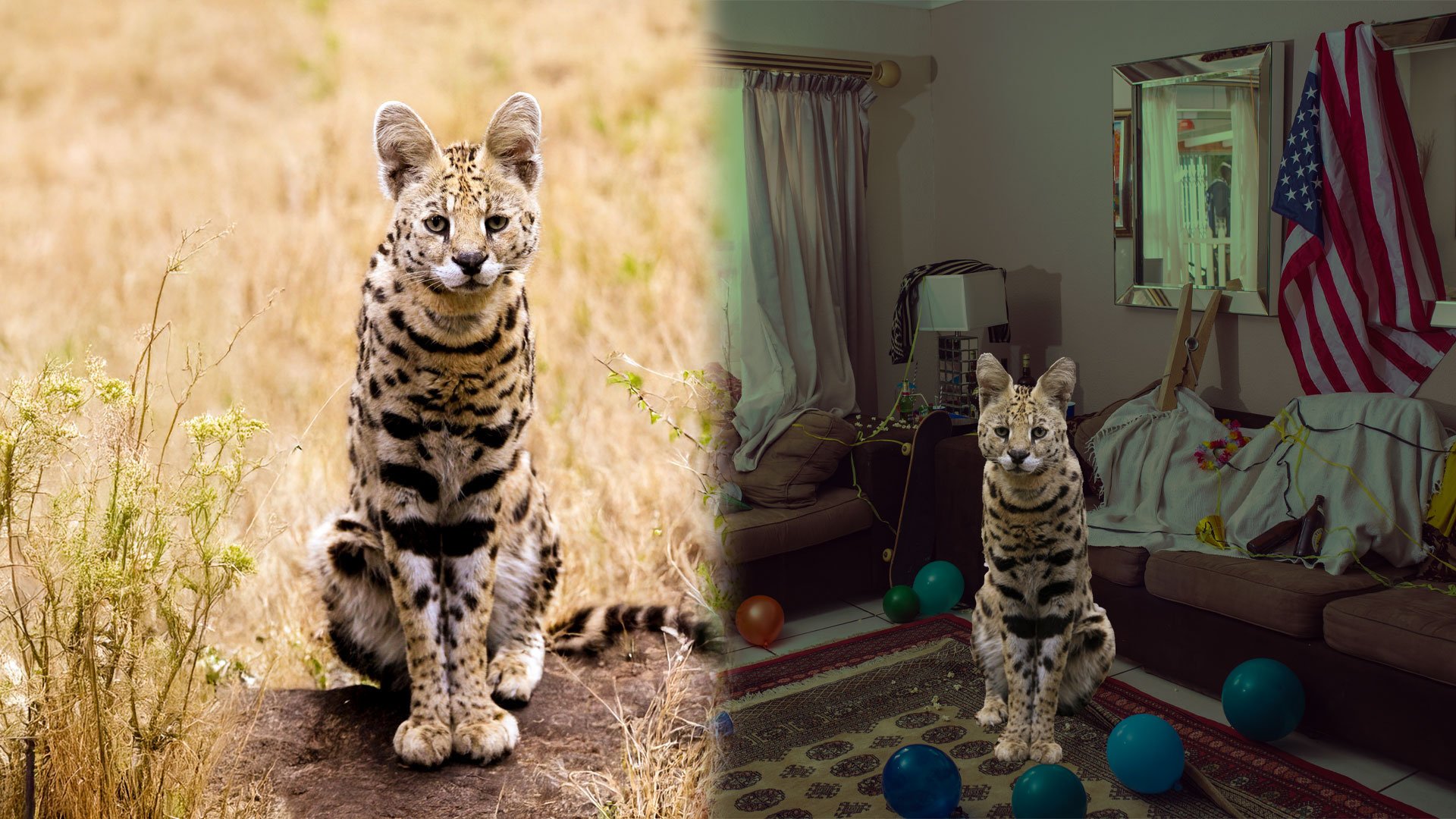
In the vast, golden sweep of the African savannah, the global gaze is almost exclusively fixed on the "Big Five." Lions and leopards command the headlines, the research budgets, and the camera lenses of every passing safari vehicle, personifying the raw, apex power of the continent. Yet, moving like a ghost through the tall grass and wetland fringes is another hunter—the serval—whose ecological significance far outweighs its public profile.
Why have we traditionally ignored this "middle class" of the savannah? A groundbreaking 2026 study conducted in the Greater Kafue Ecosystem (GKE) of Zambia seeks to disrupt this narrative. By shifting our focus from the mane to the distinctive spots of this smaller felid, researchers are uncovering critical insights into how ecosystems actually function and how wildlife persists in an increasingly fragmented world.
2. The "Cinderella" of Conservation: Why Small Cats Are Overlooked
Conservation science is not immune to the "charisma gap." Large felids are viewed as the primary indicators of ecosystem health and serve as the face of nearly all major funding campaigns. However, this aesthetic bias leaves a dangerous data vacuum for mesopredators like the serval (Leptailurus serval).
The study, published in the Journal for Nature Conservation, highlights a stark disparity in how we allocate our attention:
"Large felids... typically receive substantial research attention and conservation funding... In contrast, smaller felids, such as servals (Leptailurus serval), receive relatively less focus despite their ecological role as a mesopredator."
As mesopredators, servals are the invisible threads holding the web of life together. By regulating small-mammal populations, they maintain the delicate balance of grassland and wetland systems. When we focus exclusively on charismatic megafauna, we risk losing the "Cinderella" species that serve as the true barometers of habitat productivity.
3. The "Bycatch" Breakthrough: Tracking Ghosts with Second-Hand Data
Studying the serval is a masterclass in tracking ghosts. They are elusive, largely nocturnal, and expertly camouflaged. To find them, researchers utilized a sophisticated methodology involving Spatially Explicit Capture-Recapture (SECR) models. Rather than a dry statistical exercise, SECR is essentially a way of "mapping the ghosts"—using the distance between camera detections to pinpoint the center of a cat's home range and estimate how many individuals are moving through a landscape.
The breakthrough, however, was in the use of bycatch data. In the realm of wildlife tech, bycatch data refers to information gathered on non-target species during a study designed for someone else—in this case, massive camera-trap grids originally deployed to track lions and leopards.
To ensure scientific rigor, the team used dual-camera stations. This allowed them to photograph both the left and right animal flanks simultaneously. Because every serval possesses a unique pattern of spots and stripes, identifying individual "fingerprints" from both sides of the body allowed for a level of precision previously reserved for the "Big Five." This proves that monitoring servals can be a highly cost-effective solution for resource-limited managers: if you are already tracking the kings, you can track the "middle class" for free.
4. The Industrial Paradox: Why 6 Cats in Zambia is Different from 100 in South Africa
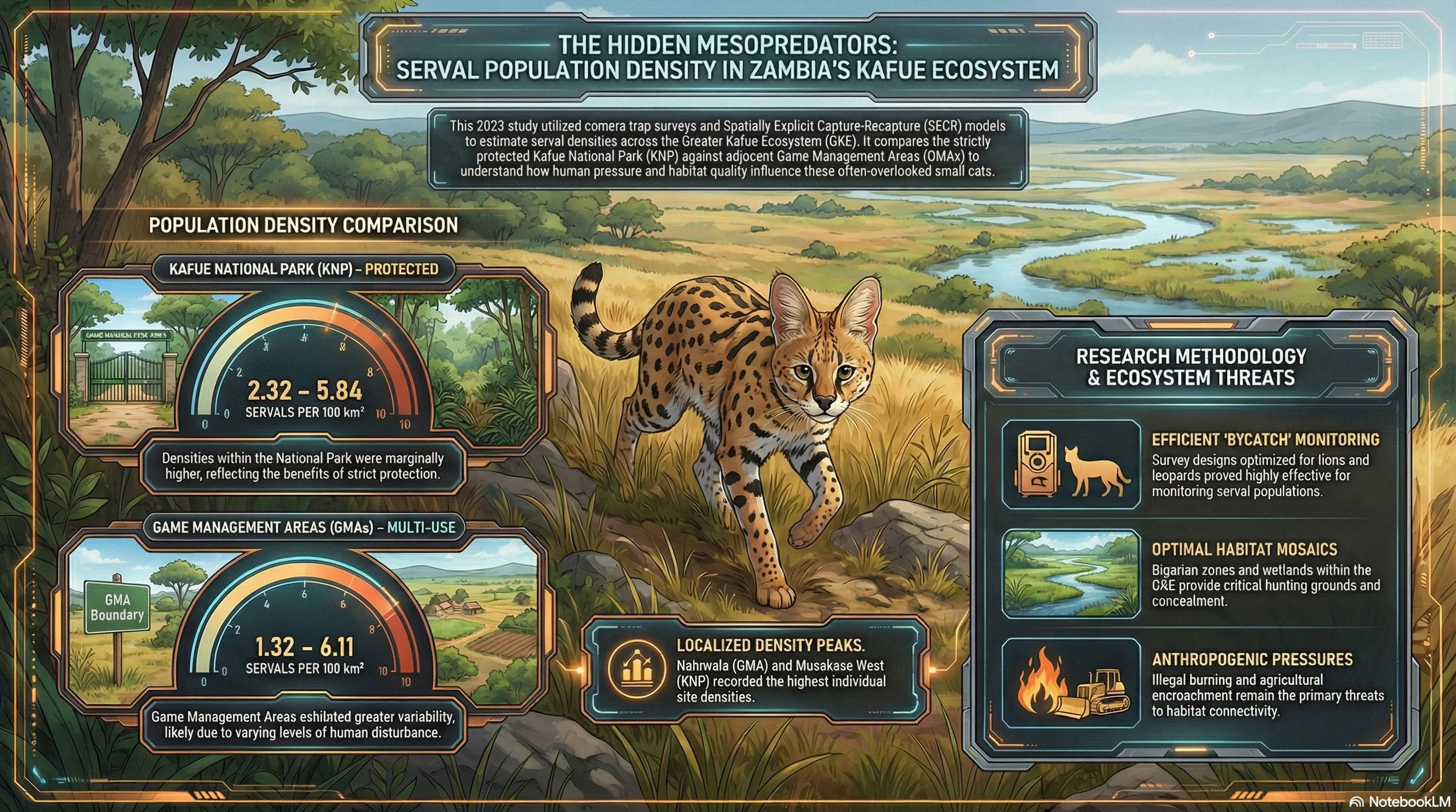
The study recorded serval densities in the GKE ranging from approximately 1.32 to 6.11 individuals per 100 km². While these numbers represent a healthy, wild population, they stand in jarring contrast to an "Industrial Paradox" found in Mpumalanga, South Africa, where densities reached a staggering 101.21 individuals per 100 km².
Why is a "wilder" landscape less dense? The answer lies in Intraguild Competition:
Predation Risk: In the GKE, servals live in the shadow of giants. The presence of lions, leopards, and spotted hyenas—apex predators that will kill smaller cats to eliminate competition—keeps serval numbers in check.
The Release Effect: In human-altered industrial sites, these apex threats are gone. Without "top-down" pressure from lions, serval populations explode in a phenomenon known as mesopredator release, provided prey is abundant.
A Natural Balance: Therefore, the 6.11 density in Zambia is a sign of a balanced, intact ecosystem where the serval must navigate a complex landscape of risk and reward.
5. A Surprising Resilience: National Parks vs. Human Landscapes
One of the most compelling findings was the resilience of servals in the face of human presence. The study compared the fully protected Kafue National Park (KNP) with the surrounding Game Management Areas (GMAs)—multi-use zones where human settlement and trophy hunting are permitted.
Counter-intuitively, the highest density (6.11) wasn't found in the heart of the park, but in the Namwala GMA. Within the park, sites like Musekese West (5.84) and Kafue Central (5.46) also showed high numbers, but the overall data suggests the serval is a master of the "African Mosaic." They thrive in the intersection of miombo woodlands, open grasslands, and riparian zones. As long as the "wetland threads"—the dense vegetation of riparian areas—remain intact for hunting, servals can navigate landscapes where humans and wildlife are deeply intertwined.
6. The 20,000 km² Warning: The Fragility of the African Mosaic
Despite their adaptability, the servals of the GKE face a tipping point. The study identifies a trio of anthropogenic pressures: unregulated burning, bushmeat poaching, and rapid agricultural encroachment. The scale of the threat is massive—approximately 20,000 km² of natural habitat in the GMAs has already been lost to the plow.
The researchers issued a sobering warning regarding habitat fragmentation:
"Zambia’s Protected Area Networks could fragment into isolated pockets, exacerbating human edge effects... unless the current rates of habitat loss and anthropogenic expansion are [checked] in the GKE."
If the GKE loses its connectivity, it will cease to be a functioning ecosystem and instead become a series of "biological islands." Preventing this requires moving beyond traditional "fortress conservation" toward community-based models that empower local populations to protect the corridors that species like the serval depend upon.
7. The Forward-Looking Summary: The Future of the GKE
This 2026 study provides more than just numbers; it establishes a critical baseline for the future. Without this data, we would have no way of knowing in ten years if the population was stable or crashing. It proves that evidence-based conservation must be inclusive, moving its lens beyond the famous and the fierce to the "invisible" species that stabilize the environment.
As we look toward the future of the Greater Kafue Ecosystem, we must confront a difficult question: If we only fund the protection of the animals that look good on a postcard, what happens to the invisible threads that actually hold the ecosystem together? To save the lion, we must ensure there is still a home for the serval in the grass.
4/8/2026