5 Surprising Reasons Why Laws Still Fail the World’s Tigers
The Hook: A Paper Fortress
The tiger is a global icon of conservation, shielded by the highest level of international protection under CITES Appendix I. On paper, it is one of the most legally fortified species on the planet.
Yet, this "paper fortress" is failing. Between 2000 and 2022, 85% of the 3,377 tigers seized globally were confiscated within Tiger Range Countries (TRCs).
The reality is a "patchwork of inconsistencies and gaps." Our laws are often blind to 21st-century threats like digital marketplaces and laboratory-bred hybrids.
Why do these frameworks continue to fail the 5,574 tigers left in the wild? The answers lie in five critical, often overlooked, legal voids.
1. The "Hybrid Loophole": Ligers, Tigons, and Legal Voids
While purebred tigers (Panthera tigris) are strictly protected, their hybrid counterparts—like ligers and tigons—occupy a legal "no-man's-land." These animals are bred exclusively in captivity and do not occur naturally in the wild.
Because they are not "naturally occurring," most TRCs fail to define them as wildlife. Of the 12 countries reviewed, only Malaysia and Viet Nam explicitly regulate these specimens.
This allows traffickers to "launder" genuine tiger parts under the guise of unregulated hybrids. If the law doesn’t recognize the animal, it cannot stop the trade in its bones or skin.
"These loopholes can allow for the continued trade in tiger parts under the guise of hybrids, undermining conservation efforts and complicating monitoring and enforcement."
2. The Digital Blind Spot
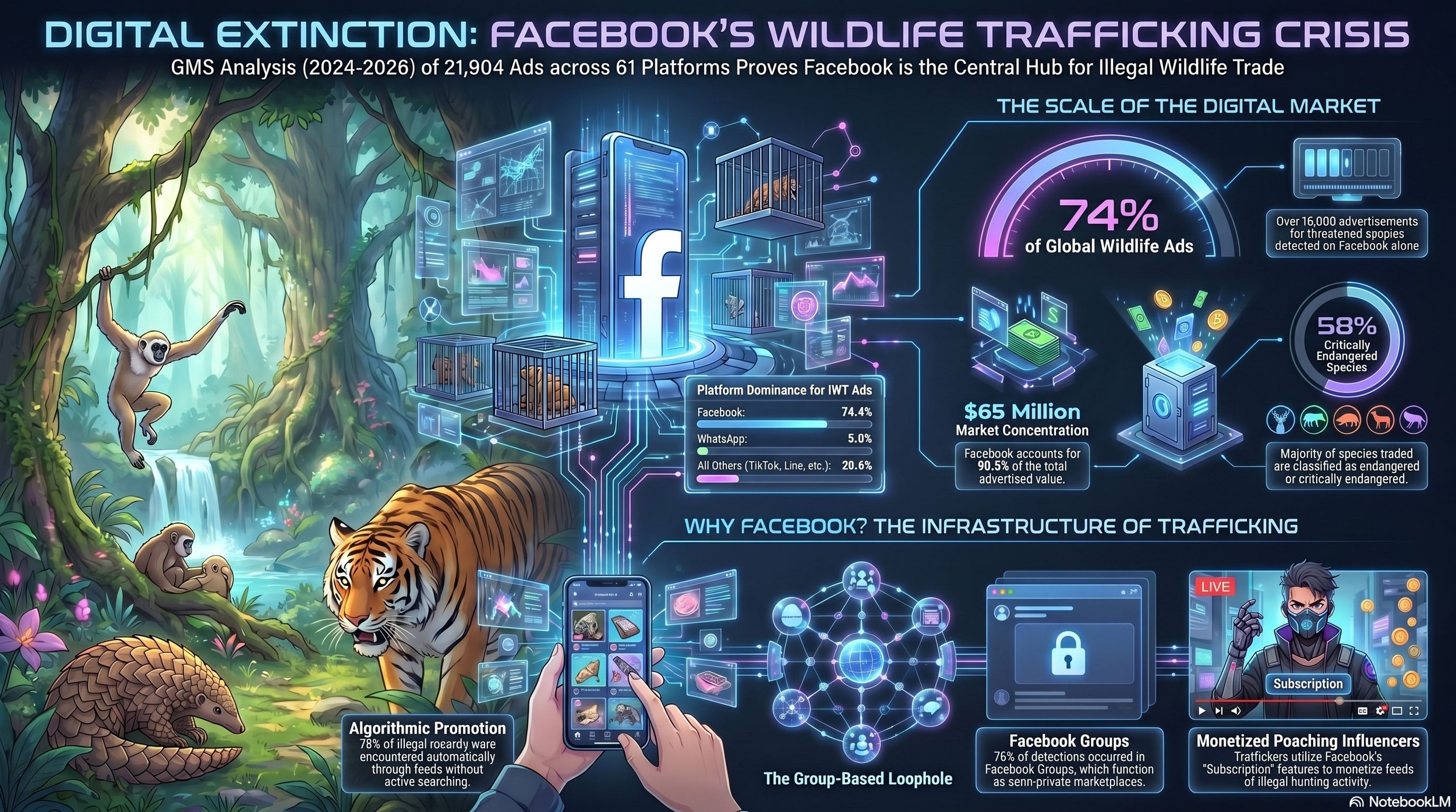
Wildlife trade has moved into the 21st century, but most laws are stuck in the 20th. There is a massive disconnect between the bustling online marketplace and the statutes used to police it.
Currently, only China and Thailand directly regulate online wildlife trade. The scale of this unpoliced digital frontier is staggering.
In Viet Nam alone, investigators identified 22,497 online listings for high-profile wildlife products over a two-year period. Regulating "advertising" is no longer enough to stop this flow.
Without clear "online trade" definitions, investigators lack the mandate for digital forensics. They cannot hold social media platforms or payment systems accountable for facilitating crime.
3. Representation Over Reality (The Power of the Label)
Proving that a processed tonic contains actual tiger DNA is an "enforcement nightmare." Scientific confirmation is expensive, slow, and often impossible for highly degraded products.
Forward-thinking nations like China and Malaysia use a powerful "Legal Fiction" to close this gap. They ban any product claiming to contain tiger, regardless of its actual physical content.
This shifts the burden of proof, making prosecution infinitely easier for overstretched authorities. If a bottle is labeled as "Tiger Bone Wine," it is a crime—no lab test required.
This "readily recognizable standard" also protects lions and leopards, which are frequently used as substitutes. It aligns with CITES Resolution Conf. 12.5 (Rev. CoP19), which targets:
"products labelled as, or claiming to contain specimens of native and non-native Asian big cat species."
4. The Captivity Paradox
There are approximately 8,900 tigers in captive facilities across East and Southeast Asia—nearly double the wild population. Many of these are "facilities of concern" that act as pipelines for the illegal market.
While India uses conservation-focused breeding with strict oversight, other TRCs lack individual identification like microchipping or stripe-pattern photography. This allows wild-caught tigers to be easily swapped into captive stocks.
A major loophole involves the "disposal of the dead." India mandates post-mortems and controlled destruction of carcasses to ensure bones don't enter the trade.
In many other regions, the lack of such protocols means a tiger that dies in a cage can vanish into the underground market. Without traceability from birth to death, captivity remains a cover for crime.
5. The "Powerless" Ranger Problem
Rangers are the first line of defense, but they often face a "physical disconnect" from legal power. They operate in remote forests, while the police with arrest authority are often miles away in urban centers.
In Laos, for example, forest officers must navigate a complex framework where police only intervene in "complex cases" upon request via LAO-WEN. This delay allows traffickers to vanish before an authorized officer arrives.
This is worsened by a lack of "Dual Criminality" harmonization. If "transporting" a tiger is a crime in Indonesia but not in Thailand, a trafficker can exploit that gap to avoid extradition.
Without broad arrest powers for rangers and harmonized laws, transnational cooperation remains a theoretical goal rather than an operational reality. traffickers simply move to the jurisdiction with the weakest mandate.
Conclusion: Closing the Gap
The evidence is clear: well-crafted laws on paper do not automatically lead to meaningful outcomes. Governments must move toward "Clarity over Ambiguity" to modernize their legislative defenses.
We must treat wildlife trafficking with the same severity as narcotics or arms smuggling. This requires empowering frontline rangers and holding digital platforms accountable.
If the law cannot see a hybrid tiger or a digital transaction, can it truly protect the 5,574 tigers left in the wild?
Source: 2025 WWF TRAFFIC report and https://www.worldwildlife.org/publications/law-of-the-tiger-a-comparative-study-of-the-laws-governing-tiger-trafficking-in-12-tiger-range-states/