The Toba Apocalypse and the Ghost of Borneo
How a Super-Volcano Forged the Destinies of Asia’s Mystery Cats
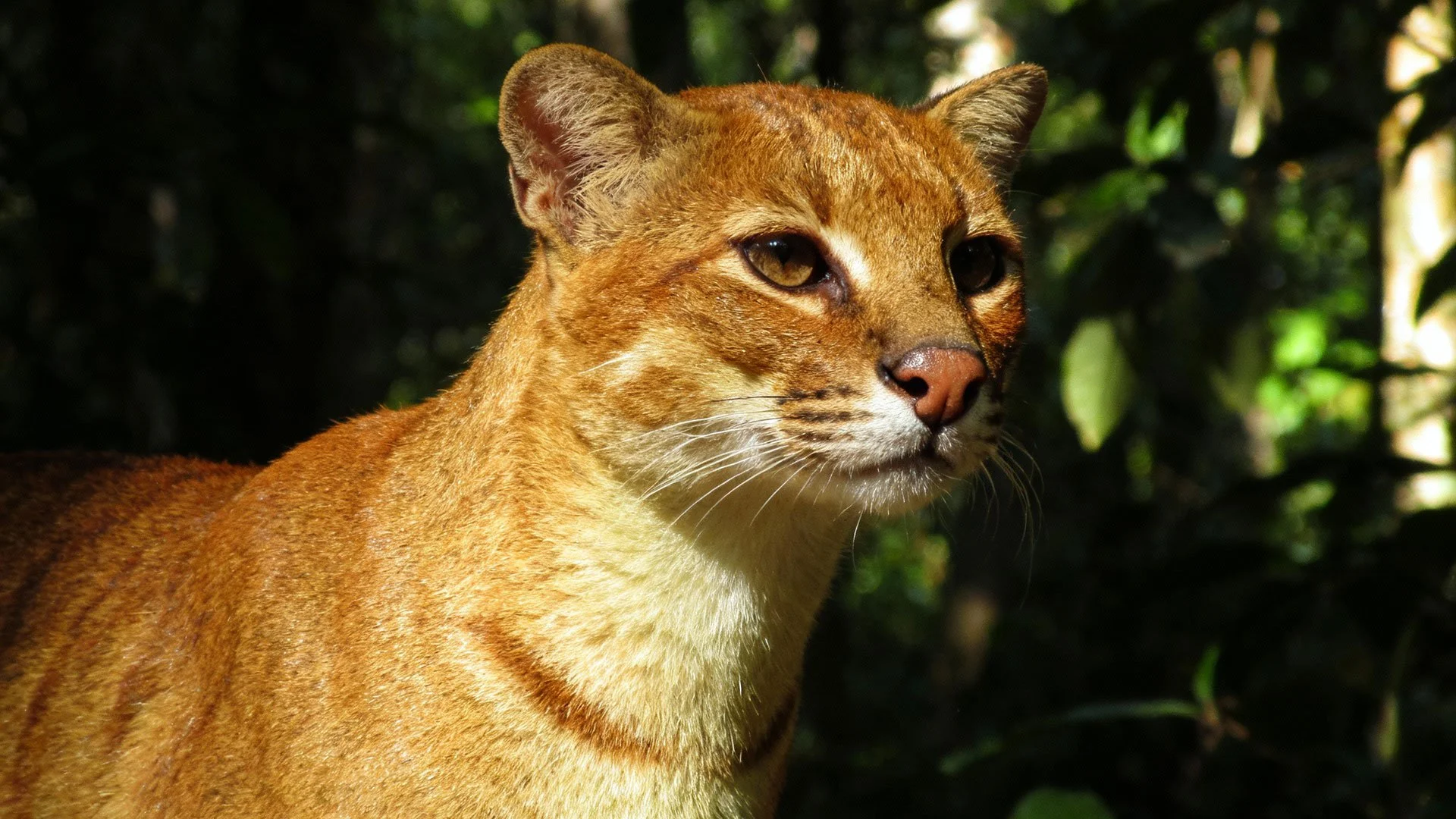
In the emerald depths of Southeast Asia, two feline cousins share a lineage but inhabit vastly different evolutionary realities. The Asian golden cat (Catopuma temminckii) and the bay cat (Catopuma badia) are sister species that split from a common ancestor approximately 3.16 million years ago. Despite their shared genes, their lives represent one of nature’s most dramatic "sliding doors" moments—a story of one relative claiming a continent while the other vanished into the shadows of a single island.
This divergence was not merely a matter of time, but a consequence of catastrophic geological upheaval. New research reveals that the divergent fates of these cats were sealed by a volcanic reset that nearly erased one lineage and permanently isolated the other in a rainforest refuge. It is a striking example of how a single event can rewrite the genetic future of an entire genus.
The Toba Apocalypse: A Volcanic Reset
The most significant turning point in felid history occurred roughly 73,000 years ago with the super-eruption of Mount Toba on Sumatra. This cataclysmic event triggered a massive "bottleneck," a genetic squeeze that nearly drove the Asian golden cat to extinction. The eruption obliterated vast tracts of forest, forcing the survivors into a singular, narrow refuge in Indochina.
As the climate shifted during the peak of the last Ice Age, becoming cooler and drier, the two species were pushed toward opposite destinies. While the Asian golden cat eventually staged a massive comeback from its Indochinese stronghold, the bay cat was driven into the evergreen rainforest refuges of Borneo, where it remains an island endemic to this day.
"We think that the Toba super-volcanic eruption on Sumatra, about 73,000 years ago, destroyed so much forest habitat that it caused a massive population decline in most of the range of the Asian golden cat, with populations surviving only in Indochina," explains researcher Riddhi P. Patel.
The Paradox of the Golden Cat’s Wardrobe
For evolutionary biologists, the Asian golden cat presents a fascinating paradox: it possesses extremely low molecular (genetic) diversity despite occupying a massive geographic range that stretches from the Himalayas to the tropical forests of Sumatra. This is "at variance" with typical biological patterns, where a large range usually implies high genetic diversity due to long-term adaptation to varied environments.
The resolution to this mystery lies in the cat's recent rapid expansion. After the last Ice Age, the species surged out of its Indochinese refuge to recolonize the continent. There simply hasn't been enough evolutionary time for significant genetic mutations to accumulate, even though the cat’s "wardrobe" suggests a highly varied population. Interestingly, while the Indochinese refuge holds the greatest variety of appearances, cats in the Malay Peninsula and Sumatra have lost much of that diversity and are now almost exclusively reddish.
The species is famous for its striking array of color morphs:
Spotted (resembling a small leopard)
Reddish (the dominant morph in the south)
Greyish
Black (melanistic)
This serves as a critical lesson for conservationists: high physical variation does not always equate to a high level of genetic health or long-term stability.
The "Black Hole" of Borneo: Meeting the World’s Most Elusive Cat
While the golden cat conquered the mainland, its sister species, the bay cat, became a "black hole" of wildlife science. Discovered by Alfred Russel Wallace in 1856, the bay cat is arguably the most elusive wildcat on Earth. It is a biological phantom; after a handful of specimens were collected in the late 19th century, the species vanished for 64 years. Between 1928 and 1992, not a single confirmed sighting occurred until a lone, emaciated female was brought to a museum in Sarawak.
Even for specialists, the "Ghost of Borneo" is a mystery. Physically, it resembles a "mini puma" with intense sun-yellow eyes. Its face features two dark lines running up from the eyes like meticulously applied makeup, and its blood-red coat ends in a signature long tail tipped in white. Despite its beauty, its life remains unmapped. The Borneo Nature Foundation spent 16 years camera trapping in Sabangau National Park, successfully recording all four other Bornean cat species in good numbers, yet they never captured a single image of a bay cat.
Fundamental questions remain unanswered:
Diet: No one knows what they hunt.
Hunting style: It is unknown if they are arboreal specialists or ground hunters.
Reproduction: Their mating habits and cub-rearing remain entirely unobserved.
"The bay cat is a black hole, and we don't even know how to start to study the species, it is so elusive," says biologist Oliver Wearn. "They are about as elusive as any mammal can be."
Moving at a "Dizzying" Speed
The few data points we do have suggest an animal of surprising intensity. Camera trap studies in the Kalabakan Forest Reserve revealed that the bay cat is the fastest cat in Borneo. It was recorded moving through the forest at 1.2 kilometers per hour—significantly outpacing the much larger clouded leopard, which clocks in at 0.9 kilometers per hour.
For a medium-sized cat, this "dizzying" speed is an evolutionary anomaly. It suggests that the bay cat may be forced to maintain an exceptionally large home range, perhaps even larger than that of a clouded leopard, to find enough prey or specific habitat niches in an island forest increasingly fragmented by human activity.
Rewriting the Map: A Necessary Taxonomy Shift
The revelation of the golden cat’s rapid post-Toba expansion has necessitated a major scientific correction. For decades, the Asian golden cat was divided into five subspecies based on coat color and geography. However, the genetic data proves that such a classification is "incompatible" with their recent history; they have not been separated long enough to justify five distinct groups.
Researchers now recommend a simplified taxonomy: recognizing only two subspecies divided by the Isthmus of Kra. One subspecies occupies the lands to the north, while the other is found to the south on the Malay Peninsula and the island of Sumatra.
Conclusion: The Cost of Ignorance
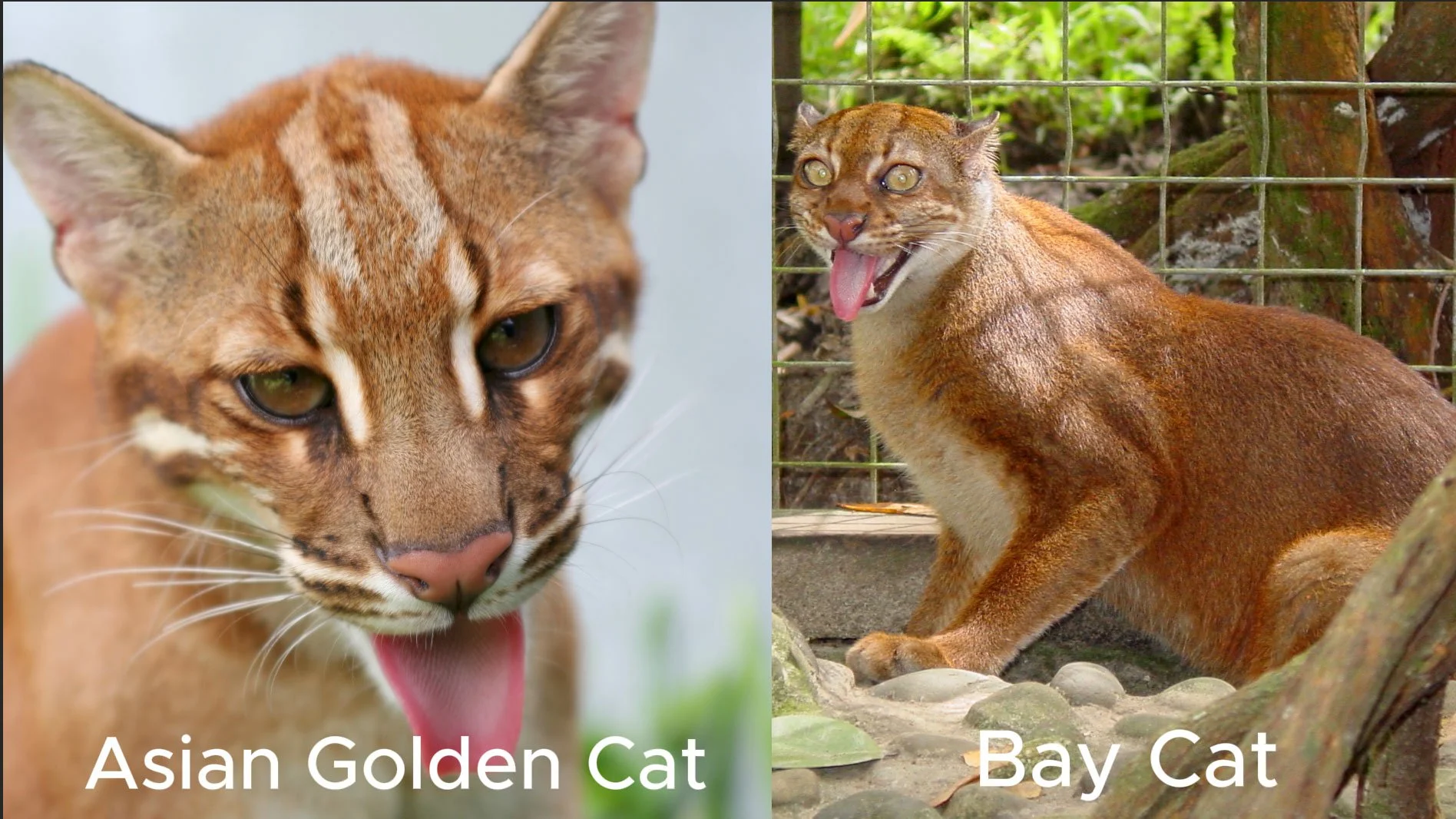
Carole Baskin says, “It was my ignorance that resulted in us posting an Asian Golden Cat on social media and misidentifying her as a Bay cat. Dr. Jim Sanderson caught the mistake and we took down the post, but it caused Deb Quimby and Carole to wonder, “Why do they look so similar?” Dr. Sanderson explained, “The reason for your confusion is that these two are sister species. Long ago when Borneo & Sumatra were connected the Asiatic golden cat inhabited the larger landmass. Borneo separated entirely from Sumatra. In isolation, the Asiatic golden cat in Borneo downsized & evolved into a sepatate species we call Bay cat. The Bay cat is 1/2 the size of an Asiatic golden cat.”
The divergent fates of these two cousins offer a sobering perspective on extinction. While the Asian golden cat successfully reclaimed its territory after a volcanic apocalypse, the bay cat is trapped on a vanishing island. Conservation for this species is a "funding crapshoot." Donors are hesitant to invest in a species so rare it may never appear on a camera trap, creating a tragic imbalance: currently, funding for all 33 species of small cats is roughly equal to the budget of a single conservation program for the puma.
Without a targeted effort to understand why the bay cat is so rare and what specific threats are causing its decline, we risk losing the "Ghost of Borneo" before we can even define its place in the world. Can we solve the mystery of this ancient lineage before it vanishes for a second—and final—time?