The Silent Trade: Why Your Favorite "Cute" Wild Cat Video is Part of a Global Crisis
The world is captivated by the "big cats." The powerful stride of a lion across the savannah or the striking rosettes of a jaguar deep in the Amazon dominate our nature documentaries and conservation headlines. These apex predators command the spotlight and the lion's share of funding. Yet, while we watch the giants, their smaller cousins—the ocelots, margays, and fishing cats—are slipping through the cracks of global awareness and into the hands of traffickers.
For most of us, the encounter with these species occurs during a mindless scroll through social media. We see a "cute" spotted kitten in a living room or a "miniature leopard" performing for a camera. These videos are framed as harmless, endearing digital debris. However, behind the screen lies a devastating ecological reality. The scale of the small wildcat trade is not just surprising; it is systemic. By unraveling the hidden impact of our digital interactions, we find that the "cute" content we consume is a primary driver of a global biodiversity crisis.
The Shadow of the Megafauna
While the black market for jaguar teeth and tiger skins has been tracked with forensic precision for decades, the trade in small and medium-sized felines has remained a ghost in the data. We are operating under a "big cat" media bias that has historically dismissed the poaching of smaller species as opportunistic or incidental. New research from Colombia suggests this perception is dangerously misguided.
A comprehensive study of official records between 2015 and 2021 revealed that small wildcats are frequently in the crosshairs of traffickers. During this six-year window, more than 700 small wildcats were seized by or surrendered to authorities in Colombia alone. The census of the confiscated includes:
Ocelots (Leopardus pardalis): The primary target, with over 400 individuals recorded.
Oncillas (Leopardus pardinoides): Also known as the clouded tiger cat, a species only identified as taxonomically distinct in 2024.
Jaguarundis (Herpailurus yagouaroundi).
Margays (Leopardus wiedii).
Melissa Arias, a wildlife trade specialist at the Zoological Society of London, notes that this is no longer a matter of local, "opportunistic activity." According to Arias, the data proves the trade is "actually quite significant." Perhaps the greatest scientific tragedy is that we are losing animals like the clouded tiger cat to the black market before we even fully understand their taxonomy or place in the ecosystem.
The Inversion of Visibility: Why Smallness is a Death Sentence
There is a cruel irony in feline conservation: the less space a cat occupies, the more likely it is to be traded, yet the less likely it is to receive international protection. Researchers have identified a clear correlation between the size of the animal and the volume of the trade. Smaller species are easier to transport, simpler to conceal in luggage, and more "marketable" to an uninformed public as exotic pets.
Vincent Nijman, head of the Oxford Wildlife Trade Research Group, highlights this lethal imbalance of attention:
“The general trend is clearly that the smaller they are, the more they are traded, but the less attention they are given.”
Because these cats lack the high-profile "megafauna" status of tigers, their disappearance from the wild often goes unremarked by the international community. They are being hollowed out from their habitats in silence, victims of their own portability and the public’s ignorance.
The Laundering of a Crisis: The Surrender Loophole
One of the most significant obstacles to law enforcement is the legal mechanism of "voluntary surrender." In countries like Colombia and Peru, individuals can hand over illegally kept wildlife to authorities without facing legal penalties. While often presented as an act of mercy for the animal, researcher Natalia Muñoz Cassolis argues it functions as a "get out of jail free card" for those within the trade.
By "surrendering" a cat rather than having it "seized" in a criminal raid, traffickers and illegal owners effectively launder the crime. These animals are often excluded from trafficking reports, creating a massive "missing piece of the puzzle" for researchers. This loophole allows the systemic networks behind the trade to remain invisible. If we do not view these surrenders as critical indicators of market demand, we fail to prosecute the professional poaching networks that supply the very kittens being "surrendered" by the public.
The Algorithm as Middleman: Our Digital Complicity
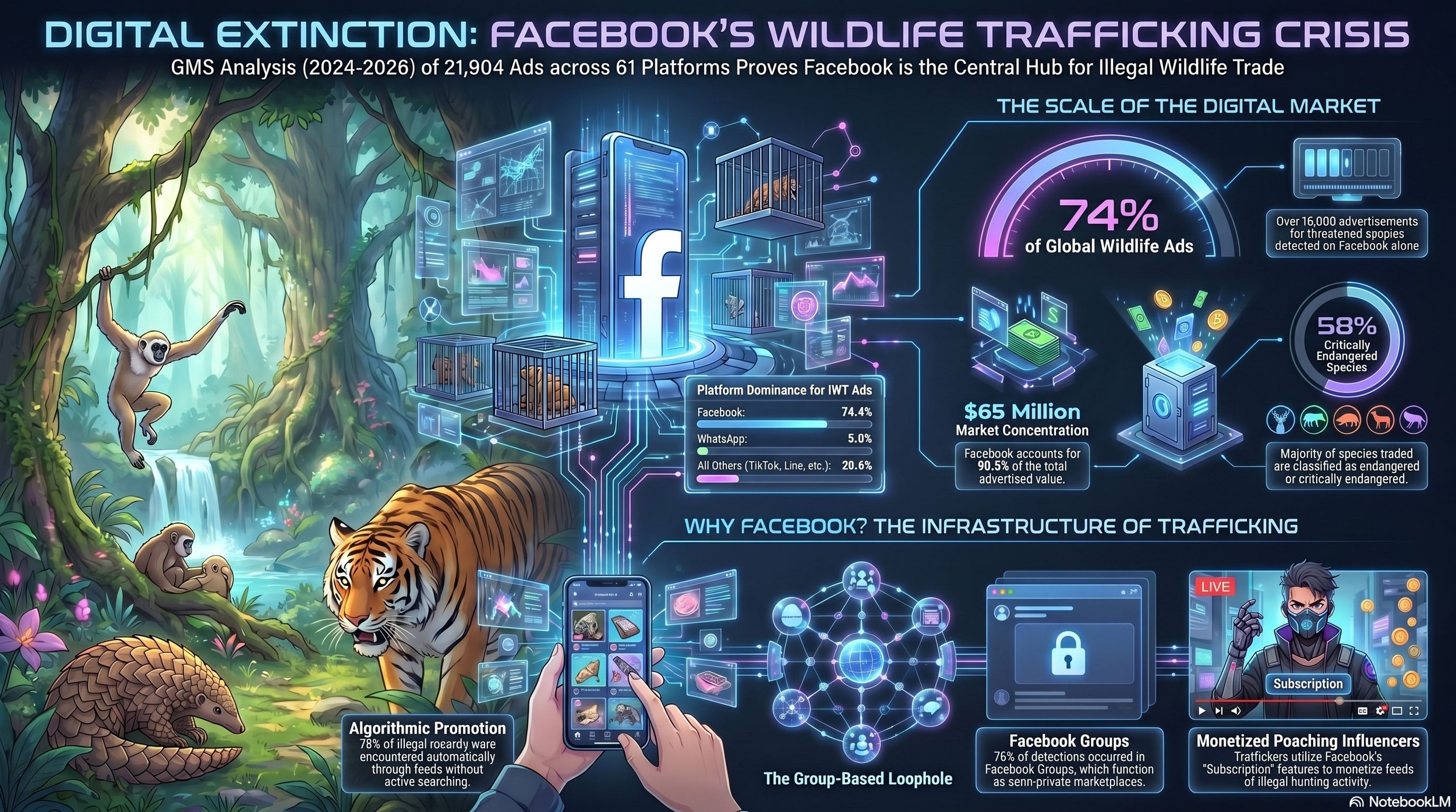
The illegal trade of wildcats has moved from the back-alley market to a borderless digital bazaar. Social media has become the primary infrastructure for this trade, where "cute" content serves as an unintentional, high-reach advertisement for the exotic pet industry. In this landscape, the viewer is no longer a passive observer; they are an economic signal.
Digital Ethics Check: Every like, comment, or share of a video featuring a wild cat in a domestic setting is a data point that justifies the capture of the next kitten. The algorithm is the new middleman in wildlife trafficking. By increasing the visibility of these animals as pets, you provide the market support necessary for the trade to thrive. In the eyes of the market, there is no difference between a "fan" of a video and a potential buyer.
The Proximity Trap: A Global Siege
The crisis is not confined to Latin America; it is a global siege exacerbated by the "proximity trap." Species like the leopard cat in Asia have successfully adapted to living in farmed and deforested areas. Ironically, their ability to survive near humans makes them the easiest targets for poachers.
This is a borderless trade fueled by a global digital appetite:
Asia: The flat-headed cat, recently rediscovered in Thailand, faces immediate threats, with a 2025 seizure highlighting its vulnerability to the pet trade. Other species under pressure include the fishing cat, jungle cat, clouded leopard, and the Asiatic golden cat.
Africa: Servals and caracals are increasingly captured live for the international pet trade or killed for their skins to be sold in medicinal markets.
Latin America: Ocelots and the newly defined clouded tiger cat continue to be the primary targets for live trafficking.
Beyond the Screen
The silent trade in small and mid-sized felines is a major threat to global biodiversity that the conservation world can no longer afford to ignore. Monitoring these "forgotten" species is not just a scientific necessity; it is an ethical imperative. Without robust data and a radical shift in how we engage with wildlife content online, we risk the extinction of these elusive cats before we even acknowledge their presence.
As we navigate a digital world where wildlife is often reduced to a 15-second clip, we must confront our role in this economy. We must ask ourselves: Is the "cute" video on our screen worth the silence of the forest it was stolen from?



Roar out to protect wild cats!