SWCCF News 2026 06
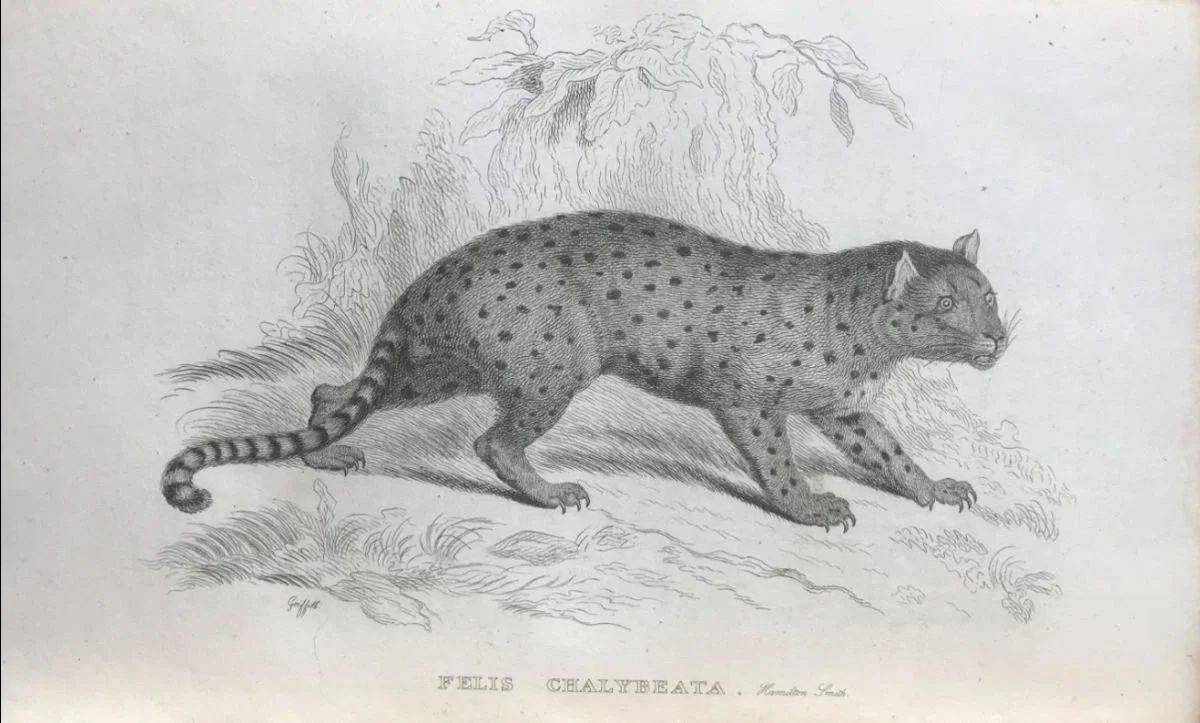
Felis Chalybeata
A brief history of the African golden cat in Angola
Jim Sanderson
In 1860, Philip Lutley Sclater, Secretary to the Zoological Society of London, provided a piece to the puzzle surrounding the geographic distribution of the African golden cat. In an article titled List of Mammalia collected by Mr. J. Monteiro in Angola, pages 245-246 in The Proceedings of the Zoological Society of London, Sclater wrote the following.
So little is known of the mammals of Angola, I have thought that it might be worth while to record the names of a few species observed or collected there by Mr. J. Monteiro during his recent residence at Bembe. Most of the specimens are flat (furriers') skins from the interior. They were obtained from the caravans that brought down ivory, and belong to animals which are natives of a district lying about 300 miles from the coast.
The third species is of interest.
3. Felis neglecta, Gray, Ann. N. H. i. p. 27.
A flat skin, agreeing with Dr. Gary's type-specimen, which is also a flat skin, in the British Museum.
Felis neglecta would later be recognized as an African golden cat. Sclater wrote that a skin like John Edward Gray’s (1838) holotype (the first, or type, specimen) was purchased from a caravan that secured specimens in the interior of Angola 300 miles from the coast. For 162 years, this would be the only evidence of the presence of African golden cat in Angola until 2021.
A few years ago in IUCN Cat News, a report was published regarding a molecular study of meat samples procured in an Angolan bushmeat market. One sample was confirmed to be from an African golden cat. The trail was getting hotter. Last year, Eduaro's team obtained photographs of a rural bushmeat hunter holding a dead African golden cat he had recently killed. The living cat had to be nearby. After 167 years, Eduardo and his team recorded a video of the first living African golden cat in Angola. See below.

First record of a living African golden cat In Angola
First record of a living African golden cat In Angola
Eduardo Lutondo, Angola, African Golden Cat Conservation Alliance
Finally, the situation has already changed for the African golden cat in Angola. In the past, African golden cats in Angola have only been known in bushmeat markets. With my team members Timoteo Julio and Graça Catuti and in partnership with the African Golden Cat Conservation Alliance (AGCCA) and Fundação Kissama, we have been working for three years to record the living African golden cat in Angola.
We started the search at Maïombe National Park following a report of the African golden cat in an adjacent bushmeat market in the Cabinda province. After more than nine months of monitoring using a trail camera, I failed to find the African golden cat. But as Jim has suggested, passion, patience, and persistence are required for anyone conserving every species of small wild cat.
In 2024, I received new information from the local communities of an African golden cat occurrence in the Uíge region in the bushmeat market. With that information, we got a bit closer to our goal of finding the mysterious cat. During our investigation, we found additional information from the local hunters that killed two. We immediately set 12 trail cameras at Serra do Pingano in Uíge province in northern of Angola. After 144 days, I returned to the cameras. What I found was a video of the African golden cat my team and I had been searching for.
Our video is the first record ever recorded of a living African golden cat in Angola. Our passion, patience, persistence had paid off. Now the priority is to continue to expand our community-led conservation program to mitigate bushmeat hunting and its threat to the African golden cat in Angola. Bushmeat hunting and trade remain key threats, as evidenced by reports of African golden cat specimens in bushmeat markets in Angola. Thanks to the efforts of AGCCA's partners in other countries, we have a good change to change the future for the African golden cat in Angola.
We wish to thank the Mohamed bin Zayed Species Conservation Fund and the Small Wild Cat Conservation Foundation for supporting our efforts
African Golden Cat Conservation Alliance

Dedicating the world's first Community Conserved Area on behalf of the Asiatic golden cat.jpg
Dedicating the world's first Community Conserved Area on behalf of the Asiatic golden cat
Giri Malla, Nagaland, India, Eastern Himalayas Marbled Cat Project
In the May eNewsletter, i wrote about Eastern Himalayas Marbled Cat Project's efforts to end ceremonial killing of Clouded leopards. Giri Malla and his team have done it again. Working closely with the indigenous people of Bamsiakilwa village, Peren district, in the Indian state of Nagaland, the Daukeling Hebamlo Community Conserved Area was created specifically to protect the Asiatic golden cat. You can see the statue of the Asiatic golden cat standing on the rock in the center of the above picture. Giri is shown with the red and black shawl over his left shoulder.
Speaking at the dedication, Dr. C. Zupeni Tsanglai, wildlife warden, Dimapur division, called attention to all four species of small cats found locally (Asiatic golden cat, Clouded leopard, Leopard cat, Marbled cat), stressing the need to conserve them as well as protect forests that sustain biodiversity and people. Dr, Tsangtai remined everyone that healthy forests provide ecosystem services such as clean air, freshwater, and help to maintain an ecological balance that promotes climate resilience, all at no cost. Today's healthy forests promote tomorrow's healthy communities.
Village chairman Pauka (third from right standing) urged villagers to stop hunting and conserve the Asiatic Golden cat and other wildlife within the Community Conservation Area. Community leaders repeated the importance of preserving forests for future generations and promised to enforce strict conservation recommendations, including a ban on hunting and disturbance of wildlife within the Community Conservation Area.
With help from the Eastern Himalayas Marbled Cat Project, the creation of yet another community protected reserve by an indigenous group reflects the growing role of indigenous and local communities in wildlife conservation across Nagaland and Northeast India, standing as a strong example of how community participation and local leadership can contribute meaningfully to biodiversity protection and climate resilience" as well as their own prosperity.
Here's a link to a Mongabay article about another of our projects that protects Marbled cats. Small cats are our flagship species but the community reserves protect all dspecies.
I wish to thank all SWCCF'S generous financial partners who support our efforts in this new frontier of NE India.
JGS: NE India is a global biodiversity hotspot. Nagaland is one of seven NE states of India where Eastern Himalayas Marbled Cat Project is making a difference. We are seeing the rise of a new, better educated, generation of indigenous young people pushing for change. Often, change does not come easily. By attending community meetings regularly, thus maintaining a presence, and by saying a minimum of words to allow young people to use the platform, change is happening. Facilitated by Eastern Himalayas Marbled Cat Project, more community conservation areas are coming. It's inspiring !!
Eastern Himalayas Marbled cat Project

Conservation in southern Ecuador is changing the story of the Northern pampas cat
Conservation in southern Ecuador is changing the story of the Northern pampas cat
Luis Arturo Román, Ecuador, Northern Pampas Cat Project
When we launched the Northern Pampas Cat Project in the dry forests of southwestern Ecuador, the published scientific literature contained fewer than five records of Pampas cat (Leopardus garleppi) in the south of the country. That number alone told us that something was seriously wrong, not with the cat itself, but with academic interests in southwestern Ecuador..
Moreover, most people in the communities surrounding the tropical dry forest of southwestern Ecuador had never heard the name of the Pampas cat. A few knew it as Sachamis, a Quechua word, where sacha means bush and mishi means cat: The Bush cat. It's a name that reflects the cultural memory of the cat that some rural inhabitants still hold, but it has no conservation status, no legal protection, and no emergency number to call. Some had seen it cross a road at night. Others had lost a chicken to one and had no reason to feel affection for it. What most communities lacked was not knowledge of the animal's existence, but a framework for understanding why the Pampas cat was important and what its disappearance would mean.
Four community workshops began to build that framework. Working with farming families, local conservation allies, and community members across the project area, we brought the Northern Pampas Cat into the places where people actually gather: fields, community halls, and a nature vacation camp for children. The workshops covered every documented threat the species faces: roads, irrigation canals that function as traps, free-roaming dogs in the agricultural fringe, and the illegal trade that begins when a wild animal is taken from the forest and ends when nobody reports it. In each case, participants left knowing not just that the cat exists, but what threatens it and what they can do.
A memorable moment occurred during a workshop at the Jorupe Reserve in a session organized with children from the city of Macará. Some of them were meeting a wildlife conservation team for the first time, when we were preparing a photo the most enthusiastic child took a replica of a traffic sign from the table and spontaneously raised it above his head, encouraging the other children to chant the name of the pampas cat. The sign, translated from Spanish, read: REDUCE THE VELOCITY—WILD CAT HABITAT. That image is powerful; members of the next generation of drivers in this region know why it's important to drive #slowforwildlife.
The workshops also opened conversations we had not anticipated. Participants raised their own concerns about wildlife they had seen harmed, asked where to report encounters, and questioned what could be done about dogs, canals, and trade routes. Those conversations are now the planning for the next phases of the project: community-based dog management initiatives, infrastructure interventions in agricultural canal systems, Chicken coops safe from predation and awareness programs at formal border control points.
In the dry forest of southwestern Ecuador, that process has begun.
Northern Pampas Cat Project