Saving the Ancestor: The Hidden Heroes Protecting the World’s First Cat
Introduction: The Ghost in the DNA
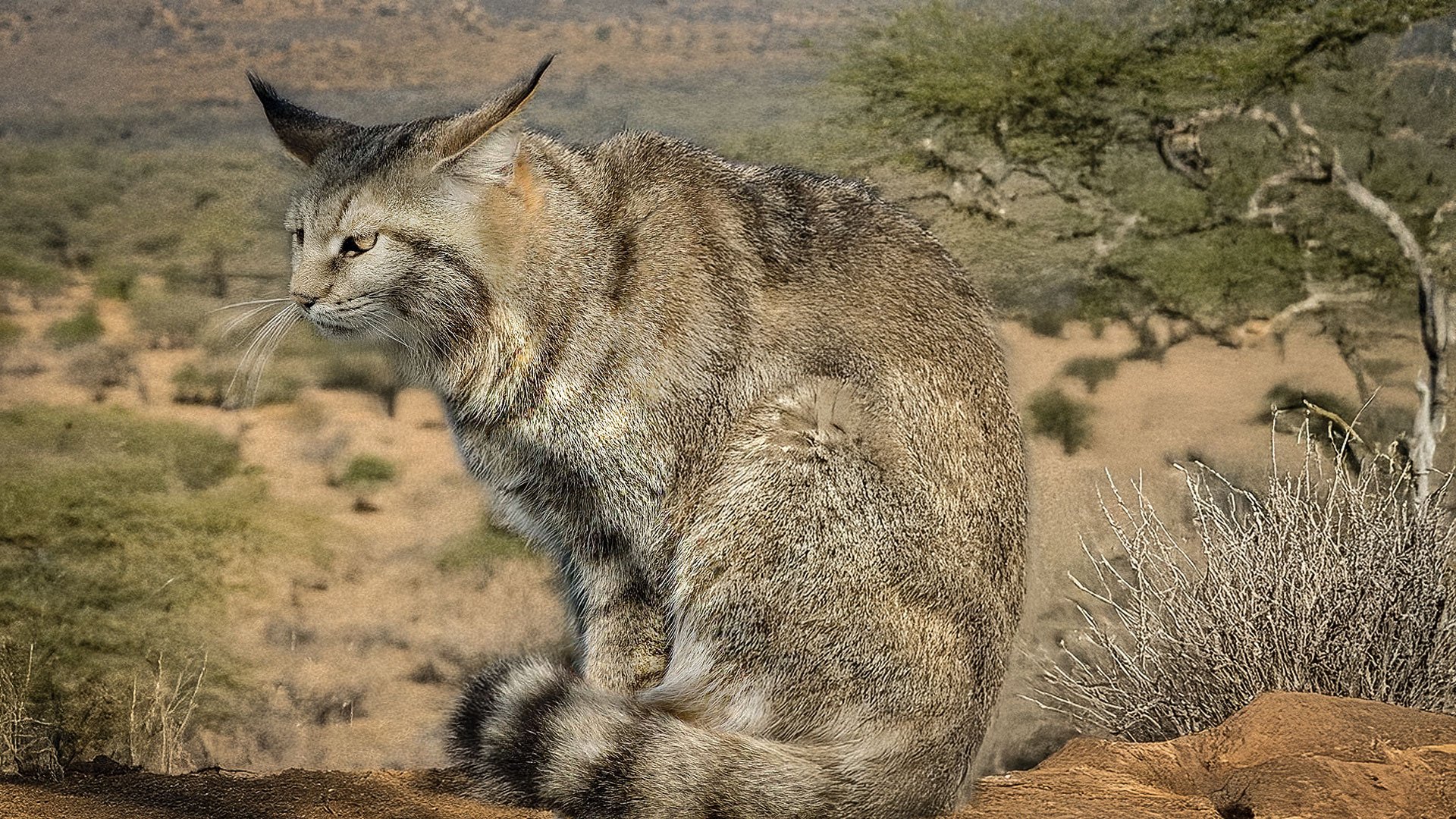
The animal purring on your lap is a living relic, a genetic bridge spanning 10,000 years to the dawn of civilization in the Fertile Crescent. Your domestic companion is the direct descendant of the African wildcat (Felis lybica), a resilient predator that essentially choreographed its own domestication by following rodents into the first human grain stores. Yet today, this progenitor of the world’s most popular pet faces a quiet, biological erasure. This is not a crisis of hunting alone, but one of "hybridization"—the slow dissolution of a wild genetic identity into a generic domestic lineage. To stem this tide, the AWC Conservation Action Plan has deployed a sophisticated strategy to safeguard the genetic integrity of the world’s first cat.
The "Permanent Barrier" – Why Sterilization is the Only Humane Fence
In the world of wildlife ethics, we often encounter paradoxes. Here, the most effective way to save a wild species is to provide high-quality veterinary care to a domestic one. Fences are porous; they cannot stop the biological imperative of domestic cats pushing into wild territories. The AWC Conservation Action Plan addresses this through the "Permanent Barrier" of sterilization, a strategy that is as much about ecological chess as it is about animal welfare.
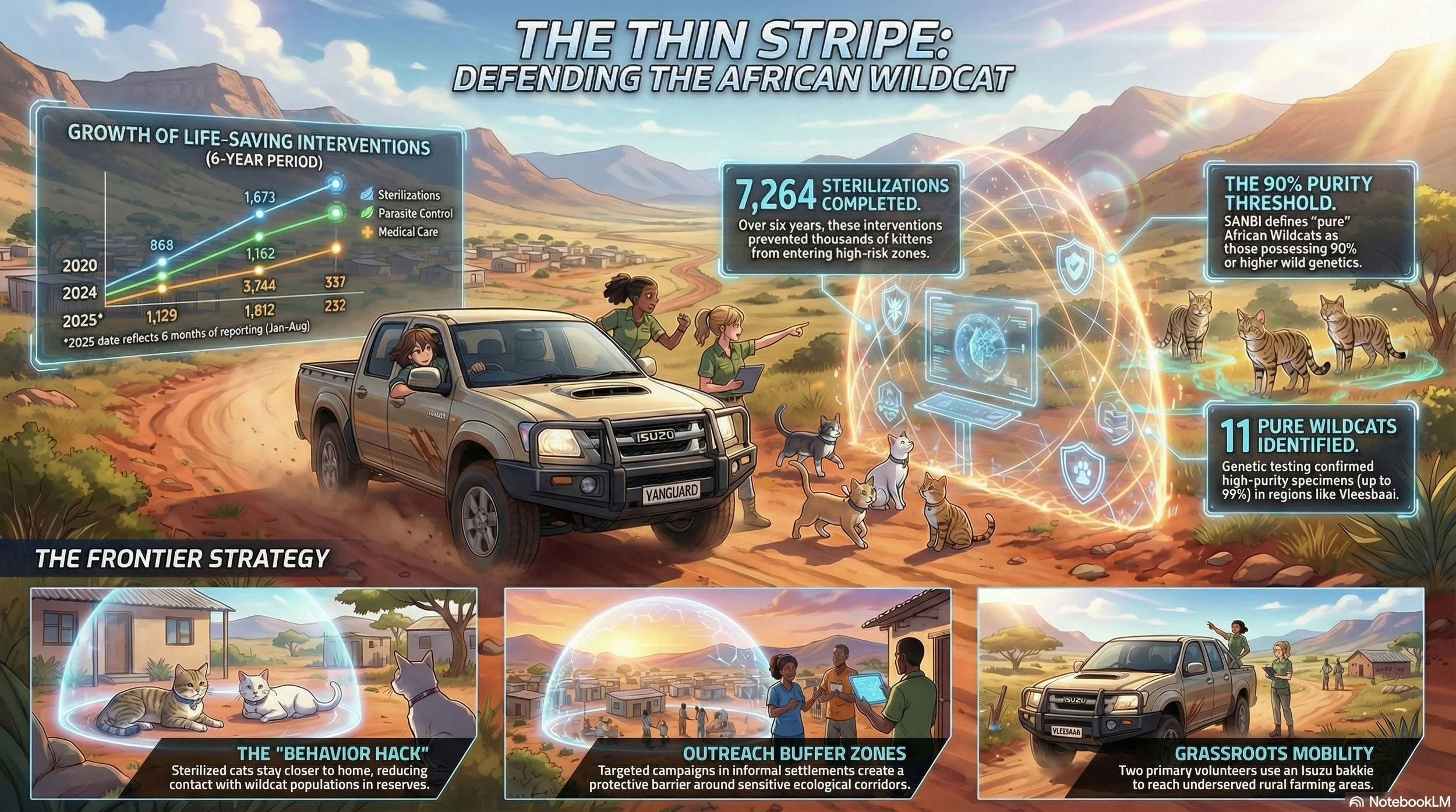
This approach is grounded in the "home range" theory championed by invasive species specialist Dr. Llewellyn Foxcroft. He argues that lethal eradication is a strategic failure because it creates a "vacuum effect"—once a cat is removed, a new breeding individual simply occupies the empty territory. Trap-Neuter-Return (TNR) creates a tactical genetic shield. By returning sterilized cats to their original range, the population remains stable but static, naturally excluding new, fertile intruders.
The stakes extend beyond mere numbers. Hybridization leads to "outbreeding depression," where offspring lose the specialized traits—such as cryptic coloration and high-heat tolerance—necessary for survival in the African bush. Furthermore, unmanaged domestic populations serve as pathogenic reservoirs. As an ethical strategist, we must recognize that these domestic "vanguards" bring more than genes; they bring Feline Leukemia (FeLV), FIV, and Coronavirus, which can decimate wildcat populations with no natural immunity.
“The reasoning here is that if a cat is removed, another will fill its home range and thus the problem is not solved. However, by returning cats which cannot breed, the home range is maintained and other cats are naturally excluded from the territory,” says Dr. Foxcroft.
The Mobile Vanguard – Dr. Ina Visser’s Remote Missions
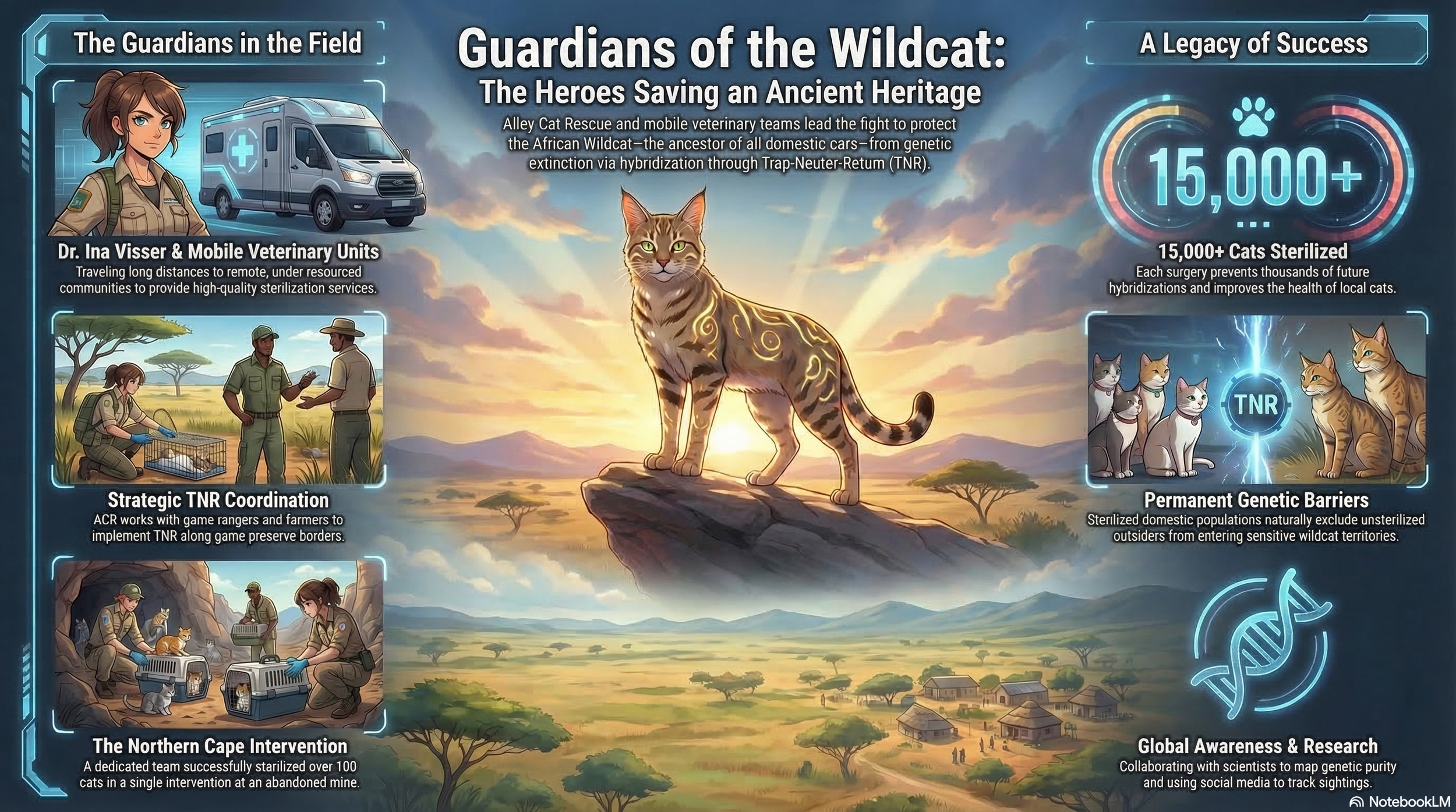
The front lines of this battle are located where the pavement ends and the wilderness begins. Leading the charge are mobile veterinary units, such as the Onderstepoort Veterinary School’s mobile unit operating out of the Hans Hoheisen Wildlife Research Station near Kruger’s Orpen Gate. Here, veterinarians like Dr. Ina Visser perform precision surgeries in environments that test the limits of clinical innovation.
The logistics are grueling. Teams have converted horse stables at Sun City into high-throughput sterilization clinics and established remote field stations in under-resourced areas like Andriesvale. One of the program's most significant tactical victories occurred at an abandoned diamond mine in the Northern Cape. In a single, high-stakes intervention, Dr. Visser’s team sterilized over 100 cats, neutralizing a massive hybridization risk in a region where veterinary access was previously non-existent.
Strategic Mapping – Defending the Genetic Strongholds
Conservation is a battle of geography, and the 2014 study by Le Roux et al. serves as the primary intelligence map. This research established a critical conservation metric: genetic purity in African wildcats correlates directly with distance from human settlements.
The southern Kalahari Desert, specifically the Kgalagadi Transfrontier Park, remains a pristine stronghold. Field research by ecologist Marna Herbst confirmed that cats deep within the park remain genetically pure. However, the "front lines" are moving. On the borders of the Kgalagadi and within the high-risk zones of Kruger National Park, the proximity of rural settlements like Buffelsdrift creates an intersection where the two species meet. These farming communities often keep unsterilized cats for rodent control, unknowingly fueling the "introgression" of domestic genes into the wild. By focusing TNR efforts on these specific "buffer zones," the Action Plan creates a firewall between human development and the wildcats' ancestral range.
The Power of 15,000 – A Scale of Success
The impact of the AWC Conservation Action Plan is now measurable on a massive scale. To date, over 15,000 cats have been sterilized, with more than 13,000 of those located specifically within the high-priority "targeted areas" identified by researchers. This is not just a veterinary milestone; it is a mathematical triumph. Each surgery represents a permanent stop to exponential population growth and a significant reduction in hybridization opportunities.
“The African wildcat is the ancestor of our domestic cats, the one who started our modern love affair with cats... we need to preserve this beautiful small wildcat,” says Louise Holton, President of Alley Cat Rescue.
By treating the domestic cat as an individual deserving of care and the African wildcat as a species deserving of protection, the program achieves a rare equilibrium in wildlife management.
The "Self-Domesticated" Ally – Reframing the Wildcat’s History
The relationship between Felis lybica and humanity began as a mutually beneficial arrangement. Genetic evidence confirms that cats were not "tamed" by force; they were self-domesticated allies who followed the rodent boom of the agricultural revolution. This bold curiosity is what allowed them to conquer the Fertile Crescent and, eventually, our homes.
However, this ancient trait has become an "evolutionary trap." Today, the southern African wildcats at Satara Camp in Kruger National Park are observed scavenging meat scraps at tourist barbeques. While this highlights their legendary adaptability, it also signals their doom. The very trait that drew them to human grain stores 10,000 years ago now lures them into the proximity of domestic cats and the inevitable genetic erasure that follows. They are being betrayed by the same curiosity that forged their legacy.
Conclusion: A Heritage Worth Holding
The AWC Conservation Action Plan is now expanding its reach, pushing into the provinces of Limpopo, the Northern Cape, and KwaZulu-Natal to shore up the remaining genetic bastions of the species. We are at a crossroads where science meets sentiment, and where the domestic and the wild are inextricably linked.
We must confront a demanding question: if the ancestor of our most beloved companion disappears on our watch, what does that say about our role as global stewards? The African wildcat is far too environmentally and historically significant to become a mere memory, a ghost buried within the DNA of our house cats. Its survival depends on our willingness to protect the wild original from the domestic copy.
Get the full report here: https://www.saveacat.org/awc-conservation-projects.html
2025: Kicking Off the Year with a Roar for the African Wildcat!
We’re thrilled to announce that the first conservation project of the year funded by Big Cat Rescue is Alley Cat Rescue’s vital work to save the African wildcat, the majestic ancestor of our beloved domestic cats. Thanks to the generosity of our incredible supporters, we’ve donated $15,000 to their spay/neuter programs for free-roaming domestic cats—programs that are critical to reducing hybridization and safeguarding the wild legacy of the African wildcat.
Alley Cat Rescue is dedicated to protecting these elusive wildcats, whose future is at risk due to interbreeding with domestic cats. This hybridization poses a real danger to the genetic integrity of the wild population. But there’s hope! Through their innovative Trap-Neuter-Return (TNR) program, Alley Cat Rescue is addressing this issue head-on. They focus on sterilizing domestic and stray cats near game reserves like Kruger National Park, where the overlap between the two populations is most pronounced.
Since this program began, over 11,000 domestic cats have been sterilized! This not only helps to keep the African wildcat’s bloodline pure but also promotes healthier, happier lives for the domestic cats themselves. Proper veterinary care for free-roaming cats reduces disease, prevents overpopulation, and creates a win-win for both domestic and wild feline populations.
But their work doesn’t stop there. Alley Cat Rescue collaborates with scientists to study the genetics and behavior of the African wildcat, exploring ways to manage and protect these wild cats more effectively. Public awareness is also a key part of their mission. In 2021, they launched the African Wildcat Project Facebook page, where they invite cat lovers and conservation enthusiasts to report sightings of these shy felines in the wild. Every sighting adds to a growing database, helping to map out the species' distribution and shape future conservation strategies.
By supporting Alley Cat Rescue, you’re not just helping to preserve the African wildcat—you’re ensuring a brighter future for domestic cats as well. Together, we can protect the wild heritage of all cats, fostering a world where big cats, small cats, and every cat in between can live and thrive.
Let’s celebrate this important step forward as we continue our mission to protect wild cats in the wild—where they belong.
Visit Alley Cat Rescue at http://www.saveacat.org/awc-conservation-projects.html
Check out more of the conservation projects funded by Big Cat Rescue or check out these below: