Beyond the Hook: Fishing Cat Diets in Nepal’s Farmed Landscapes
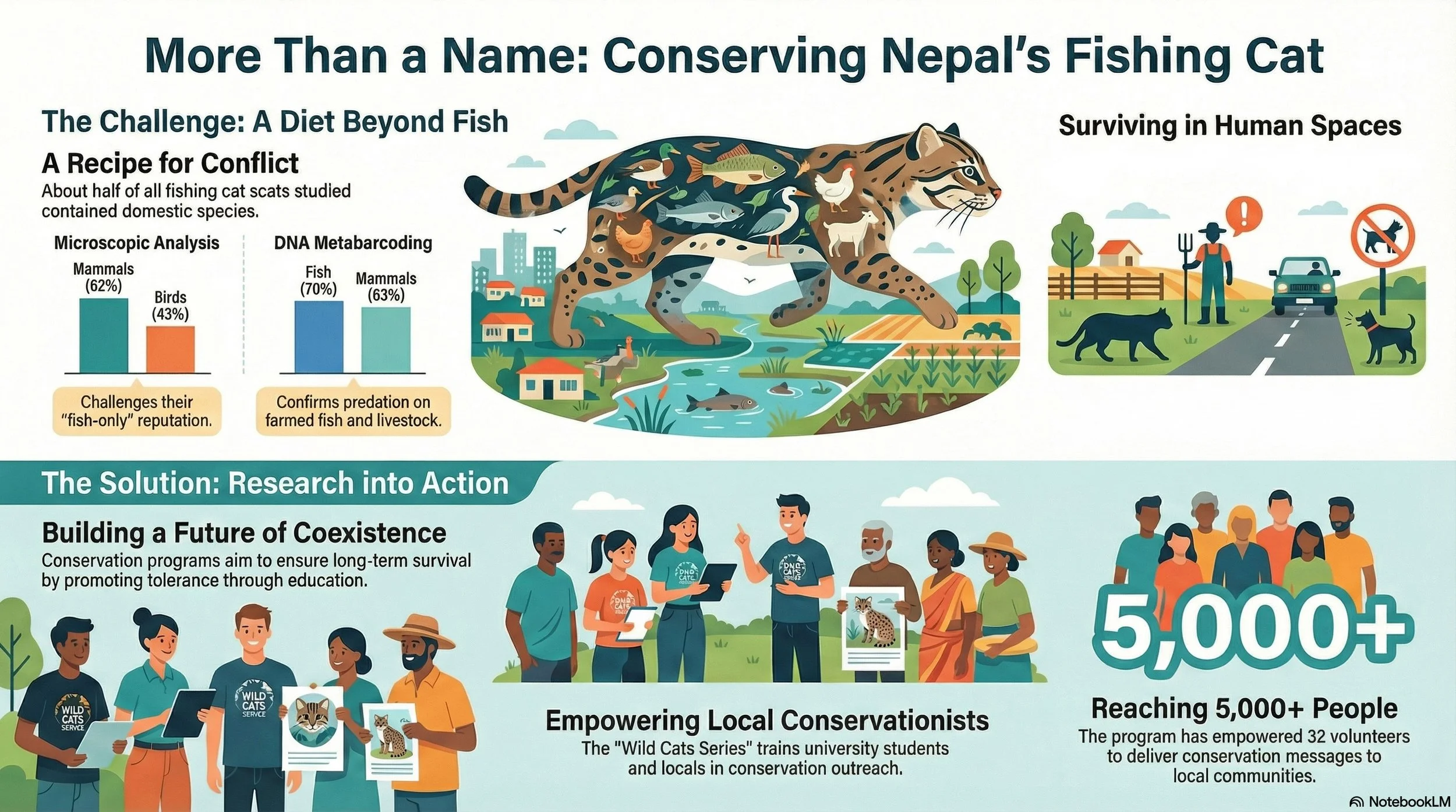
This video details extensive conservation and education initiatives focused on protecting wild cat species, with a specific emphasis on the fishing cat. Organizations are working to mitigate human-wildlife conflict by providing livestock owners with predator-proof coops and educating fish farmers on the ecological value of these felines. To ensure long-term success, orientation training for university students and citizen scientists provides hands-on experience in field research and camera trapping. Outreach efforts further engage the public through multilingual storybooks, audiobooks, and documentaries designed to foster community empathy. By combining scientific research with local capacity building and journalism, these programs aim to secure a future for diverse cat populations across the Terai lowlands.
https://www.facebook.com/fishingcatconservationalliance
https://www.instagram.com/fishingcatconservationalliance/
https://www.youtube.com/channel/UC5oJlwTroI-uS7dFpPk3b4w
https://smallcats.org/wp-content/uploads/2025/07/fcca-annual-report-2024--2.pdf
The Secret Lives of Asia’s Most Elusive Cat: 4 Surprising Takeaways from the 2025 FCCA Report
1. Introduction: The Ghost in the Reeds
When we think of "wild cats," our minds often drift to the apex predators of the deep Amazonian canopy or the sprawling, remote savannas of the Serengeti. We rarely imagine a lethal hunter lurking in a roadside drainage ditch or navigating the neon-lit outskirts of a high-density metropolis. Yet, the fishing cat (Prionailurus viverrinus) is rewriting the rules of feline survival, proving that "wild" is a relative term in the increasingly human-dominated wetlands of Asia.
As the primary "guardian" of these elusive creatures, the Fishing Cat Conservation Alliance (FCCA) operates a sophisticated network of 15 partners across eight nations—Bangladesh, Cambodia, India, Indonesia, Myanmar, Nepal, Pakistan, and Sri Lanka. Their 2025 Annual Report is more than a biological update; it is a strategic blueprint for how a species can persist on the edge of the Anthropocene. Here are the four most impactful discoveries from this year’s findings.
2. Takeaway 1: Colombo is a Wild "Urban Jungle" (Literally)
The most counter-intuitive revelation in the 2025 report is the success of the Urban Fishing Cat Conservation Project in Sri Lanka. While many specialists flee at the first sign of concrete, fishing cats are not just surviving but thriving within the metropolitan limits of Colombo and the surrounding districts of Kalutara, Gampaha, and Kurunegala.
This project has effectively dismantled the myth that urban wetlands are "wastelands." This paradigm shift was catalyzed by project lead Anya Ratnayaka, whose TEDx talk, "The Thriving Wetlands of Colombo," served as a turning point for public perception. By reframing these fragmented green spaces as vital biological corridors rather than empty plots awaiting development, the FCCA has successfully integrated wildlife survival into the city's "blue-green" identity.
Strategic Reflection: Urban conservation is the new frontier. In a world of shrinking wilderness, the ability of a species to utilize urban wetland walks and navigate human infrastructure is the ultimate test of resilience. For conservation strategists, this highlights the necessity of prioritizing "green-blue" infrastructure in urban planning to ensure these urban ghosts have a permanent home.
3. Takeaway 2: Engineering for Wildlife—Research vs. Infrastructure
As developing nations expand their transit networks, the FCCA has adopted a dual-track strategy: high-tech infrastructure monitoring and intensive field research. The report highlights the "RAW Connect" collaboration with Sri Lanka’s Road Development Authority, which uses camera traps at underpasses and overpasses along the E04 Expressway (Mirigama to Kurunegala). This data allows the alliance to provide the engineering evidence needed to turn roads from death traps into permeable pathways.
However, the scale of effort required in rugged, rural landscapes is even more staggering. In the Central Highlands, the Save Fishing Cats Conservation Project (SFCCP/SCAR) recorded a massive 172,800 camera trap hours across three new study areas. This rigorous field monitoring provided the foundation for a significant peer-reviewed publication in Global Ecology and Conservation, which analyzed people’s knowledge, attitudes, and conflicts with carnivores.
Strategic Reflection: We cannot manage what we do not measure. Combining the engineering precision of the RAW Connect project with the deep scientific validation of the Central Highlands research allows the FCCA to speak the language of both policy-makers and the academic community.
4. Takeaway 3: Conservation as a Community Effort, Not Just a Science
The 2025 report demonstrates that long-term sustainability is built on "social license"—the trust and participation of local communities. This was best exemplified by the launch of SAVE.CAT, an island-wide citizen science initiative. By engaging a network of 15 partners to crowdsource data, the FCCA is filling massive data gaps regarding small wild cat distributions that traditional research alone could never bridge.
The alliance’s 2025 outreach was extensive:
Education: Reaching over 1,500 children in rural school programs.
Youth Leadership: The January 2025 Science Communication Camp and 10 new internships provided the professional pipeline for the next generation of conservationists.
Strategic Evolution: While 2025 focused on data collection and education, the alliance has already laid the groundwork for 2026 conflict-mitigation tools, including beehive initiatives, chicken coop support, and stray animal vaccinations.
Strategic Analysis: Community-led conservation is more effective than top-down mandates because it addresses the root of human-wildlife conflict. By transitioning from mere research to providing practical tools like better coops and beehives, the FCCA transforms the fishing cat from a perceived predator of livestock into a neighbor in a shared ecosystem.
5. Takeaway 4: Resilience in the Face of Crisis (Cyclone Ditwah and Beyond)
The year 2025 tested the alliance’s agility. In November, Cyclone Ditwah devastated parts of Sri Lanka. In response, the FCCA demonstrated its "community-first" ethics by pivoting from research to recovery, repairing damaged road signs and assisting in wildlife rescues. Most notably, the alliance made the strategic decision to cancel the "Fishing Cat February 2026" fundraising event out of respect for the affected communities.
Similar resilience was required in Myanmar, where monitoring efforts continued despite persistent political instability.
Strategic Reflection: Wetland ecosystems are the front lines of climate change and political upheaval. The choice to prioritize human recovery over institutional fundraising wasn't just a reaction; it was a strategic investment in long-term trust. It reinforces the idea that conservationists are part of the community, not separate from it.
Conclusion: A Bridge to the Future
The 2025 FCCA report concludes with a haunting image: a fishing cat caught on a camera trap, crossing a simple wooden bridge at night. This cat is a sentinel—a bridge between the wild past of the Asian wetlands and an urbanized future. From the floodplains of Nepal to the mangroves of Pakistan, the work of these 15 partners proves that coexistence is achievable if we are willing to monitor the data, adapt to the climate, and engage the people.
As we look at the "empty" wetlands in our own vicinities, we must ask ourselves: are we looking at a wasteland, or are we looking at a hidden corridor for a species that has learned to live among us in silence?
The survival of the fishing cat depends on our ability to recognize the "wild" that persists in our own backyards.
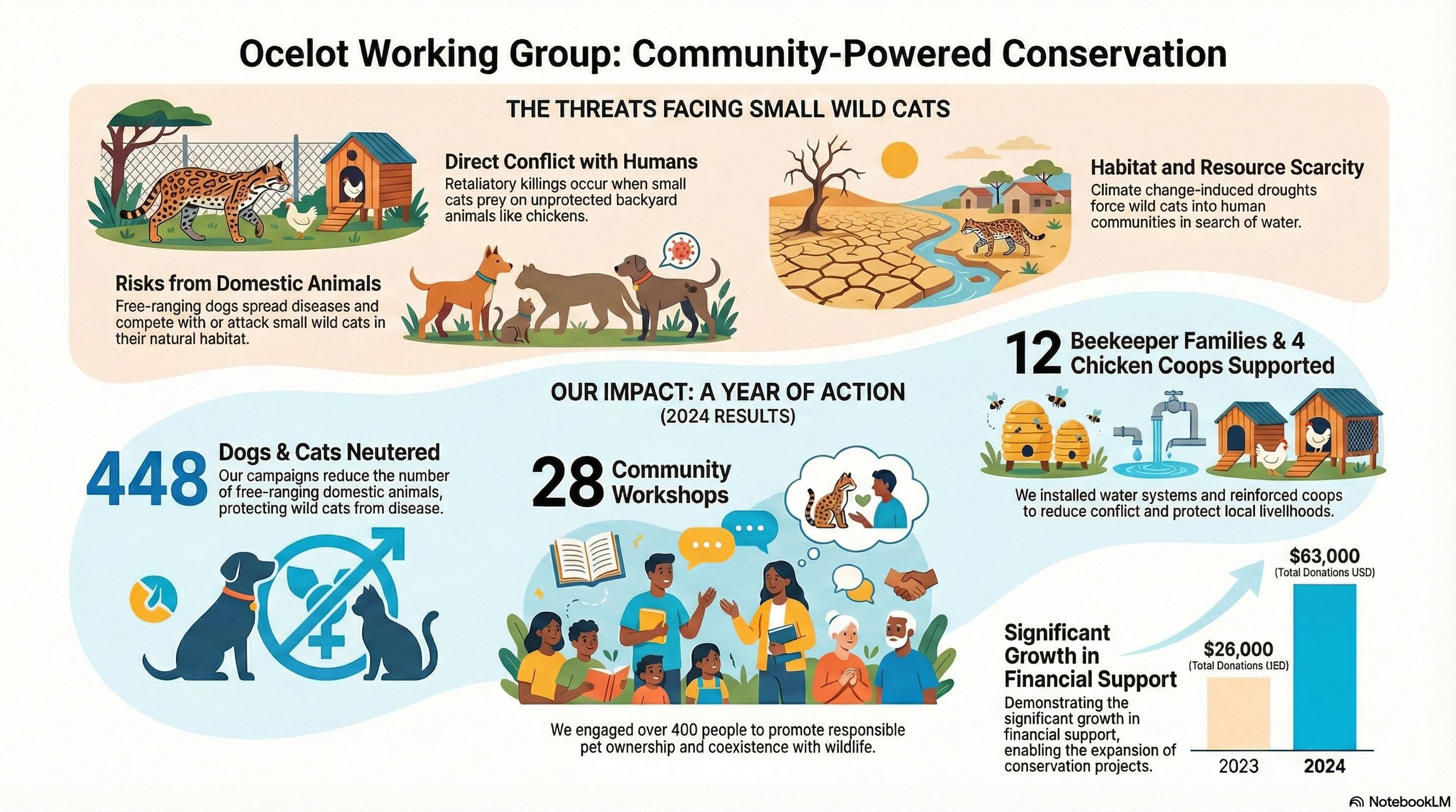
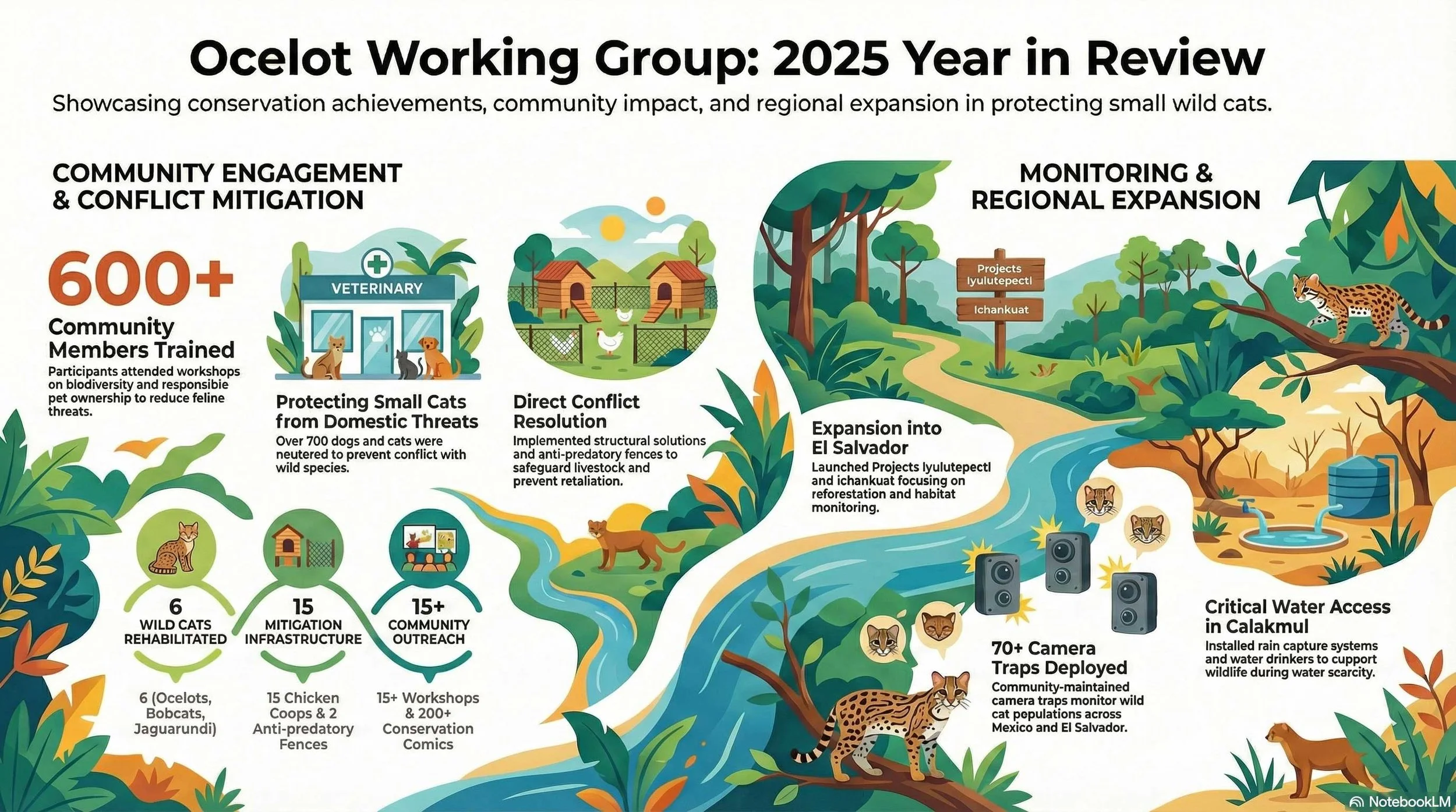

In the lush landscapes of Mexico, where the whispers of the wild carry stories of majesty and survival, stands a hero whose dedication to conservation is as profound as the roots of the ancient trees. Mariam Weston, leading the Ocelot Working Group under the mentorship of Dr. Jim Sanderson, embodies the spirit of hope for the region's most elusive inhabitants: the Jaguar, Ocelot, Puma, Bobcat, Margay, and Jaguarundi.