Toxins and Microplastics Found in Indian Fishing Cat Scat
The Warning in the Mangroves: What a Wild Cat’s Diet Reveals About Our Shared Future
1. Introduction: A Hidden Crisis in the Sundarbans
The Sundarbans, a sprawling labyrinth of emerald mangroves and tidal waterways, is a realm where the land and sea trade blows daily. It is the fortress of the fishing cat—a specialized, medium-sized feline with partially webbed feet and a mastery of the water. Yet, beneath the breathtaking wildness of this UNESCO World Heritage site, a microscopic invasion is underway.
In a disturbing discovery first reported by Mongabay, researchers analyzing the biology of these elusive predators found something that shouldn't be there. The scat of the fishing cat is no longer just organic waste; it is a map of our industrial footprint. A study led by Samrat Chakraborty of the University of Calcutta reveals that microplastics and heavy metals have successfully infiltrated one of the world's most remote ecosystems. This isn't just an "environmental" problem—it is a harrowing reality where our industrial output has become integrated into the very life force of the wild.
2. Pollution in the Most Unlikely Places
The data paints a grim map of regional hotspots across four distinct sites in Southern West Bengal: Henry's Island, Lothian Island, Pakhiralay, and Patharpratima. Collected between October 2024 and April 2025, these samples prove that no corner of the mangroves is truly pristine.
The geographical specifics are telling. Henry's Island showed the highest concentrations of chromium, but it was Pakhiralay—a bustling hub for tourism and the primary gateway to the Sundarbans—that emerged as a significant hotspot for lead. Finding these materials in the biology of a wild feline is a jarring wake-up call, yet it mirrors the quiet contamination occurring within our own bodies. When tourism hubs like Pakhiralay become centers for heavy metal concentration, the line between "wild" and "urban" effectively disappears.
3. The Bioaccumulation Trap: It’s What’s for Dinner
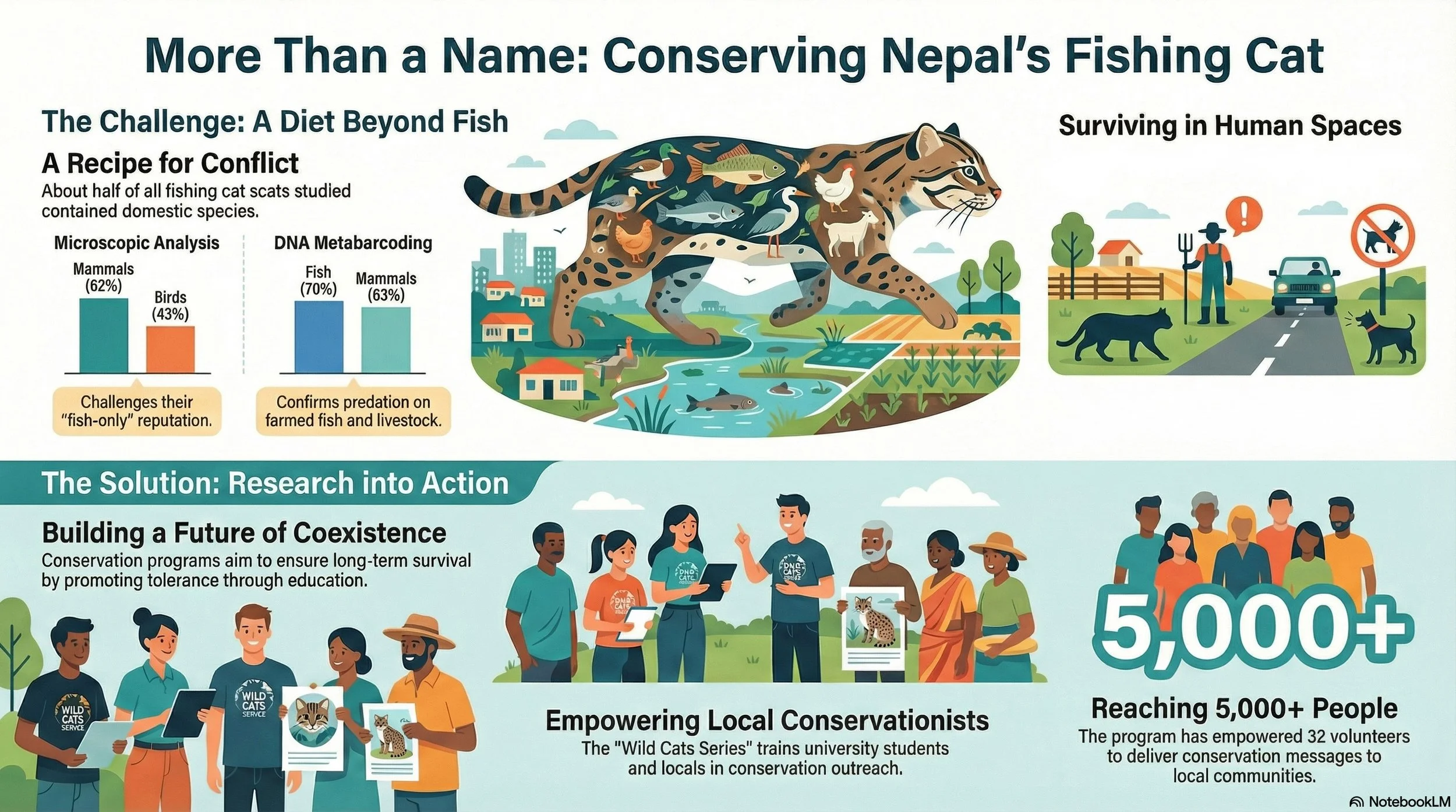
Fishing cats aren't eating plastic bottles or industrial slag directly. Instead, they are victims of a "bioaccumulation trap." These predators survive on a diet of fish, crabs, birds, and rodents—the same creatures that spend their lives filtering the water and sediment of contaminated wetlands.
The primary culprits are industrial effluents, agricultural runoff, and untreated sewage flowing from delta towns into the Hooghly–Matla system. These waterways have become conduits for the waste of human expansion. This isn't an isolated incident; it's part of a regional systemic failure across India’s deltas. To understand the gravity, we must look to similar findings from the Godavari delta in the southeast:
"These metals have 'devastating effects' and are being spread widely through wildlife food chains in the wetlands."
4. Top Predators as the Ultimate Health Indicator
Biologist Tiasa Adhya warns that these "priority metals"—specifically lead and chromium—are known to damage the physiology and behavior of top predators. When these chemicals are amplified by other environmental and biological stressors, the long-term stakes include reduced reproductive success and plummeting survival rates.
However, the fishing cat is more than a conservation icon; it is an early-warning system for human health. The cats hunt the exact same fish and crustaceans that sustain local villages. Crucially, these wetlands are a global trade hub; the seafood harvested here is exported to other markets, meaning the "Warning in the Mangroves" isn't just local—it’s global. If the feline at the top of the food chain is showing signs of physiological damage, everyone connected to this food web, whether in a Sundarbans village or a distant city, is potentially at risk.
5. Beyond the Cats: The Human Health Link
The link between environmental stressors and biological health is becoming more undeniable. The study highlights a specific, chilling physiological risk: microplastics and nanoplastics, when exposed to environmental changes and weathering, are linked to an increased risk of blood clots.
This discovery bridges the gap between a "conservation issue" and a "public health crisis." The same water that feeds the mangroves feeds the local economy and the global seafood market. We are sharing a struggle for biological integrity with the fishing cat, as the purity of the water dictates the health of every heart—human or feline—that relies on it.
6. The "Non-Negotiable" Path Forward
We can no longer afford to treat our river systems as open sewers. The shift from using storm drains as conduits for waste to building actual management systems is an existential requirement. Based on the insights of Adhya and Chakraborty, the path forward is a manifesto for survival:
Enforce stricter industrial effluent limits, specifically targeting the discharge of lead, chromium, and other priority metals.
Achieve "zero discharge" of untreated effluent into river systems as a non-negotiable standard for all industries.
Upgrade municipal sewage and solid-waste management in delta towns to prevent canals from acting as direct conduits for plastics.
Drastically reduce plastic waste through aggressive community awareness and systemic waste-collection overhauls.
7. Conclusion: A Final Thought-Provoking Takeaway
The fishing cat's health is a mirror reflecting our own. The contaminants found in its waste are the physical manifestation of choices made far upstream in our cities and factories. As microplastics and heavy metals integrate into the global food chain, we are forced to confront the ethics of our industrial "non-negotiables."
Are we willing to accept a future where the "wild" is simply a filter for our own industrial waste? Or will we recognize that by poisoning the fishing cat's dinner, we have already set our own table?
Source: https://india.mongabay.com/2025/12/heavy-metals-microplastics-found-in-fishing-cats/