The Second Generation Rises
Why India’s Wild-Born Cheetahs are the Ultimate Proof of Concept
For seven decades, the grasslands of India were haunted by a specific kind of silence—the absence of the world’s fastest land animal. Since the Asiatic cheetah was declared extinct in the country in 1952, the prospect of their return was long dismissed by critics as a costly, romantic impossibility. When the first translocated cats arrived from Namibia and South Africa in 2022, the scientific community watched with bated breath: could an African-born predator truly navigate the anthropogenic landscapes and seasonal shifts of the Indian subcontinent, or would "Project Cheetah" remain a perpetual experiment in high-stakes relocation?
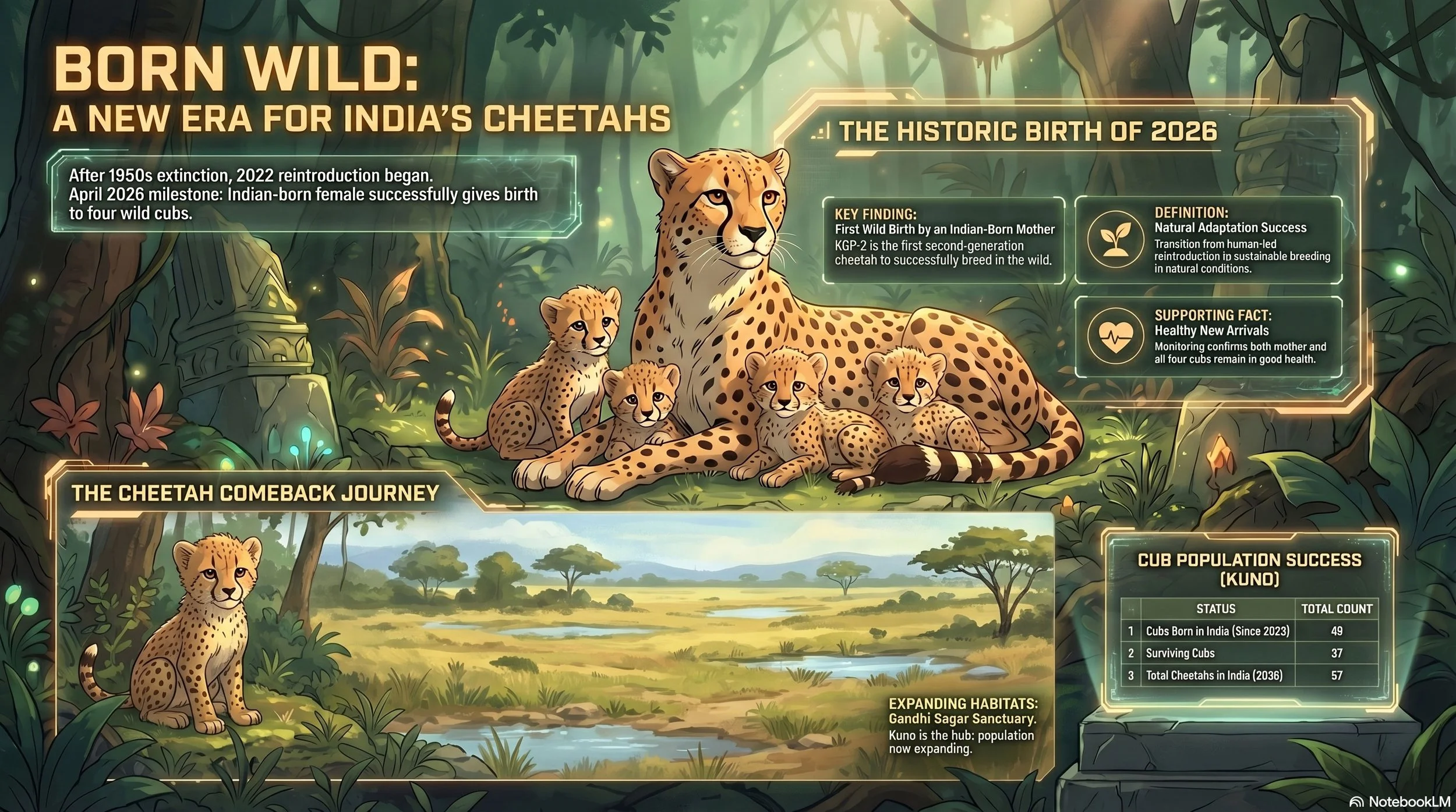
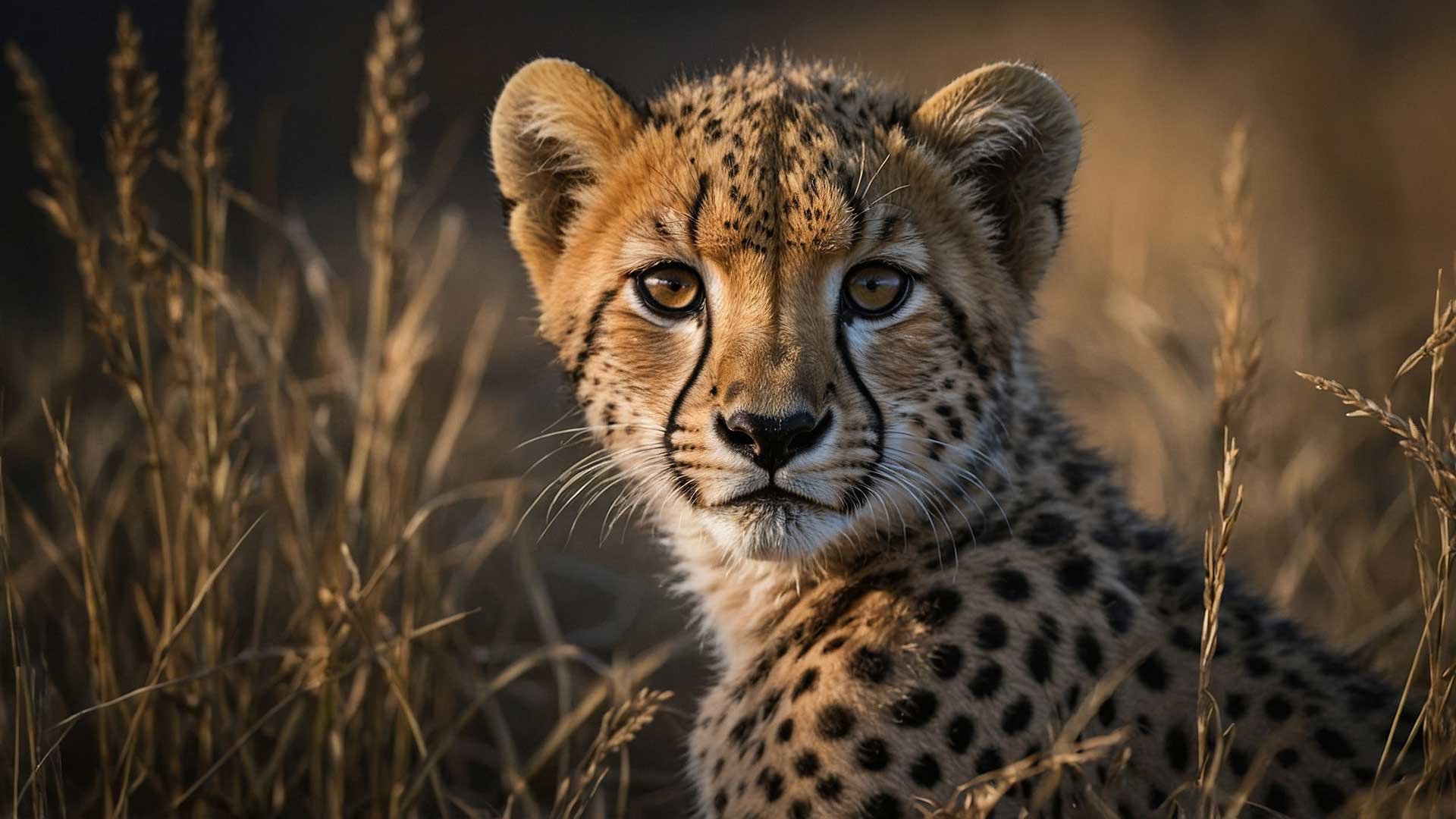
The answer arrived decisively in April 2026. The birth of four healthy cubs to the female KGP-2 in Kuno National Park is not merely a population update; it is a biological homecoming. This milestone, occurring alongside another recent litter, signals that the project has transitioned from human-managed reintroduction to true trophic integration.
The "Granddaughter" Milestone: A Pattern of Intergenerational Success
The most sophisticated metric of any rewilding project is the "second generation" threshold. KGP-2, the 25-month-old mother of the new litter, is herself a product of the project’s early success. She is an Indian-born female, the offspring of Gamini, one of the original pioneers translocated from South Africa.
Crucially, this is not an isolated success. Just days prior to KGP-2’s delivery, another Indian-born female named Mukhi—offspring of the famous Jwala—gave birth to five cubs. This dual success across different lineages (Gamini’s and Jwala’s) proves that the first generation of Indian-born cheetahs has successfully reached reproductive maturity and possesses the maternal instincts required to rear the next generation in the wild.
Union Environment and Forest Minister Bhupender Yadav characterized the gravity of the moment:
“A historic moment unfolds at Kuno National Park as an Indian-born female Cheetah of Gamini, aged 25 months, has given birth to four cubs in the wild—marking a major milestone in India's cheetah conservation journey.”
From Relocation Experiment to Natural Reproduction
In the early phases of Project Cheetah, the narrative was dominated by logistics: crate dimensions, international flight paths, and quarantine protocols. Today, the focus has shifted to the only metric that guarantees long-term viability: natural reproduction.
As a rewilding strategist, one recognizes that a translocated animal is essentially a guest within an ecosystem. However, a wild-born mother like KGP-2 or Mukhi represents a permanent resident. Chief Conservator of Forests Uttam Kumar Sharma noted that the project’s core objective—survival and breeding under natural conditions—is finally being realized. While the births are "natural," they are the result of an environment meticulously crafted by the tireless efforts of field staff, veterinarians, and managers who have monitored these cats through every hunt and heartbeat.
The Power of the "Long Game" and International Synthesis
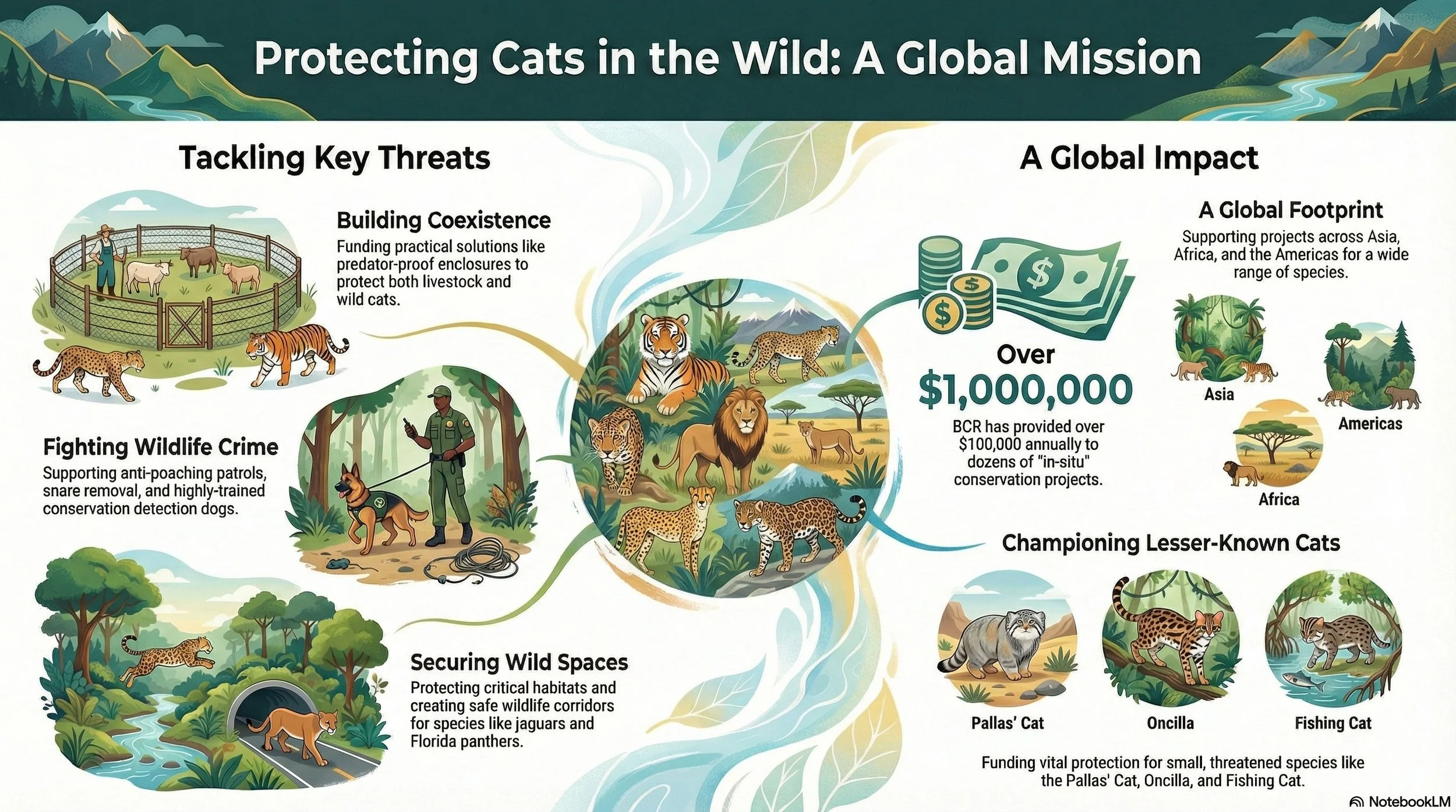
Rewilding is a discipline of patience and persistent risk-taking. The flourishing population of 2026 is the direct dividend of strategic investments made years prior. In 2022, an early catalyst came from Big Cat Rescue, which donated $10,000 to the Corbett Foundation to fund the initial release of eight Namibian cheetahs. This international support provided the literal "down payment" for the lineages now thriving in Kuno.
The complexity of this global pipeline has only increased with time. On February 28, 2026, a third batch of nine cheetahs arrived from Botswana, further diversifying the genetic pool. This continuous international collaboration ensures that the Indian population remains resilient against the "bottleneck" effects that often plague small, isolated predator populations.
The Statistical Anomaly: Success by the Numbers
To appreciate the magnitude of the Indian success, one must look at the "cub count" through the lens of global ecology. In many regions of Africa, cheetah cub mortality rates can reach a staggering 90% due to predation and environmental stress. In Kuno, the figures tell a very different story:
Total Population: 57 cheetahs now call India home.
Birth Momentum: Since 2023, 49 cubs have been born across 11 different litters.
Survival Rate: Remarkably, 37 of those 49 cubs have survived—a survival rate that far exceeds wild averages and suggests a highly supportive habitat.
Strategically, the project is also evolving into a "metapopulation management" model. To mitigate the risk of localized disease outbreaks, the population is being distributed; while 54 cheetahs remain in Kuno, three have been relocated to the Gandhi Sagar Sanctuary in Mandsaur. This multi-habitat strategy is the hallmark of a mature conservation program designed for "perpetuity."
Adaptation and the "Conducive Land"
The stabilization of these apex predators suggests that the Indian landscape, though absent of cheetahs for seven decades, remains biologically fertile for their return. All seven adult female cheetahs in Kuno have now successfully produced litters, proving that the ecosystem can provide the requisite prey base and cover.
Chief Minister Dr. Mohan Yadav reflected on this environmental synergy, stating that the birth of cubs in the open wilderness is proof that the land is "conducive for their growth." The cheetah is no longer adapting to India; it appears India has successfully re-adapted to the cheetah.
Conclusion: The New Wild
India is no longer just a participant in cheetah conservation; it has become the global vanguard for the species' revival. The transition of the cheetah from a "translocated guest" to a "wild-born mother" marks a definitive shift in the history of rewilding. We are witnessing the rise of a population that knows no other home but the Indian scrubland.
As we look toward the horizon, this success challenges our collective ambition: If we can restore the world’s fastest land animal to its lost range after seventy years of absence, what other "extinct" ecosystems can we breathe life back into? The return of the cheetah is proof that with enough scientific rigor and international will, the "lost" horizons of our planet are still within our reach.
Published April 13, 2026